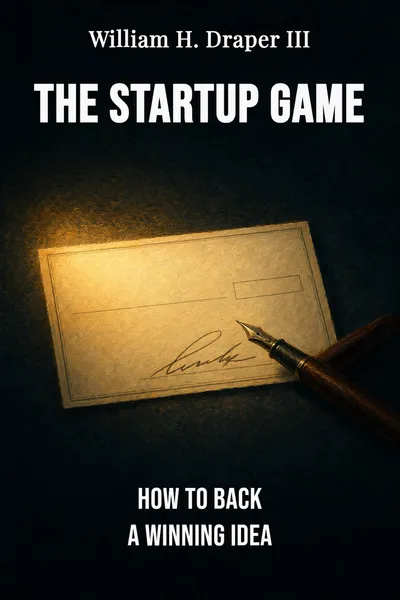
The Startup Game
How to back a winning idea
Description
In 1959, a young man named Bill Draper walked into offices along what wasn't yet called Sand Hill Road and started asking engineers what they were building. His father, William Draper Jr., had already helped start one of the first West Coast venture firms, so the son knew the family trade: you find people with an idea and give them money before anyone can prove they deserve it. Draper would spend the next fifty years doing exactly that — co-founding Sutter Hill Ventures, backing companies in the days when "venture capital" was a phrase you had to explain at dinner parties, later running the Export-Import Bank and the United Nations Development Programme, and eventually funding startups in India and China before either was fashionable.
His book, The Startup Game, is the memoir of someone who sat on the money side of the table for a career and watched thousands of pitches walk through the door. Most failed. A few — Skype, Activision, Hotmail, Qualcomm in its early rounds — did not. What separates the two is the thing everyone wants bottled and nobody can quite bottle: the judgment to look at an unproven idea and a nervous founder and decide, today, with incomplete information, to write the check.
Draper is not selling a formula, because he doesn't believe one exists. What he offers instead is closer to a field report from inside a relationship that most people only see from the outside — the strange, mutual, often uncomfortable bond between the person with capital and the person with the dream. We tend to picture venture capital as a spreadsheet exercise. Draper spends the book insisting it is almost entirely a human one.
The question we’re asking : If backing a winner can't be reduced to a formula, what is the venture capitalist actually judging when the check gets written?What we’ll see : A career spent on the money side of the table, and what it reveals about the bond between the person with capital and the person with the dream.
Table of contents
01 Chapter 1 — The handshake nobody writes down
Draper's first lesson is that the deal you sign is not the deal that matters. The term sheet, the valuation, the board seats — all of it is scaffolding around something the lawyers can't draft, which is trust between two people who are about to spend years chained together through outcomes neither can control. He describes venture capital as a marriage more than a transaction, and like a marriage, the paperwork is the least interesting part of it.
This reframing changes what the investor is actually doing in a first meeting. Draper isn't only evaluating a market or a technology; he's asking whether he can stand this person in a crisis, because there will be a crisis. Startups run out of money, miss a launch, lose a co-founder. The question is not whether trouble comes but who the founder becomes when it does. He recounts backing people partly on how they handled a setback in front of him — a founder who owned a mistake cleanly told him more than any projection.

02 Chapter 2 — What a bet on a person actually looks like
When Draper describes evaluating an idea, he almost immediately stops talking about the idea. Markets shift, technologies get leapfrogged, the original plan rarely survives contact with customers — so betting on the plan is a mistake. He bets on the founder's capacity to keep being right about a moving target. The pitch tells him how someone thinks; the person tells him whether they'll still be thinking clearly after the pitch stops working.
He looks for a specific mix that's easy to name and hard to find: obsessive conviction paired with the flexibility to change course. Too little conviction and the founder folds at the first bad quarter; too much and they drive a doomed product off a cliff rather than admit they were wrong. The great ones, in Draper's experience, hold the vision tightly and the tactics loosely. He watched founders pivot an entire company in a weekend and come out stronger, and watched others cling to a dead idea out of pride until nothing was left.
03 Chapter 3 — The founder on the other side of the table
Draper wrote the book partly for the entrepreneurs, and he flips the lens to show the deal from their seat. Raising money, he argues, is not begging — it's recruiting a partner, and founders who approach it as supplicants end up with the wrong investors on the wrong terms. The best founders he met came in knowing what they needed beyond cash, and they optimized for the relationship, not the headline valuation. A high valuation from the wrong partner is a trap that detonates in the next round.
He's blunt about the mistakes that sink promising companies, and most of them aren't technical. Founders raise too little and starve, or raise too much and lose discipline. They give away control too early, or refuse to give away any and can't attract talent. They hire friends instead of the people the company needs, and they wait too long to fire the ones who can't grow with it. Draper has watched good ideas die of governance far more often than of engineering.
04 Chapter 4 — Why the game needs a state that clears the field
Here Draper widens the frame in a way his own biography earns. After decades in venture capital he ran the Export-Import Bank of the United States under Reagan and then led the United Nations Development Programme, and those years left him convinced that the private bet only pays off inside a public frame someone has to build and maintain. The entrepreneur and the investor take the visible risk. But the conditions that let them take it — the ones nobody in the pitch meeting thinks about — are set elsewhere.
He points to the unglamorous machinery that makes American venture capital possible: capital-gains treatment that rewards patient risk, bankruptcy law that lets a failed founder try again instead of being ruined for life, immigration that let engineers from everywhere land in one valley, and courts that enforce a contract when a deal goes bad. Change any of those and the willingness to fund unproven ideas quietly evaporates. The check Draper writes is downstream of policy he didn't set.
05 Conclusion
Draper's career ran from Sand Hill Road in its infancy to development finance across three continents, and the through-line is simpler than it looks: he spent it deciding whom to trust with money and a chance. The Startup Game returns, in the end, to the two people at the table — one with capital, one with a dream — and insists that everything consequential passes through the relationship between them, not the numbers on the page.
Related books