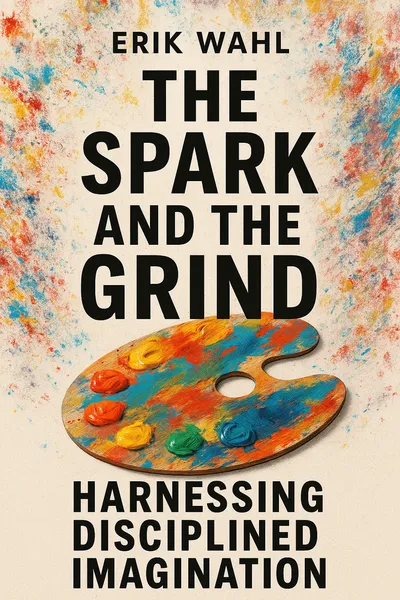
The spark and the grind
Harnessing disciplined imagination
Description
Creativity is a lifestyle, not a single event. To set the stage for ongoing inspiration: surround yourself with creative people, educate yourself continuously, don't limit your ideas, take time for reflection, find work you're passionate about, embrace the creative process of gathering ideas and letting them incubate, and don't be afraid to try new things. Living this way leads to an authentic flow of creativity.
Table of contents
01 Step #1 – fuel the fire
To truly excel in creativity and success, one must embody both the innovator, who dreams up new ideas, and the executor, who brings these ideas to life through perseverance. Nolan Bushnell, the co-founder of Atari, famously said that having a good idea is common, but the real measure of success is the effort put into realizing that idea after the initial inspiration. This dual approach becomes a natural rhythm for great creators, who know when to let their imagination soar and when to focus on the hard work of implementation.
Bushnell's own career exemplifies this balance. After the success of Pong and the sale of Atari, he focused on Chuck E. Cheese's, using it to fund various creative ventures. Despite financial setbacks that led to selling his businesses, Bushnell's legacy is also marked by missed opportunities, such as not investing in Apple, which highlight the importance of maintaining a balance between innovation and execution. Bushnell's failure to invest in what would become giants like Apple and Pixar underscores the necessity of staying open to new possibilities. Creativity expert Erik Wahl points out that while Bushnell successfully turned his initial ideas into profitable businesses, his reluctance to embrace new opportunities limited his potential impact. The lesson here is the importance of fluidly switching between roles as the situation demands, allowing for the exploration of new ideas while also dedicating oneself to the realization of current projects.

02 Step #2 – find your voice
To produce exceptional work, it's essential to harness and articulate your unique talents and viewpoints—your individual "bone" that distinguishes you from others. While it's beneficial to draw inspiration from others, simply replicating their style seldom leads to innovation. Instead, fully engage with your work, infusing it with your personal experiences and insights. As artist Erik Wahl puts it, being a perpetual creator not only enhances your work but also enriches your identity. We possess an inherent desire to evolve into our most complete selves, and the creative process offers a route to self-actualization, urging us to meet the challenge of achieving our highest potential.
Each creative endeavor propels you forward, building momentum for the next. By deeply immersing yourself in the creative process, you turn it into a journey that generates personal energy. Take the example of Dr. Bennet Omalu, a forensic pathologist at the Allegheny County Coroner's Office in Pittsburgh. With an impressive array of advanced degrees and certifications, Dr. Omalu was tasked in 2002 with determining the cause of death of Mike Webster, a former Pittsburgh Steelers star. Webster had died of a heart attack at 50, his life post-football marred by drugs and poor lifestyle choices.
03 Step #3 – uncover creativity in the mundane
To become a creator who consistently innovates, begin by exploring opportunities for creativity within your existing roles. View your job not as a constraint but as a foundation for innovative thinking that can lead to positive transformations. As someone deeply embedded in your industry, you possess invaluable hands-on experience and a deep understanding of the challenges your field faces. Leverage this insider knowledge to envision improved operational methods. Consider how you can introduce groundbreaking solutions from within your organization. Your direct experience equips you to identify and act on creative opportunities that address everyday needs.
Moreover, maintaining your current job offers the financial security needed to explore creative ventures during your personal time. There's no need to abandon your job to chase uncertain artistic aspirations. Instead, use your 9-to-5 job as a practical lab for experimenting with ideas inspired by your passion projects, allowing each area to enrich the other. There's a beneficial synergy in this approach. The discipline and time constraints of a regular job can sharpen your creative focus in your spare time. With limited hours available, your mind becomes adept at filtering ideas, honing in on those with genuine potential. The structure provided by employment can also elevate the quality of your independent creative projects.
04 Step #4 – cultivate creative discipline
Embracing a strict discipline and the power of grit can surprisingly enhance creativity, even for the most unconventional minds. It might seem paradoxical, but establishing a routine is crucial for sustaining a continuous flow of creative ideas. Such a structure acts as a stabilizing force, ensuring that ideas don't merely float aimlessly but move with purpose and direction. By covering the basics, a routine liberates the mind to engage in more innovative and creative endeavors. This concept is exemplified by President Obama's choice to wear the same style of suits daily, a decision aimed at conserving mental energy for more significant matters. However, it's essential to strike a balance; while routine lays the groundwork for creativity, allowing for some flexibility can lead to unexpected discoveries and insights.
05 Step #5 – awaken through the unfamiliar
Sparking creativity often involves stepping out of our comfort zones and embracing the unfamiliar. This shift in routine encourages agility and fosters a mindset conducive to creative thinking. As artist Erik Wahl suggests, becoming too accustomed to our surroundings can dull our senses. He advocates for viewing the world with "new eyes," allowing us to perceive the familiar in novel ways, thus stimulating our creative faculties across all senses. The journey of Herb Alpert serves as a compelling illustration of this concept. In 1955, Alpert, a post-college trumpet player struggling to make his mark in the music industry, found inspiration during a weekend trip to Mexico. Captivated by the spirited trumpet sounds at a bullfight, he returned home and composed "The Lonely Bull," a Latin-jazz fusion that catapulted him to fame. His band, Herb Alpert and the Tijuana Brass, achieved remarkable success, surpassing even the Beatles in sales at their peak. Alpert's experience underscores how new environments can spark groundbreaking ideas.
06 Step #6 – retain beginner's boldness
Embracing the spirit of experimentation and pushing the boundaries of what's known can lead to remarkable discoveries, even if it means starting with seemingly foolish attempts. Education and experience are valuable, but they should not deter you from exploring uncharted territories. Clay Shirky highlights that the creative spectrum ranges from mediocrity to brilliance, emphasizing that even the most modest creative endeavors contribute to progress. The journey from doing nothing to creating something, no matter how mediocre, is a crucial step towards improvement.
The willingness to dive into the unknown without fear can spark unparalleled creativity. For instance, Django Reinhardt, despite a tragic accident that impaired his playing ability, reinvented his guitar technique and gave birth to a new genre of jazz. This resilience and openness to exploration are traits shared by many successful creators and innovators. Howard Schultz, William Hewlett, and David Packard, for example, all started with uncertain beginnings but remained open to learning and adapting, leading to monumental successes in their respective fields.
07 Step #7 – create from the heart
Creativity is born from a deep-seated love, not the pursuit of wealth or fame. Artists are captivated by the creative process itself, a love affair that binds them for life. They may appear a tad obsessed or eccentric, but they are unwaveringly committed to their craft. History is replete with great art arising from the most unexpected places. Agatha Christie wrote her novels without a desk, Jane Austen in a lively parlor, and Martin Luther King Jr. composed his letters from a jail cell. Iconic bands and tech giants alike started in humble garages, proving that the spark of creativity needs no perfect setting.
Liz Powers' journey exemplifies this. As a Harvard freshman, she volunteered at homeless shelters and later founded art groups for the homeless. Her initiative, Artlifting, emerged from her desire to showcase their art, eventually gaining media attention and driving significant sales. Today, Artlifting supports numerous street artists, demonstrating how creativity driven by empathy can create substantial impact. An ancient Japanese tale further illustrates this point. A tea merchant named Sakai, who bought a beautiful Chinese jar, destroyed it in frustration when its beauty went unappreciated. However, guests repaired it with gold, enhancing its allure. This story teaches us that creativity can make the broken more beautiful, urging us to embrace our flaws as unique creative tools.
Related books