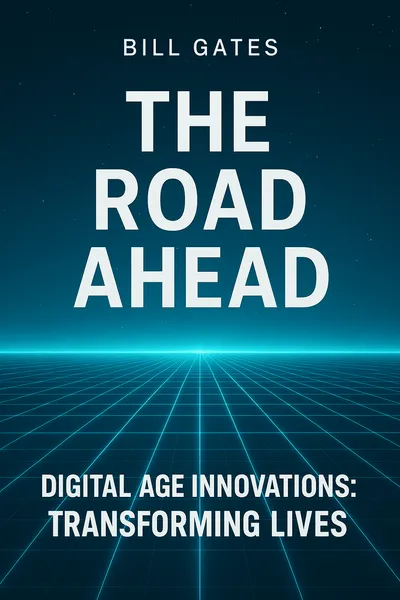
The road ahead
Digital age innovations: transforming lives
Description
The emerging digital technologies promise to revolutionize life worldwide by enhancing quality of life and eliminating unneeded intermediaries. Over the next decade, as the information economy matures, technology will transform how business is conducted, work is done, education happens, and people communicate. Digital advancements will provide affordable access to information for all. By removing middlemen who add no value, efficiency improves.
The global information infrastructure holds immense potential to empower individuals and enrich societies. Technology progression aims to boost productivity, understanding, and connections between people regardless of geography. The possibilities to uplift humanity through information sharing are boundless. Access for all combined with removing waste promises greater prosperity.
Table of contents
01 The information revolution
The vision of connecting every home and office to a high-speed network, enabling access to vast information, is a goal shared by countless companies and governments worldwide. This ambition, often symbolized by the "information superhighway" metaphor, initially promoted by Al Gore, aims to revolutionize international business and commerce through the free global exchange of information. However, the metaphor might be less apt than likening this to a vast global marketplace, much like an enormous department store or stock exchange, where information is the primary currency.

02 The genesis of the information age
The Information Age is marked by the advent of high-speed, affordable technology that processes and transmits data worldwide, a revolution initiated by the invention of computers. Unlike previous eras defined by the materials of tools and weapons, such as the Bronze and Iron Ages, the Information Age is characterized by the intangible nature of information, which plays a crucial role in today's economy. The ability to access vital information at the right time can significantly impact the economic success of individuals, companies, or nations.
Most of today's information is stored electronically, with significant advancements in computer technology laying the foundation for the information economy. These include Blaise Pascal's mechanical calculator in 1642, Charles Babbage's "Analytical Engine" in the 1830s, and the development of the first electronic computer in the 1940s by Alan Turing, Claude Shannon, and John von Neumann, which introduced concepts like general-purpose use, the binary system, and computer memory.
03 Learning from history
Investing in the infrastructure for the emerging information economy is crucial for companies to avoid past mistakes seen in the microcomputer industry's early days. That industry's rapid growth showed that traditional strategies don't apply to new markets. Small firms quickly became billion-dollar entities, while established giants faltered, unprepared for the swift change. In communications, network effects are critical; a product's value is largely tied to its user base. Early dominance in setting industry standards can lead to significant market share and profits. This was also true for microcomputers, where the value lay in the software's ability to perform essential tasks, driving hardware sales.
04 Flexible access
The information economy revolutionizes how we access content, allowing us to consume information and entertainment at our convenience rather than at predetermined times. This shift has significant implications, introducing the concept of "killer application" into the business lexicon. Originating in the computer industry, this term refers to technology so compelling that it drives market demand, making its commercial availability a necessity.
For instance, Lotus 1-2-3 served as the killer app for personal computers, spurring the growth of the PC market as consumers sought out the software. In the realm of the information highway, killer apps merge information, education, entertainment, shopping, and communication, accessible through devices that combine computing and telecommunications capabilities. Key appliances facilitating this new economy include television set-top boxes that link TVs and phones, wallet PCs capable of transmitting information, storing digital currency and IDs, and replacing keys, as well as information kiosks in public spaces that provide access to the information highway.
05 Evolution to the information highway
The internet, though still in its early stages, has become a cornerstone of daily life. It is evolving into a sophisticated "information highway" that will revolutionize communication and commerce. Despite current limitations, the internet's rapid growth signals a deep-seated demand for its full potential. As technology progresses, enabling smooth video calls, high-bandwidth virtual reality, and a proliferation of connected devices, usage is expected to surge.
Investing heavily in digital infrastructure is key to this evolution. Upcoming 5G and 6G networks will provide faster, more widespread mobile access, while fiber optics will enhance high-speed connections for homes and businesses. Innovations in communication protocols and hardware will make real-time holographic interactions and virtual experiences possible.
06 Unleashing creativity
The advent of the information superhighway is set to transform communication and information access globally. As internet and digital connectivity improve in speed, affordability, and reach, they will open up unprecedented avenues for expressing ideas and sharing content. This leap in connectivity is poised to positively influence various aspects of life by making data transfer cheaper, thus facilitating instant and cost-effective sharing of ideas, news, entertainment, and more worldwide.
07 Location independence
In the coming decade, we're poised to witness a revolution in the dynamics of work, driven by advancements in communication and collaboration technologies. The significance of physical location is set to diminish, paving the way for more flexible and decentralized work models. Employees will increasingly have the freedom to work from any location with internet access, thanks to technologies like video conferencing, cloud computing, and virtual workspaces.
This shift will encourage companies to embrace remote teams and for more individuals to work as freelancers or independent contractors, moving away from the traditional full-time office roles. Consequently, remote work and distributed teams will see a significant rise, with companies adopting a "virtual first" approach. Workers will enjoy greater autonomy in choosing their work settings, influenced by personal preferences or cost of living, rather than the necessity of being near a corporate office. This flexibility will also allow for a migration from urban to suburban or rural areas without sacrificing job opportunities.
08 Frictionless markets
The rise of a global information network holds the potential to transform industries worldwide by enabling efficient markets and direct connections between producers and consumers. This shift could lead to increased innovation, reduced costs, and expanded choices. However, challenges such as resistance from established interests, regulatory hurdles, and concerns over privacy and security need to be navigated carefully. If managed wisely, these networks can democratize market access, foster creativity, and address global issues like disease and poverty through open collaboration. Success depends on promoting competition, investing in digital literacy, and ensuring equitable access for all.
09 Lifelong learning
The internet and information technology are revolutionizing education, moving away from a system where prestigious institutions hold the keys to learning, to one where the individual learner is at the center of their educational journey. In the past, only those with access to top schools could benefit from the best educational resources and networks. Now, digital technologies are leveling the playing field by making educational materials widely accessible. Resources such as YouTube, Wikipedia, MOOCs, and online forums provide a wealth of knowledge that is either free or very affordable, enabling self-directed learning for anyone with internet access.
10 Still social
The assertion that the information highway's vast resources and self-education opportunities won't diminish our pursuit of social interaction and community events is insightful. It balances the recognition of our deep-seated need for social connection with the benefits of information technology. Humans are social by nature, and while technology is engaging, it can't replace the fulfillment derived from in-person activities such as concerts, dining with friends, community service, or religious gatherings. We may use technology to find new experiences, but most wouldn't be satisfied with only virtual knowledge of these activities.
11 An open race
Despite the buzz in business news suggesting a clear frontrunner in the race to build the information highway, the reality is that its construction is just beginning. The vastness of this project means predicting the services and features consumers will ultimately embrace is nearly impossible. With limited exposure to the potential of this emerging system, the public's desires remain undefined, making current investments by companies largely speculative. Yet, the promise of significant returns for those who navigate this uncertainty successfully is undeniable.
Rapid innovation is shaping the information highway's future, with companies across sectors experimenting with various components. However, these trials often raise more questions than they answer. History shows us that in new tech markets, it's the agile startups, not the established giants, that often lead the way. This suggests the development of the information highway will be a market-driven journey of trial and error until a consensus emerges.
12 Dawn of a new era
The information superhighway ushers in a new era marked by unprecedented access to information and technology, revolutionizing the way we communicate, entertain ourselves, and conduct business. As we steer through this era, the decisions we make will shape its direction, with the potential to enhance or detract from its promise. The digital economy offers both optimism and uncertainty, with concerns about job prospects, the impact of sophisticated artificial intelligence, the affordability of technology, and how we value intellectual property.
Despite these concerns, the information superhighway is likely to create more opportunities than it displaces. Historically, as economies advance, they tend to generate new employment and raise living standards, a pattern expected to persist with the expansion of the information technology sector. Although the idea of computers outsmarting human intelligence is worrisome, such breakthroughs are not yet a reality, and technology still primarily augments human abilities.
Related books