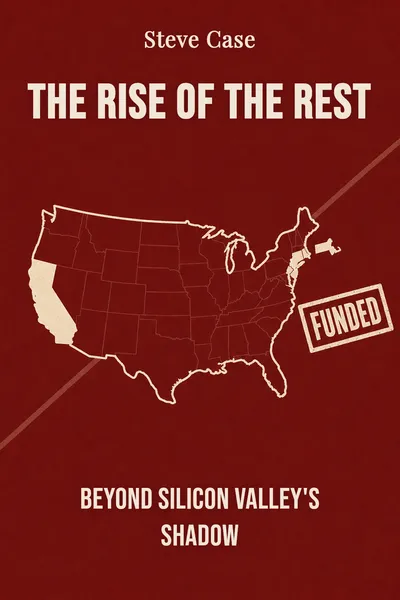
The Rise of the Rest
Beyond Silicon Valley's shadow
Description
In 2014, a former internet mogul started renting a tour bus and driving it into American cities that venture capitalists had spent thirty years ignoring. Steve Case had co-founded AOL, sold it into the largest merger in corporate history, and could have spent the rest of his life on a beach or a board. Instead he pointed the bus at Detroit, Nashville, Des Moines, Pittsburgh — places the coastal money map treated as flyover country — and started meeting the founders nobody was funding. He called the road trip, and later the book that grew out of it, the same thing: the Rise of the Rest.
The premise is almost provocative in its simplicity. Roughly three-quarters of American venture capital, for years running, has flowed to just three states — California, New York, Massachusetts. The other forty-seven share the rest. Case's argument is that this concentration is not proof that the best ideas live on the coasts. It is proof that the money got lazy, clustered, and self-reinforcing — and that the next wave of important companies will come from the cities the map forgot. He puts his own capital behind the claim through a fund with the same name.
What makes the book more than a venture pitch is where Case has stood. He built a company in the Washington suburbs, not Palo Alto, in an era when that was a handicap. He watched the industry he helped create pull inward toward a single valley. So the question underneath the road trip is less about startups than about who gets to build the future, and whether geography should decide it.
The question we’re asking : If talent is spread evenly across the country, why is the money that funds it crowded into a handful of zip codes — and what happens when that starts to change?What we’ll see : A former AOL founder trades the boardroom for a tour bus, and turns a road trip through overlooked cities into an argument about where the next American companies will come from.
Table of contents
01 Chapter 1 — The bus that went looking for founders
The format sounds like a stunt, and Case knows it. Starting in 2014, the Rise of the Rest tour loaded partners, reporters and local organizers onto a bus and rolled into a city for a day — a tour of startups, a session with the mayor, a pitch competition where one founder walked away with a $100,000 check written on the spot. Then the bus moved to the next town. Over the following years it covered dozens of cities and tens of thousands of miles, from Buffalo to Birmingham to Salt Lake City. The theater was the point: attention is a resource these places rarely get, and a bus full of investors from Washington and beyond is, in its way, a headline.
But the anecdotes Case collects are what carry the book. He meets founders building software for the trucking industry in Chattanooga, agriculture-tech companies in Iowa growing up next to the farms they serve, health startups in the shadow of hospital systems in Baltimore and Cleveland. What strikes him is not that these entrepreneurs are underdogs. It is that they have advantages a San Francisco founder can only envy — proximity to an actual industry, cheaper talent that doesn't churn every eighteen months, a cost of living that lets a company survive a lean year without incinerating cash.

02 Chapter 2 — Why the map got so lopsided
To explain the imbalance, Case reaches back to how Silicon Valley became Silicon Valley. The story is genuinely remarkable — a dense weave of Stanford, defense spending, semiconductor pioneers, a culture that treated failure as tuition rather than shame. Venture capital grew up alongside it, and the two reinforced each other. Investors clustered where the deals were; founders clustered where the money was. Success compounded into gravity.
The trouble, in Case's telling, is that the gravity became a kind of tunnel vision. Venture is a business of pattern-matching, and the patterns that worked in one valley — young founders, consumer apps, hypergrowth, a willingness to lose money for years — got mistaken for the definition of a good company. Investors began funding people who looked like the founders who had already succeeded, in the places those founders lived. The model was extraordinarily good at producing a certain kind of software company and strangely blind to everything else.
03 Chapter 3 — The three lines that write the checks
If the diagnosis is a capital gap, the prescription is about who fills it and how. Case is clear that founders alone cannot fix an ecosystem. What turns a city into a place where companies get built is a convergence of players who usually barely talk to each other — and much of the book is about getting them into the same room.
The first line is capital itself. Case argues, with his own fund as evidence, that betting on overlooked geographies is not charity but arbitrage: the same quality of company can be backed at a lower price simply because fewer investors are competing for it. He recruits an unlikely coalition of backers — figures like Jeff Bezos, Eric Schmidt, and a roster of established founders and family offices — precisely to signal that this is an investment thesis, not a philanthropic gesture. Local capital matters too; a region needs its own investors who will take the first risk before outsiders arrive.
04 Chapter 4 — When innovation stops being a coastal privilege
Step back from the bus and the pitch competitions, and Case's real wager is a claim about human potential: that talent is distributed evenly across the country, but opportunity is not. If that is true, then the concentration of innovation in a few coastal cities is not a meritocratic sorting of the best ideas to the top. It is a vast, ongoing waste — the systematic under-use of most of the nation's imagination because the capital and the networks never reached it.
This reframing is what lifts the book above a regional booster's brochure. It is not anti-Silicon Valley; Case is emphatic that the Valley remains extraordinary and will keep producing landmark companies. His argument is additive. A country that funds founders in fifty states rather than three does not diminish its best-known hub — it enlarges the whole enterprise, and spreads the wealth and the jobs that come with it into places that have watched prosperity happen somewhere else.
05 Conclusion
The bus, in the end, is a device for making an invisible thing visible. What Case is really driving through is a map — the one every investor carries in their head, where a few coastal dots glow bright and everything between them fades to grey. The tour exists to argue that the grey is full of companies nobody bothered to look at, and that looking is not generosity but good business. He backs the claim with his own money and an unlikely coalition of co-investors, which is the most convincing part of the book: he is not asking anyone to believe something he hasn't bet on himself.
Related books