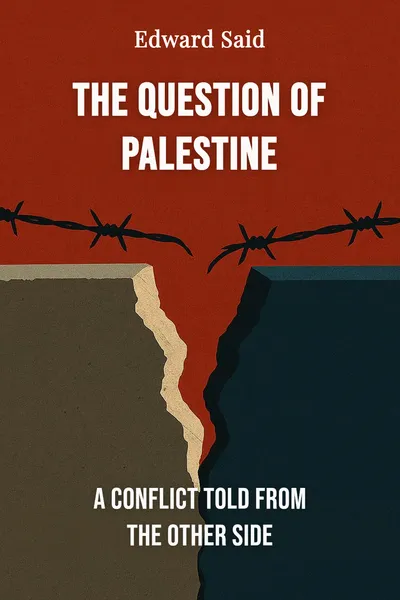
The Question of Palestine
A conflict told from the other side
Description
In 1979, a professor of comparative literature at Columbia University published a book that tried to do something almost nobody in the American mainstream had attempted: state the Palestinian case in plain terms, from the inside. Edward Said was Palestinian by birth, born in Jerusalem in 1935, and by then already known for Orientalism, his study of how the West had constructed the East as an object to be described and managed. The Question of Palestine turned that same lens on his own people. It was not a polemic dressed as scholarship, and it was not a memoir. It was an argument about a history that, in the country where he lived and wrote, was routinely told as if one of its main characters did not exist.
The book landed at a strange moment. Israel and Egypt had just signed the Camp David accords, and the American public had a settled story about the region: a democratic state built by survivors, ringed by hostile neighbors, with the Palestinians appearing mostly as a security problem or a footnote. Said did not deny the Jewish tragedy that gave Zionism its urgency. What he refused was the arithmetic by which that tragedy was made to cancel out another one — the loss, for a whole population, of a homeland they had lived in for centuries.
To write the Palestinian side was, in 1979, an act with almost no institutional support. There was no accepted vocabulary for it, no shelf of respectable books, no room at the table. Said was trying to build the argument and defend the right to make it at the same time. That double task is what gives the book its particular charge, and it is what we come back to at the end.
The question we’re asking : What does the history of the region look like when it is told from the Palestinian side, and why has that telling been so hard to make heard?What we’ll see : How Said reconstructs a dispossession that was rarely named, and turns the fight over land into a fight over who is allowed to narrate it.
Table of contents
01Chapter 1 — The people who were already there
Said begins with a fact so basic it should not need stating, except that so much of the debate had been built on ignoring it: Palestine was inhabited. In the late nineteenth century, when the Zionist movement began to imagine a Jewish return, the land was home to a settled Arab population — farmers, town-dwellers, merchants, an entire society with its own economy, its own notables, its own long attachment to the place. They were not a wandering absence waiting to be filled. They were a people living where they had always lived.
The phrase that captured the erasure, Said notes, was the old Zionist slogan of a land without a people for a people without a land. Whatever its authors intended, the effect was to write the existing inhabitants out of the picture before the argument even started. If Palestine had no people, then settling it raised no moral question about anyone already there. The Palestinians appeared, when they appeared at all, as a demographic obstacle rather than as a nation with claims of its own.

02Chapter 2 — A movement built on the best intentions
What makes Said's account harder to dismiss than a simple accusation is that he takes Zionism seriously as an idea. He does not treat it as a conspiracy or a mere land grab. He grants that it answered a genuine, murderous problem: European antisemitism, culminating in the Holocaust, which made the case for a Jewish refuge unanswerable to those who lived through it. From the inside, Zionism was a liberation movement, and Said writes about it as one.
His argument is that a movement can be redemptive for one people and catastrophic for another at the same time, and that these two truths do not cancel. For Jews, Zionism meant survival, a state, an end to statelessness. For Palestinians, the same project meant the loss of the country they lived in. Said's word for this doubleness is that Zionism has to be understood from the standpoint of its victims as well as its beneficiaries — and that Western accounts had almost never done the first.
03Chapter 3 — The dispossession that had no vocabulary
The rupture Palestinians call the Nakba — the catastrophe — came with the 1948 war and the founding of Israel. Somewhere around seven hundred thousand Palestinians fled or were driven from their homes, and were never allowed back. Villages were emptied and, in many cases, physically erased. A society that had existed for generations was scattered into refugee camps across the region, where many of its descendants remain. This is the event Said places at the center: not an abstract grievance, but a concrete, datable loss of home.
What struck him most was that this dispossession had almost no standing in the Western imagination. The refugees existed as a humanitarian file, a problem of camps and rations, rarely as a political people with a claim to return. Their expulsion had happened, in a sense, off-camera. In the dominant telling, 1948 was a founding, a rescue, a beginning — and the several hundred thousand who lost everything so that it could happen simply slid out of frame, becoming, in official language, the Arab refugee problem rather than the Palestinians who had been removed.
04Chapter 4 — Who gets to tell the story
Underneath the history, Said is making an argument about narration itself — and this is where the book steps beyond the recitation of events. The conflict over Palestine, he argues, is also a conflict over who has the authority to describe it. One side had the institutions, the sympathetic press, the scholarly apparatus, the ear of the great powers. The other had lived the loss but could not get it into the record on its own terms. To recover the Palestinian past was therefore not enough; one had to fight for the right to tell it at all.
This is why so much of the book is concerned with language — with the words that make people appear or vanish. When Palestinians are called terrorists, or infiltrators, or simply the refugee problem, the naming does political work before any argument is made. It decides in advance who is a legitimate actor and who is a disturbance. Said's project of Orientalism had shown how description could be a form of domination; The Question of Palestine turns that insight on his own dispossession, where the power to name is inseparable from the power over the land.
05Conclusion
Said wrote The Question of Palestine as a Palestinian addressing an American public that had almost never heard the case put by one of its own. That situation — the effort to make a whole history admissible where it had been treated as noise — is the book's real subject, more than any single event it recounts. He does not ask the reader to abandon sympathy for the Jewish tragedy that produced Zionism. He asks only that a second loss be granted the same reality, and that the people who suffered it be allowed to speak as a people rather than a problem.
Related books