The Princeton Companion to Mathematics
The map of all mathematics
Description
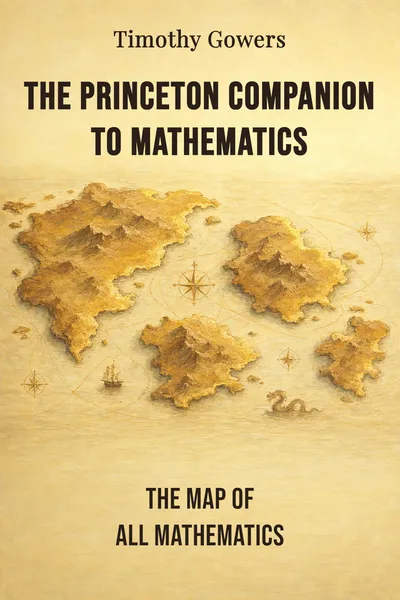
In 2008, Princeton University Press published a single volume of roughly a thousand large pages, edited by the British mathematician Timothy Gowers, with two associate editors and something like two hundred contributors. It was called The Princeton Companion to Mathematics. Gowers had won the Fields Medal in 1998 — the closest thing the field has to a Nobel — and he could have written a manifesto or a memoir. Instead he assembled a guidebook. Not a textbook you work through, not an encyclopedia you consult once and shelve, but something closer to an atlas: a thing you could open anywhere and find yourself somewhere real, with roads leading out to everywhere else.
The ambition was almost absurd on paper. Mathematics by 2008 had fractured into hundreds of specialties so deep that a topologist and a number theorist could sit at the same lunch table and barely follow each other's work. The running joke was that no living person understood more than a sliver of the whole. And here was a book proposing to lay the sliver-holders side by side, in prose a curious outsider could actually read, and quietly insist that the slivers add up to one continent.
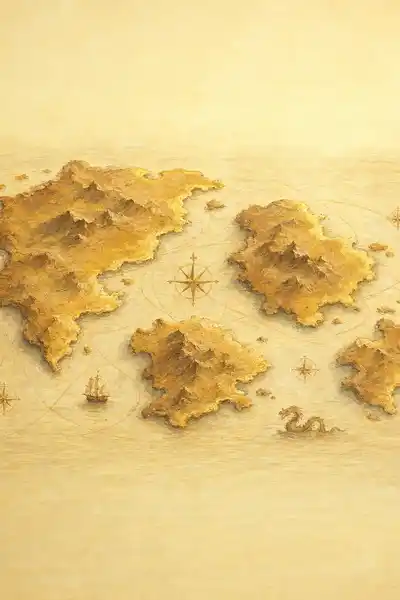
That insistence is the interesting part. The Companion is usually praised as a reference — accurate, generous, beautifully edited. But its shape carries an argument, and the argument is about what mathematics even is. Not a pile of results. A place. A place with a history, with inhabitants, with regions still being surveyed and borders still in dispute.
The question we’re asking : How do you put the whole of mathematics between two covers without either drowning the reader or lying about how big the thing is?What we’ll see : How the book is built, what it decides matters, who it lets us meet, and what its honesty about the unfinished edges says about the discipline itself.
Table of contents
01Chapter 1 — A book that behaves like a country
Most attempts to survey a field pick one of two doomed strategies. Either they go encyclopedic — thousands of short, dry entries, alphabetical, each one a dead end — or they go narrative, tracing a single story and leaving out everything that doesn't fit. Gowers and his co-editors, June Barrow-Green and Imre Leader, did neither. The Companion is organized in layers that let you enter at your own altitude and travel as deep as you like.
It opens with an introduction to the raw materials: what a number actually is, what a function is, what it means for something to be proved. Then come the big structures — the groups, fields, and spaces that recur everywhere, treated as a shared vocabulary rather than as separate topics. Only after that does the book move into the branches proper: algebra, analysis, geometry, number theory, logic, probability, each given a long essay by someone who works inside it. Around all this sit shorter pieces on famous theorems and open problems, on individual mathematicians, and on the ways the subject touches physics, biology, economics, and computation.

02Chapter 2 — The grammar before the sentences
Before the Companion lets anyone loose on the glamorous results, it spends a long stretch on things that look, to an outsider, almost too basic to bother with. What is a real number, really? What do mathematicians mean when they say a statement is true, as opposed to merely useful? Why is the humble idea of a function one of the most powerful ever invented? These early essays are doing the work that makes everything afterward legible.
The bet is that most people are locked out of mathematics not by its hardest peaks but by a missing layer of grammar underneath. We were taught to compute without ever being told what the objects we computed with actually were. Gowers, who is unusually good at this kind of thing, treats the foundations as genuinely interesting rather than as chores to clear. He wants the reader to feel why the definition of a limit had to be so fussy, why infinity needed to be tamed, why proof matters more in mathematics than anywhere else in human thought.
03Chapter 3 — People, not just proofs
A striking share of the Companion is given over to human beings. Scattered through the volume are short biographical essays on the people who built the subject — Euclid, Archimedes, Fermat, Euler, Gauss, Riemann, Cantor, Hilbert, Emmy Noether, Ramanujan, and on toward the twentieth century. They are not hagiographies. They are compact portraits that put ideas back inside the lives and quarrels and dead ends that produced them.
This is a deliberate corrective. Mathematics presents itself as timeless: a proof is either valid or it isn't, and it doesn't matter who wrote it or when. True enough. But the Companion insists that the timeless results were made by people working under real constraints, often getting things wrong for years, sometimes fighting bitterly over what counted as legitimate. Cantor's infinities were resisted as almost heretical. Whole programs were launched, like Hilbert's dream of proving mathematics complete and consistent, and then quietly demolished — in his case by the young Kurt Gödel.
04Chapter 4 — When the map admits it hasn't finished
The boldest thing about the Companion is that it doesn't pretend to be complete. A less confident book would have ended on the triumphs and closed the cover. This one devotes real space to open problems, to areas where the experts disagree, to questions nobody yet knows how to attack. The Riemann Hypothesis sits there unproved. The P versus NP question hangs over computer science. Whole essays end not with a resolution but with an honest "here is where the frontier currently runs."
That honesty is the deeper argument the book's structure has been building toward all along. If mathematics were a finished monument, you could photograph it and be done. But the Companion treats it as a living landscape — surveyed in the center, sketchy at the edges, with expeditions still setting out. The point of laying every branch beside every other wasn't just navigation. It was to show that the connections are where the future lives: a problem stuck for decades in one region often gets cracked by a tool imported, unexpectedly, from another.
05Conclusion
The thing Gowers assembled in 2008 was, on its surface, a reference volume — the kind of book that ends up on a shelf and gets pulled down when someone needs to check what a Lie group is. But it was built to do more than answer questions. It was built to show that the questions belong together, that the branches touch, that the subject its readers had been taught in disconnected fragments is in fact one continuous and human thing. Open it anywhere and the roads lead out to everywhere else.
Related books