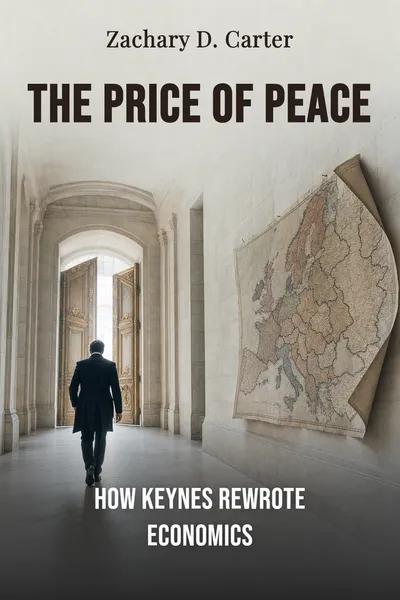
The Price of Peace
How Keynes rewrote economics
Description
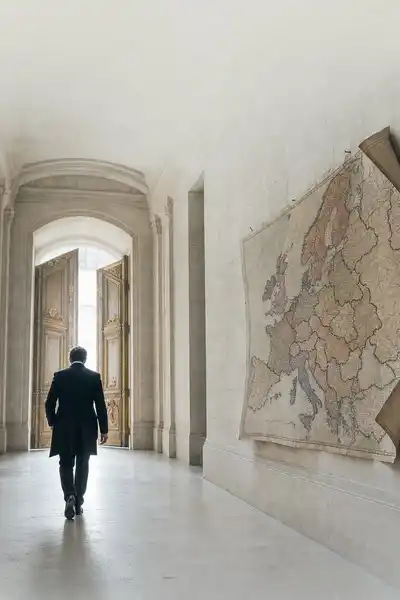
In June 1919, a thirty-six-year-old Treasury official walked out of the Paris peace talks in disgust and went home to write a book. John Maynard Keynes had spent months in the corridors of Versailles watching the victors carve up a defeated Germany, and he had concluded that the reparations being demanded were not just cruel but arithmetically impossible — a bill no economy could pay without collapsing, and a collapse that would drag the rest of Europe down with it. The book he wrote in a few furious weeks, The Economic Consequences of the Peace, sold roughly a hundred thousand copies and made him famous across two continents almost overnight.
That is where Zachary D. Carter begins, and the choice tells us a lot. Carter's The Price of Peace is not a tour of supply curves and multipliers. It is the story of a man who thought economics was, at bottom, a question about how people should live together — and who spent thirty years arguing, against nearly everyone, that prosperity was a political choice rather than a law of nature. Between Versailles and his death in 1946, Keynes watched the gold standard break, the Great Depression swallow the industrial world, and a second war confirm his darkest predictions about the first peace.
Carter's Keynes is a bundle of contradictions worth sitting with: a Bloomsbury aesthete who loved ballet and speculation, a technocrat who distrusted technocracy, a defender of capitalism who wanted to save it from itself. The book follows the idea more than the equations, and it follows the idea past its author's death — into the hands of the economists and politicians who would claim him, tame him, bury him, and dig him back up.
The question we’re asking : How did a Cambridge economist turn prosperity from a natural law into a political choice — and what happened to that idea once he was gone?What we’ll see : A life lived through catastrophe, a way of thinking about money that was really a way of thinking about freedom, and the long strange career of an idea that keeps outliving its own obituaries.
Table of contents
01Chapter 1 — The bad peace of Versailles
Carter opens with the scandal because it sets the frame for everything that follows. At Versailles, the Allied leaders wanted Germany to pay for the war in full, plus interest, plus a moral debt that no ledger could hold. Keynes, sitting on the British delegation, did the sums and found them monstrous. A Germany stripped of its coal, its merchant fleet, and its capacity to earn foreign currency could not possibly transfer the demanded billions abroad. The attempt to force it, he warned, would produce not justice but ruin — inflation, resentment, and eventually a politics of revenge.
What makes the episode Keynesian, in Carter's telling, is the reasoning behind it. Keynes did not object to the reparations on narrow accounting grounds. He objected because he saw the European economy as a single interdependent organism, where impoverishing one nation impoverished all of them. The victors were treating money as punishment, as if wealth were a fixed pile to be redistributed by conquest. Keynes saw it differently: prosperity was something a society produced together, and it could be destroyed by bad decisions as easily as it was built by good ones.

02Chapter 2 — Money as a moral idea
Behind the policy proposals, Carter argues, sat a philosophy that Keynes had absorbed long before he touched economics. As a young man at Cambridge he belonged to the Bloomsbury circle — Virginia Woolf, Lytton Strachey, the painters and writers who believed that the point of life was friendship, beauty, and states of mind worth having. Keynes never really abandoned that conviction. Wealth, for him, was not the goal. It was the scaffolding that let people pursue the things that actually mattered. An economy that produced misery had failed even if the numbers looked fine.
This is why Carter resists calling Keynes simply a technician. His famous claim that markets can stay irrational longer than you can stay solvent was not just trading wisdom; it reflected a whole view of how the world works. People are not the coolly calculating agents of the textbooks. They act on confidence, fear, and what Keynes called animal spirits — the gut impulse to invest or to hoard. When that confidence drains away, a market economy can seize up and sit there, with willing workers and idle factories, for years. Nothing forces it to recover on its own.
03Chapter 3 — The revolution that got tamed
Keynes wanted to save capitalism, not overthrow it, and Carter is careful about that distinction. In the 1930s the choice on offer seemed to be laissez-faire misery on one side and Soviet planning on the other. Keynes rejected both. His middle path was a mixed economy where markets did most of the work but the state stood ready to fill the gap in demand when private spending fell short. It was radical to the orthodox and far too timid for the revolutionaries — which was roughly where Keynes always liked to stand.
The Second World War proved the point almost by accident. Governments spending without limit to fight fascism discovered that the mass unemployment of the Depression simply vanished. The economy could be run near full capacity if someone was willing to buy what it produced. Keynes spent the war years back at the Treasury and then at Bretton Woods in 1944, where he helped design the postwar financial order and lost most of his arguments to the Americans, who held the money and therefore the pen. He died two years later, exhausted, in 1946.
04Chapter 4 — What we do with an idea after its author
Step back from the life and Carter's real subject comes into focus: not Keynes the man but Keynesianism the afterlife — what happens to a powerful idea once the person who thought it can no longer defend it. The book spends nearly as many pages on the decades after 1946 as on Keynes himself, following his idea through the hands of American economists, Cold War politicians, and eventually the free-market revival of the 1980s that treated his name as an insult.
The pattern Carter traces is one of repeated capture and revival. Keynes gets absorbed by the establishment, sanded down into a manageable technique, blamed when the technique fails, pronounced obsolete — and then, when the next crisis hits, quietly resurrected because nobody has anything better. This is exactly what happened in 2008, when governments that had spent thirty years disavowing him suddenly reached for deficit spending and bank rescues, the most Keynesian instruments available. The obituaries turned out to be premature again.
05Conclusion
The Price of Peace circles back, in the end, to the young man storming out of Versailles. Everything Keynes went on to build grew from that first refusal to accept that suffering was simply the price of some natural economic order. He spent the rest of his life insisting that the numbers were not destiny — that a society could decide to be prosperous or decide, through neglect and bad theory, to be poor. He died before he could see how thoroughly that insistence would be both honored and betrayed.
Related books