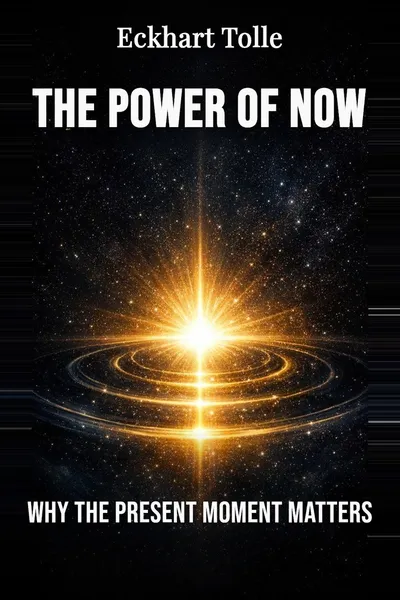
The Power of Now
Why the present moment matters
Description
In the late 1970s, a man in his late twenties was living in London, depressed enough that he later said he had thought seriously about not going on. One night he woke up in a state of dread so total it felt unbearable, and a thought surfaced: "I cannot live with myself any longer." He noticed something odd in the sentence. If he couldn't live with himself, there must be two of him — the "I" and the "self" it couldn't tolerate. Maybe, he thought, only one of them is real. The man's name was Eckhart Tolle, and what happened next he describes as a kind of dissolving. The dread had nothing left to hold on to.
He spent the following years sitting on park benches, by his own account, in a state of uncomplicated wellbeing he couldn't fully explain. Eventually he started talking to small groups, then writing. The book that came out of it, The Power of Now, was published in 1997, sold quietly at first, then got picked up by Oprah Winfrey and went on to move several million copies. Its claim is disarmingly simple and slightly maddening: nearly all of our suffering is manufactured by the mind's refusal to stay in the present moment, and freedom is closer than we think.
It's easy to file this under the soft-focus shelf of airport spirituality, and plenty of people do. But Tolle isn't really offering tips. He's making a claim about what a human being actually is — and arguing that the chatter we take for our own thinking is mostly a machine running on its own, dragging us between a past that's gone and a future that hasn't arrived. The present, the one moment that's ever real, gets skipped.
The question we’re asking : Why would the present moment, the thing we're always technically in, be so hard to actually inhabit — and what is the mind doing instead?What we’ll see : How Tolle traces our restlessness back to thought itself, to our strange relationship with time, and to a self that may not be what we assume.
Table of contents
01 Chapter 1 — The mind that won't stop talking
The first thing Tolle asks us to notice is uncomfortable once you see it: the voice in your head almost never stops. It comments, rehashes, plans, worries, replays an argument from three years ago, drafts one for tomorrow. We tend to assume this running monologue is us — that thinking is what we are. Tolle's reversal is the heart of the book. We are not the voice. We are the awareness that can hear it. The proof he offers is almost too plain to argue with: if you can observe the thought, you cannot be the thought. There's a watcher, and the watcher is quieter than the noise.
Most of what the voice produces, he argues, is involuntary and repetitive, and most of it is unhappy. It feeds on problems because a mind with nothing to chew on feels, to itself, like it's disappearing. So it generates friction — resentment about what happened, anxiety about what might. The technical word in some traditions is compulsive thinking; Tolle just calls it the noise. And the noise has a cost. We're rarely where our body is. We eat without tasting, walk without seeing, sit with someone we love while mentally somewhere else entirely.

02 Chapter 2 — Time is something we invented
If the mind is the engine, time is the fuel. Tolle's second move is to take apart our relationship with past and future, and the argument is bolder than it first sounds. The present moment, he says, is the only thing that has ever existed. Whatever happened, happened in a now. Whatever will happen, will happen in a now. The past is a memory held in the present; the future is an expectation held in the present. We never actually leave it — we only think our way out of it.
He's careful to separate two uses of time. Clock time is practical and necessary: learning from yesterday, catching a train tomorrow, planning a meal. That's fine. The trouble is psychological time, the habit of treating the past as identity and the future as the place where life will finally begin. We carry grievances like luggage and postpone contentment like a payment. The mind whispers that we'll be at peace once the promotion, the relationship, the move arrives — and when it arrives, the mind has already moved the goalpost. Salvation is always one step ahead, which is to say it never comes.
03 Chapter 3 — The pain-body and the self that feeds on it
If watching the mind is the practice, the pain-body is the obstacle Tolle takes most seriously. It's his term for the accumulated residue of emotional pain — old hurts, griefs, humiliations that didn't get fully felt and were instead stored. He describes it almost as a semi-autonomous thing living inside us, mostly dormant, that periodically wakes up hungry. And what it feeds on is more pain. When it's active, it pulls our thinking toward the memories and situations that will generate the emotion it craves, then rides the resulting drama.
This sounds mystical, and Tolle's language sometimes is. But the experience he's pointing at is recognizable to anyone. There are days a small irritation triggers a wave of feeling wildly out of proportion to the cause. A comment lands and suddenly you're flooded with an old, familiar bitterness, and some part of you almost enjoys being wronged. That, in his framing, is the pain-body taking over the controls — and crucially, it isn't you, even though it borrows your voice and your reasons.
04 Chapter 4 — Presence as the oldest idea in the world
Step back from the cover and the talk-show endorsements, and what Tolle is saying stops looking like a 1990s self-help product and starts looking like a very old claim in modern clothes. The Buddhist tradition had been talking about non-attachment and the illusory nature of a fixed self for over two millennia. Meister Eckhart, the medieval Christian mystic whose name Tolle borrowed, wrote about a stillness in the soul beneath all activity. The Stoics distinguished what's in our control from what isn't, and located peace in that line. Tolle's contribution is not the discovery. It's the translation — stripping the vocabulary of religion and asking the reader to verify the thing directly.
That's also the source of the suspicion the book attracts. By detaching presence from any tradition, doctrine, or community of practice, Tolle makes it portable and a little weightless. Critics point out that "be here now" can quietly become an instruction to stop caring — to treat injustice, ambition, and grief as so much mental noise to be observed and released. Tolle answers that presence sharpens action rather than dissolving it, that you act more clearly without the static of fear and resentment. Whether the book delivers that or just a pleasant inner quiet is a fair question, and it depends heavily on the reader.
05 Conclusion
The young man dissolving on a London park bench is the whole book in miniature. Nothing in his outer life had changed overnight — no money arrived, no problem was solved. What shifted was that he stopped being identified with the anxious voice and became the space in which it played out. The Power of Now is the long attempt to describe that shift in ordinary words and to suggest it isn't reserved for people who break down at three in the morning. It's available, Tolle insists, in any pause we're willing to take.
Related books