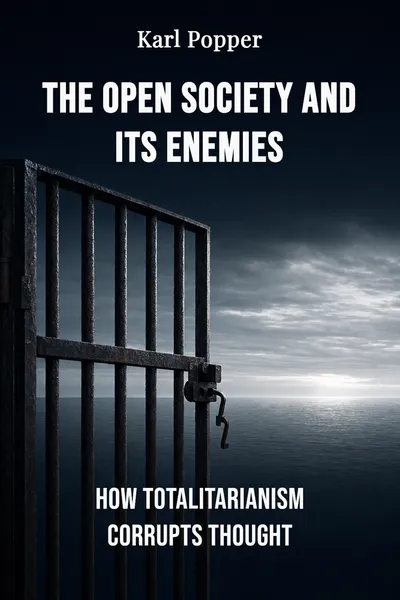
The Open Society and Its Enemies
How totalitarianism corrupts thought
Description
On the day in March 1938 that German troops crossed into Austria, a thirty-five-year-old philosopher named Karl Popper was already on the far side of the world, teaching at a small college in Christchurch, New Zealand. He had left Vienna the year before, reading the situation more clearly than most of his colleagues and getting out while the getting was possible. He was of Jewish origin; relatives who stayed did not survive the war. From that distance — as far from Europe as it is possible to be — he spent the war years writing a long, furious, meticulous book about how thinking men had talked themselves into tyranny.
Popper had made his name in the philosophy of science, arguing about what separates a real theory from a fake one. But watching Austria fall, he set that work aside for something more urgent. He wanted to understand not the tanks and the camps directly, but the ideas that had cleared the road for them — the respectable philosophies, taught in universities, that had made total control sound reasonable, even noble. He called the book, when it appeared in 1945, his war effort. It was, he later said, the thing he could do instead of fighting.
The Open Society and Its Enemies goes after names one does not expect to find in a dock: Plato, Hegel, Marx. Not cartoon villains but pillars of the Western canon, thinkers most educated people were taught to admire. Popper's charge is that a certain habit of mind runs through all of them, and that this habit, followed to its end, arrives at the closed society — the one that permits no dissent because it believes it already knows where history is going.
The question we’re asking : How does a philosophy — a way of reasoning, taught with a straight face — end up preparing the ground for tyranny?What we’ll see : A book born in exile turns on some of the most revered names in Western thought, and traces totalitarian politics back to a single, seductive mistake about knowledge and history.
Table of contents
01 Chapter 1 — A book written in exile, against the times
Popper was born in Vienna in 1902, into a cultivated middle-class family with roots in Judaism, in a city that was then one of the great intellectual capitals of Europe. He trained as a philosopher and made his first mark on the theory of science, with the argument that a genuine scientific claim is one that could in principle be proven false — that testability, not certainty, is the mark of real knowledge. That idea, humble on its surface, would turn out to be the seed of everything he later said about politics.
By the mid-1930s the ground under Vienna was shifting. Popper watched the rise of fascism and the appeal of Soviet communism among his own friends, and he grew alarmed at how many clever people were drawn to systems that promised to abolish uncertainty. In 1937 he took a teaching post in New Zealand, a deliberate retreat to safety. The following year Germany annexed Austria. The distance saved his life and, in a strange way, gave him the room to write.

02 Chapter 2 — Plato, or the beautiful cage
The first and longest target is Plato, which shocked Popper's readers more than any other choice. Plato is not a fringe figure; he is close to the founding father of Western philosophy, and generations had read his Republic as a noble dream of a just city ruled by the wise. Popper read the same book and saw a blueprint for the closed society — a rigidly ordered state where each person is fixed in a caste, where the rulers alone may lie for the public good, and where change itself is treated as decay.
What disturbed Popper was the logic underneath. Plato believed the world of experience was a shadow of unchanging perfect Forms, and that the best society would freeze itself as close to that perfection as possible. Motion, dissent, individual ambition — these were corruptions to be engineered out. The philosopher-kings would know the truth and impose it, for everyone's benefit, whether the governed liked it or not. Popper called this the appeal of the beautiful, static ideal, and he found it terrifying precisely because it is so attractive.
03 Chapter 3 — Hegel, Marx, and the seductions of history
If Plato supplied the ancient template, Popper argued, the modern versions were assembled in Germany, and his sharpest scorn falls on Hegel. Writing in the early nineteenth century, Hegel made history the unfolding of a World Spirit moving through nations toward its destiny, with the state as its highest expression and the individual conscience a small thing beside it. Popper treated Hegel almost as a court philosopher of Prussian power, a maker of grand, cloudy language that dressed obedience up as reason. Whatever exists, in this telling, is somehow rational and right — a doctrine that flatters whoever happens to hold power.
Marx is handled differently, and here Popper is careful and even respectful. He plainly admired Marx's moral seriousness, his rage at the misery of industrial capitalism, his effort to put social science to humane use. Marx, unlike Hegel, cared about suffering and wanted to end it. That is why Popper takes him seriously enough to argue with at length rather than dismiss.
04 Chapter 4 — Why open societies stay unfinished
Step back from the individual targets and Popper's real argument comes into focus. Totalitarianism, in his diagnosis, does not begin with jackboots. It begins with a theory of knowledge — with the belief that history has a plan, that some people can read it, and that reading it confers the right to remake everyone else. The camps and the secret police are downstream. What comes first is a way of thinking that treats uncertainty as a weakness to be abolished rather than a condition to be lived with.
Against this, Popper set the open society, and its defining feature is not a set of policies but an attitude toward being wrong. An open society is one that assumes its arrangements are fallible, holds them up for criticism, and changes them when they fail — the same method he had proposed for science, transplanted into politics. It is built to be corrected. That is why he cared so much about the peaceful removal of bad governments: elections are less a way of finding the wise ruler than a way of firing the incompetent one before he can do lasting harm.
05 Conclusion
Popper finished his book in New Zealand and published it in 1945, the year the war he had been writing against finally ended. He moved to England in 1949 and spent the rest of a long career at the London School of Economics, returning largely to the philosophy of science that had first made his name. But The Open Society and Its Enemies remained the book that carried his argument into politics, read by people who never opened a page on falsifiability. It arrived exactly as Europe was surveying the wreckage and asking how educated nations had let it happen.
Related books