The Obstacle Is the Way
Turning trials into triumph
Description
Around the year 170, somewhere along the Danube frontier, the Roman emperor Marcus Aurelius was writing notes to himself between military campaigns. He never meant them to be read. One of them, later collected in what we call the Meditations, contains a line that a young American media strategist named Ryan Holiday would build an entire book around almost two thousand years later: "The impediment to action advances action. What stands in the way becomes the way." Marcus was talking about how a fire consumes whatever gets thrown into it, turning obstruction into fuel. He was, by most accounts, one of the most powerful men alive and also one of the most besieged — plague, war, betrayal, chronic illness. The philosophy he leaned on was Stoicism, and he used it as a survival tool, not a theory.
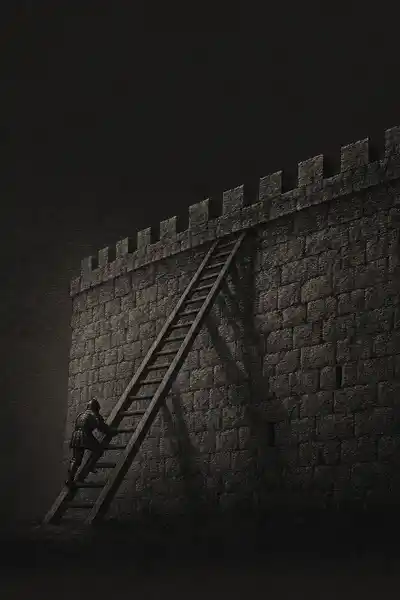
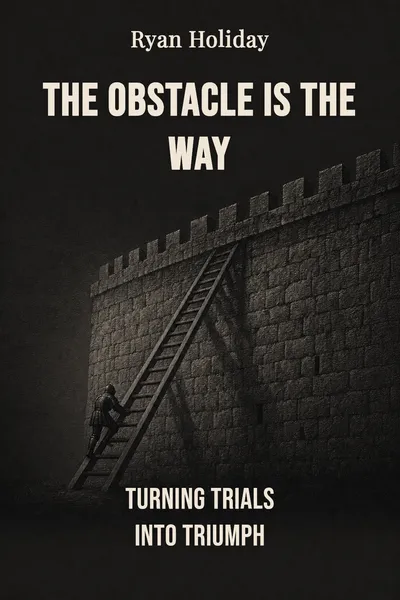
In 2014, Holiday took that single sentence and turned it into The Obstacle Is the Way, a slim guidebook that argues adversity is not something to be endured but something to be used. The book found an unlikely audience. It circulated through NFL locker rooms and Silicon Valley boardrooms, got passed around by coaches and founders, and sold steadily for years on word of mouth rather than a launch spike. Holiday, who had cut his teeth in marketing before turning to ancient philosophy, had done something the professors mostly hadn't: he made Stoicism sound like advice a friend would give you, backed by stories of people who had actually lived it.
The pitch is simple enough to fit on a bookmark, which is part of why it travels. But the simplicity hides a specific claim about how a person meets a bad situation — a claim with a structure, borrowed almost intact from Marcus, Seneca, and a former slave named Epictetus. That structure is what makes the book more than a motivational poster, and it's worth following closely.
The question we’re asking : How do you turn a setback into an advantage without lying to yourself about how bad it is?What we’ll see : How an emperor's private notes became a modern handbook for meeting adversity — and what that handbook actually asks of us.
Table of contents
01 Chapter 1 — The line that outlived an emperor
Holiday didn't invent the material, and he's the first to say so. The Obstacle Is the Way is a repackaging of Stoic philosophy — a school founded in Athens around 300 BCE by Zeno of Citium and later carried into the Roman world by three men who wrote most of what survives. There's Seneca, the wealthy statesman and playwright who advised Nero and eventually died on the emperor's orders. There's Epictetus, born into slavery, who taught after gaining his freedom and whose lectures were written down by a student. And there's Marcus Aurelius himself, the reluctant emperor whose journal became the book's spine.
What unites them is a single, stubborn idea: we don't control what happens to us, but we fully control how we judge and respond to it. Epictetus put it bluntly — people are disturbed not by events, but by their opinions about events. The lost job, the failed deal, the diagnosis, the betrayal: none of these carry a fixed emotional weight. We assign the weight. And if we assign it, we can reassign it.

02 Chapter 2 — Perception comes first
The first stage is the one everything else depends on, and it's also the one we skip. When something goes wrong, the reaction arrives before the thought — the flash of panic, the sense of unfairness, the story we tell ourselves about how bad this is. Holiday's argument, straight out of Epictetus, is that this reaction is optional. The event is real; the meaning we staple onto it is not. And that meaning determines almost everything that follows.
He's careful not to sell denial. Seeing clearly doesn't mean pretending the obstacle is small or that a setback is secretly a gift. It means refusing to add anything the situation doesn't contain — the catastrophizing, the self-pity, the imagined judgments of other people. Marcus had a practice for this: he would strip an event down to its bare components, describing a fine meal as the corpse of a fish or a lavish robe as dyed wool, so that its power over him dissolved. The point is to look at what's actually there, not the inflated version fear produces.
03 Chapter 3 — Then the body moves
Clear sight is worthless if it stays in your head, and Holiday's second stage is unglamorous by design: you have to act, and you have to keep acting. Stoicism is often misread as passive acceptance, a shrug in the face of fate. Holiday spends the middle of the book correcting that. The Stoics were doers — statesmen, generals, working people — and their calm was in service of relentless effort, not a substitute for it.
The action he describes has a particular texture. It's persistent rather than heroic, iterative rather than decisive. He leans hard on Thomas Edison, who ran through thousands of failed materials before finding a workable filament and reportedly framed each failure as one more way that didn't work, narrowing the search. The obstacle here isn't overcome by a single brilliant stroke. It's ground down through repetition, through a willingness to fail forward and treat each dead end as information. Process, in Holiday's telling, beats inspiration almost every time.
04 Chapter 4 — The will is the last stronghold
Some obstacles don't yield. You can see them clearly, act on them relentlessly, and still lose — the illness that doesn't heal, the loss that can't be undone, death itself. This is where Holiday's third stage takes over, and it's the part that separates the book from ordinary success literature. Will, in his account, is not the force that overcomes the world. It's what remains standing when the world refuses to cooperate.
Here he draws on the darkest corners of the tradition. Seneca calmly preparing for a death ordered by his former pupil. Marcus governing an empire while burying most of his children and watching plague sweep his legions. The Stoics practiced what they called premeditatio malorum — rehearsing misfortune in advance, so that when it arrived it found them ready rather than shattered. The aim wasn't gloom; it was to strip catastrophe of its ambush. If you've already accepted the worst as possible, it can't unmake you.
05 Conclusion
Marcus Aurelius wrote his line about the fire without any expectation that anyone would read it, let alone that it would headline a book eighteen centuries later. He was a man trying to hold himself together on a cold frontier, using the only tool he trusted. That's the quiet power of what Holiday assembled: a philosophy field-tested by people under genuine pressure, from an emperor at war to inventors, athletes, and founders staring down their own dead ends.
Related books