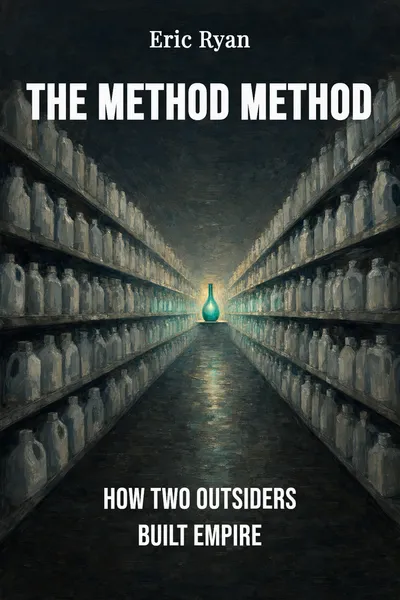
The Method Method
How two outsiders built empire
Description
In the early 2000s, in a cramped apartment in San Francisco's Marina district, two roommates were mixing cleaning products in beer pitchers. Eric Ryan had a background in advertising and design; Adam Lowry was a chemical engineer who had worked on climate research. Neither had ever run a company, and neither knew much about the soap business, which was exactly the point. They looked at the cleaning aisle of any American supermarket and saw a wall of the same thing: harsh chemicals, warning labels, packaging designed to look industrial, brands that had been fighting the same price war for decades. They decided the household aisle deserved something people might actually want to display on the counter.
What they built became Method, a brand of soaps and cleaners that treated a mundane category as a design problem instead of a chemistry problem. The dish soap came in a teardrop bottle that people left out on purpose. The scents were named like a boutique's, not a factory's. The ingredients were non-toxic and the whole thing was pitched, only half-jokingly, as bringing style and conscience to a corner of the store nobody had thought about in years. It grew fast, landed in Target, and turned into one of the more improbable consumer stories of its era.
Ryan tells that story in his book The Method Method, and it is less a memoir than a working argument. The two founders had none of the qualifications the category expected, and they treated that lack as an advantage rather than a handicap. The book is an attempt to bottle what let two outsiders build something in a market ruled by giants.
The question we’re asking : How did two people with no experience in the industry turn a soap bottle into a fast-growing brand — and what did they figure out that the incumbents couldn't?What we’ll see : The scrappy origin of Method, the counterintuitive bets that powered it, and what its unlikely founders offer anyone building from outside the club.
Table of contents
01 Chapter 1 — Two roommates and a spray bottle
Eric Ryan and Adam Lowry met as roommates in San Francisco, and the origin story Ryan tells is almost too tidy: two young men in a shared apartment, one obsessed with brand and design, the other with chemistry and the environment, both irritated by the same thing every time they cleaned the kitchen. The products under the sink were ugly, toxic, and boring. Nobody had bothered to make them better because nobody had to. Procter and Gamble, Unilever, Clorox and the rest had carved up the category long ago and competed mostly on price and coupons, which is a comfortable way to sleep at a market that has stopped changing.
Ryan came at it from the marketing side. He had worked in advertising and understood that a brand could win on how it made people feel long before it won on performance. Lowry came at it from the lab. He had studied chemical engineering and worked on climate science, and he knew that non-toxic, plant-based formulas were possible without the harsh solvents the industry defaulted to. Neither of those halves was, on its own, enough to start a company. Together they added up to a thesis: a cleaner that worked, didn't poison anyone, and looked good enough to leave out.

02 Chapter 2 — Design as the whole strategy
The decision that defined Method was to treat design not as decoration but as the entire strategy. Most consumer brands think of packaging as the last step, a skin stretched over a product decided elsewhere. Ryan and Lowry inverted that. The bottle came first, or at least it came as an equal partner to the formula. The now-famous dish soap dispenser, a curved teardrop shape designed by Karim Rashid, was engineered to be beautiful enough that people would leave it on the counter rather than hide it. In a category where the goal had always been to be forgotten under the sink, Method wanted to be seen.
This was not vanity. It was distribution. A bottle people display is a bottle that advertises itself in the one place a competitor's marketing can't reach — the customer's own kitchen. Method spent almost nothing on traditional advertising in its early years; the product did the talking. Ryan makes the case that in a crowded, commoditized market, design is the most efficient marketing budget a small company has, because it travels home with the buyer and keeps working. The look wasn't a way to dress up the value proposition. It was the value proposition.
03 Chapter 3 — Values that had to hold under pressure
From the start Method tied its identity to more than looks. The products were non-toxic and biodegradable, and the company built environmental responsibility into how it operated, not just how it advertised. Lowry's background made this credible rather than decorative — the green claims came from a chemical engineer who actually cared about the molecules, which is a different thing from a marketing department discovering that sustainability sells. Ryan is honest that values and commerce don't always pull in the same direction, and much of the book is about the friction when they don't.
The interesting part is that Method treated its values as operating constraints rather than slogans. Choosing plant-based ingredients limited what suppliers they could use and what the products could cost. Refusing certain chemicals made some formulas harder to get right. These were real costs, and the temptation when money is tight is to quietly relax the standard and hope nobody notices. Ryan argues that the moment a company does that, it loses the only thing that made it different in the first place. The values were the brand; compromising them privately would have hollowed it out publicly, even if no customer ever saw the spreadsheet.
04 Chapter 4 — The playbook for people who don't fit the mold
Step back from the soap and Method's story is really about who gets to start things. The two founders were, by the standards of the cleaning industry, entirely the wrong people. No experience in the category, no fortune behind them, no obvious credential that said they belonged. Ryan's whole framing treats that outsider status as the engine rather than the obstacle. Because they came from elsewhere — design from one, chemistry from the other — they saw a tired category as a set of assumptions waiting to be questioned, not a settled world to be joined.
This is the more general thing the book offers a next generation of entrepreneurs. The instinct when entering an established market is to study how the leaders do it and try to do it slightly better or slightly cheaper. Method suggests the opposite move: find where your unusual background lets you see the problem differently, and build the company around that difference instead of apologizing for it. The advantage of not fitting the mold is that you aren't carrying the mold's baggage. You don't have a legacy product to protect or an old way of thinking to defend.
05 Conclusion
Method grew from beer pitchers in a Marina apartment into a brand that sat on shelves nationwide and eventually became part of a larger sustainable-goods company. The journey Ryan describes is not a straight line of triumphs; it is a run of near-failures, tight negotiations, and moments where staying true to the founding idea cost more than caving would have. Two roommates who had no business succeeding in the soap aisle did, and they did it by treating everything the industry took for granted as an open question — the look of a bottle, the honesty of an ingredient, the reason an entire category had agreed to be boring.
Related books