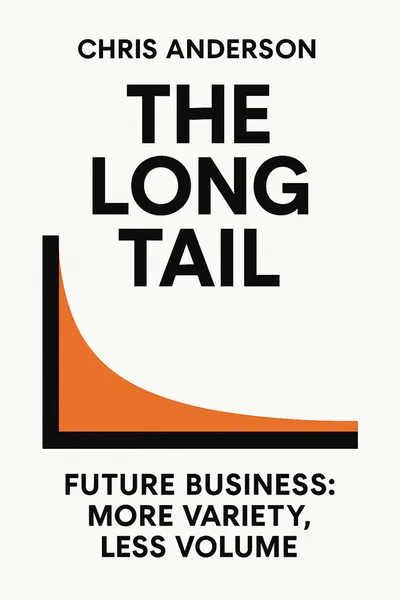
The long tail
Future business: more variety, less volume
Description
The essence of the Long Tail theory is a shift from a traditional focus on a few popular products at the demand curve's peak, towards embracing a vast array of niche markets. This shift is facilitated by the removal of distribution and storage limitations, allowing for the economic viability of specialized products.
The ease of matching supply with demand not only changes market dynamics quantitatively but also qualitatively, uncovering a hidden demand for unique content. As niche markets become more accessible, their economic potential increases, creating a feedback loop that will likely redefine industries and cultural norms, ushering in an era where interests, rather than geography, define market segments.
Table of contents
01 Understanding long tail
In the realm of product markets, the advent of smart technology has led to a significant transformation, turning what were once mass markets into a myriad of smaller, specialized niche markets. While each of these niches might appear insignificant on their own, their collective volume surpasses that of the traditional mass market successes. This shift indicates that the future's vast commercial potential does not lie in catering to the "short head" of the demand curve, which focuses on selling multiple copies of the same product. Instead, the real opportunity for growth and innovation is found in addressing the "long tail" of the demand curve, which consists of millions of diverse niche markets.
Historically, the primary goal of businesses has been to create products that would sell in the millions, a strategy known as short head thinking. This approach concentrated on the left-hand side of the demand curve, where items of high popularity reside. The rationale behind this strategy was grounded in several economic realities: physical distribution systems have limited capacity or "shelf space," leading owners to maximize the volume of goods they handle; broadcast networks have a finite amount of bandwidth, catering to broad tastes to maximize reach and appeal to advertisers; economies of scale favor selling a few bestsellers at exceptional deals; and geographical constraints mean only products with local appeal are stocked. These factors contributed to a 20th-century commerce landscape dominated by a search for universal products, attempts to predict demand, quick removal of unsold products, and a limited range of available popular products.

02 Long tail's key drivers
The phenomenon of the long tail emerges in industries when the costs associated with reaching niche markets significantly decrease. This decline in costs is driven by three primary forces: the widespread availability of production tools, the reduction in distribution costs, and the establishment of methods to connect supply with demand.
When these forces converge within an industry, a long tail pattern of commerce often becomes the dominant economic model. The first force propelling the long tail effect is the democratization of production tools. As these tools become more affordable and accessible, a greater number of individuals can engage in creative and productive activities that were previously the domain of professionals.
For instance, the advent of the personal computer has revolutionized the way we create and disseminate content. With a PC and appropriate software, anyone can produce a short film, write and publish articles, or record and distribute music.
This was evidenced in the music industry when the number of new albums released surged by 36 percent in 2005, largely due to the easy access to music production tools. The proliferation of digital video cameras, music and video editing software, blogging tools, desktop publishing, and photo editing software has empowered individuals to generate a vast array of content. This surge in production has effectively lengthened the tail of available products and content.
03 Long tail market strategies
In the evolving landscape of the digital economy, the emergence of the long tail phenomenon is reshaping the way businesses approach market dynamics. Traditionally, the Pareto Principle, also known as the 80/20 Rule, dictated that a small fraction of products would generate the majority of a company's revenue. This principle encouraged businesses to focus on stocking and promoting only the most popular items, under the assumption that less popular products were not worth the shelf space or the investment.
However, the advent of the long tail economy has challenged this notion by demonstrating that, in a digital marketplace, the cost of carrying an extensive inventory is negligible, allowing even the most niche products to become profitable.
The digital marketplace, free from the physical constraints of traditional retail, reveals the true demand for products, unobscured by the limitations of shelf space and distribution bottlenecks. This has led to a significant shift in consumer behavior, with customers increasingly gravitating towards niche products that cater to their specific interests and needs.
As a result, businesses that embrace the long tail model find that the previously overlooked segments of their catalog can drive substantial revenue growth. This shift is not limited to retail; it extends across various industries, transforming the way products are sold and consumed.
04 Long tail success principles
In the evolving landscape of an economy increasingly influenced by the principles of long tail economics, the blueprint for commercial triumph hinges on two fundamental directives: ensuring the availability of your entire product range and facilitating the consumer's search for their desired items. In the practical realm, businesses that will flourish are those that recognize their consumers as unique individuals rather than mere statistics within a demographic. The cornerstone of such successful enterprises will be mass customization, which caters to the individual preferences of each customer.
To adapt to this shift, consider the possibility of establishing a virtual inventory. This involves showcasing and selling products that are physically housed in a partner's warehouse as though they were part of your own selection. The most cost-effective version of this is a digital inventory. As the economy transitions from the physical distribution of goods to the electronic transfer of products, traditional limitations will vanish, paving the way for emerging niche markets. Align your business with this trend by expanding and diversifying your inventory of customer products and services. Take inspiration from Amazon.com, which utilizes its Marketplace program to sell physical products located in partner warehouses without incurring inventory costs or spending additional funds. Investigate various strategies to replicate this efficient model.
Numerous companies have expanded their operations by providing tools that enable customers to contribute to the workload. This "peer-production" model is exemplified by eBay, where customers handle the listing and auctioning of goods, shipping, and mutual reviews. Netflix benefits from customer-generated movie reviews, and Skype's user base performs tasks that would typically require paid employees. This approach, known as "crowdsourcing," often results in customers outperforming professionals, as seen with the insightful and trusted reviews on Netflix. By leveraging the collective time and energy of a vast customer pool, businesses can extend their capacity significantly in a long tail economy. Strive to make your business self-service, allowing customers to produce what they are most passionate about, as they are the best judges of their own needs. This creates a business that is more finely tuned to customer preferences.
Related books