
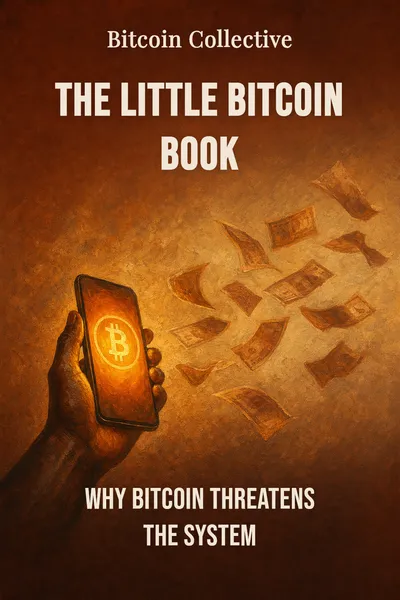
The Little Bitcoin Book
Why Bitcoin threatens the system
Description
A group of writers, engineers and organizers who publish under the name Bitcoin Collective put out a short book in 2019 with a deliberately modest title: The Little Bitcoin Book. It is barely a hundred pages, written to be handed to someone who has heard the word a thousand times and understood it zero. No price charts, no trading tips, no promises of getting rich. The premise is almost the opposite of the usual pitch. Before you can decide whether Bitcoin matters, the book says, you have to notice something you have probably never questioned: the money already in your pocket.
Most of us treat money the way we treat air. It is simply there, it works, and someone competent is presumably in charge of it. The book's opening move is to make that assumption visible and then poke at it. Who prints it? Who decides how much exists? What happens to the people who hold it when those decisions go wrong? The authors are less interested in the technology of Bitcoin than in the questions the technology forces open — and they answer them by traveling, drawing on stories from Nigeria, the Philippines, Venezuela and the United States rather than from a spreadsheet.
That framing is what separates this book from the noise. It is not trying to convince us that a coin will hit some number by December. It is trying to convince us that money is not a neutral tool but a system with owners, incentives and blind spots — and that Bitcoin is best understood as a response to those blind spots. Whether the response works is a fair thing to argue about. But the argument only makes sense once we see what it is arguing against.
The question we’re asking : Why would anyone build an alternative to money, and what exactly does Bitcoin claim to fix?What we’ll see : How the book takes apart the money we already use, and where it says something different becomes possible.
Table of contents
01Chapter 1 — Money you never chose
The book starts with a question that sounds naive until you sit with it: where does money come from? Not the coins in a jar, but the whole supply — the dollars, the naira, the bolívars. The answer, the authors point out, is that a small number of institutions decide. Central banks set interest rates and, when they choose to, create new money. Commercial banks lend far more than they hold. None of this is secret, but almost none of us ever agreed to it. We inherited a system, and we use it because everyone else does.
For most people in stable economies, that arrangement feels fine, because the currency mostly holds. The book's point is that "mostly" is doing a lot of work. When more money is created, each existing unit buys a little less. Slowly, in a place like the United States, this shows up as prices that drift upward year after year — a quiet tax on anyone holding cash rather than assets. You are not robbed at any single moment. You are diluted over decades.

02Chapter 2 — A ledger without a boss
Having established what it is reacting against, the book turns to what Bitcoin actually is — and here it works hard to avoid jargon. Strip away the mystique, the authors say, and Bitcoin is a ledger: a record of who owns what. The strange and important part is that no single institution keeps the ledger. Thousands of computers around the world hold identical copies, and they agree on updates through a shared set of rules that no participant can quietly rewrite.
The two rules the book keeps returning to are scarcity and permissionlessness. Scarcity: the software caps the total supply at twenty-one million coins, and no central authority can decide to make more. This is the direct answer to the printing problem from the first chapter — nobody can dilute you, because nobody has the switch. Permissionlessness: you do not need to open an account, prove your identity, or get approved by a bank to hold or send it. If you have the keys, you have the money, full stop.
03Chapter 3 — The people the system leaves out
The middle of the book is where its heart clearly is, and it is not in finance. It is in the people for whom the existing system does not work at all. The authors are frank that in a wealthy country with a reliable currency and easy banking, Bitcoin can look like a solution in search of a problem. So they go where the problem is obvious, and let the stories do the arguing.
In Nigeria, they describe young people locked out of the global economy by capital controls and a banking system that treats them as a risk. Sending or receiving money across borders is slow, expensive, and often simply refused. Bitcoin, in these accounts, is not an investment thesis; it is a way to get paid by a client abroad without asking a bank's permission. In the Philippines, the recurring figure is the overseas worker sending wages home, watching remittance fees skim a painful percentage off money that families are counting on.
04Chapter 4 — When the plumbing becomes political
Step back from the coins and the keys, and the book is making a claim that is bigger than any technology: money is not neutral. We tend to think of currency as a passive ruler, a unit for measuring value that has no opinions of its own. The authors reject this completely. Every monetary system encodes a set of choices about who can create it, who can move it, and who can be shut out — and those choices are always someone's choices, serving someone's interests.
This is why the book insists that a technical question — who keeps the ledger — is actually a political one. When a central bank prints, it is deciding, deliberately, whose savings will be worth less. When a payment processor blocks a transaction, it is enforcing a boundary someone drew. None of these are laws of nature. They are governance, hidden inside plumbing that most of us never inspect. Bitcoin's provocation, in the authors' telling, is to make the plumbing visible by proposing a version where the choices are fixed in code that no single party controls.
05Conclusion
The Little Bitcoin Book ends more or less where it began: with the ordinary money in an ordinary pocket, now looking a little less ordinary. It never quite tells us to buy anything. Its ambition is smaller and stranger — to change the questions we ask when we hear the word Bitcoin on the news. Not "how high will it go," but "what is it reacting to," and "who is the current system leaving out." The stories from Lagos, Manila and Caracas are the argument; the technology is just what makes the argument possible.