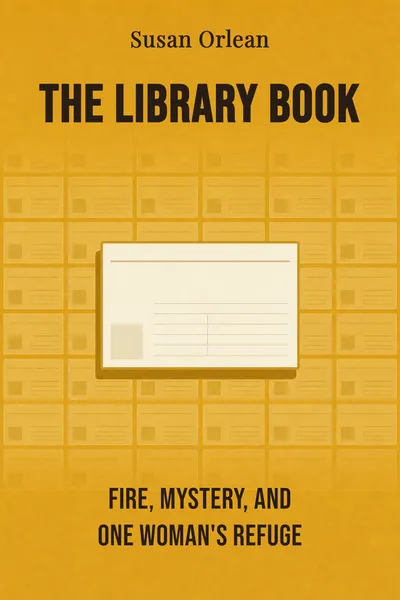
The Library Book
Fire, mystery, and one woman's refuge
Description
On the morning of April 29, 1986, a fire alarm went off at the Los Angeles Central Library and, as usual, nobody paid it much attention. Alarms went off there all the time. Staff started ushering readers toward the exits with the mild irritation of people doing a routine they assume is pointless. Then the smoke came, and it wasn't gray, it was black, and it was moving fast through the stacks. Within hours the fire had reached temperatures over 2,000 degrees. It burned for more than seven hours. When it was finally out, roughly 400,000 books were destroyed and another 700,000 were damaged by water and smoke — one of the worst library fires in American history.
And almost nobody remembers it. The fire happened the same week Chernobyl melted down, and the reactor in Ukraine swallowed the front pages whole. A catastrophe that gutted the largest public library west of the Mississippi barely registered outside Los Angeles. Decades later, the writer Susan Orlean moved to the city, took her young son to his neighborhood branch, and stumbled onto the story almost by accident. She had never heard of the fire. Once she learned it existed, she couldn't stop pulling the thread — and the thread led somewhere stranger than she expected.
Because the fire was ruled arson. Investigators decided someone had set it deliberately, and they settled on a suspect: a charming, unreliable aspiring actor named Harry Peak, who told so many different stories about where he'd been that day that the truth dissolved entirely. Orlean's book braids that unresolved crime together with the century-long life of the building itself, and with something more personal she wasn't quite expecting to write about.
The question we’re asking : Who burned the Los Angeles Central Library — and why does a place full of books matter enough that its loss feels like grief?What we’ll see : How a single unremembered fire opens onto a mystery, a city's memory, and one writer's quiet reckoning with what libraries hold.
Table of contents
01Chapter 1 — The morning everything burned
The Central Library was already a strange, beloved building by 1986 — a 1926 pile of pyramids and sphinxes and painted ceilings, crammed to bursting with books it had long outgrown. On the morning of the fire, it opened normally. Then the alarm sounded, staff cleared the floors, and what began as a nuisance turned into something no one on the scene had ever witnessed.
The blaze started deep in the stacks, in the northeast section where the fiction was shelved. Books, it turns out, are excellent fuel. The narrow steel shelving acted like a chimney, and the fire climbed. Firefighters described flames that were nearly colorless from the sheer heat — pale, almost invisible, ferocious. They couldn't simply flood the place, because water destroys books almost as thoroughly as fire does, so they fought it in a slow, agonizing grind. It took some 350 firefighters most of the day.

02Chapter 2 — The man who may or may not have done it
The suspect was Harry Peak. He was in his late twenties, good-looking in a way people kept mentioning, a would-be actor who worked odd jobs and told grand stories about the parts he was about to land and the celebrities he knew. He was, by every account, a compulsive and rather delightful liar — the kind of person who improved reality as he narrated it, not out of malice but out of a hunger to be interesting. Which, when you become the prime suspect in an arson case, is close to the worst possible personality to have.
Peak told friends several different accounts of where he'd been the day of the fire. In one, he was nowhere near the library. In another, he'd been inside and left just before it started. In another still, he practically hinted he'd done it. He seemed to relate to the fire the way he related to everything — as a story he could star in. Investigators found this deeply incriminating. A reader might find it merely tragic: a man so addicted to attention that he talked himself into the center of a crime that may never have been a crime at all.
03Chapter 3 — A building that kept reinventing itself
If the book stayed on Harry Peak it would be a decent true-crime read and nothing more. But Orlean keeps pulling back from the fire to tell the longer story of the institution itself, and that's where the book grows into something larger. The Los Angeles Public Library, she shows, has always been a stage for outsized, improbable people.
There's the extraordinary Charles Lummis, an early city librarian who once walked from Ohio to Los Angeles — on foot, for the publicity — and ran the place like a personal empire. There's Mary Jones, the librarian pushed out in the early 1900s in a bruising fight over whether a woman should hold the post, a conflict that says as much about the era as any fire. Orlean moves through a whole gallery of directors, eccentrics, and reformers, and through them she tells the story of the city growing up around its books.
04Chapter 4 — What a library is actually for
Step back from the fire and the suspect and you reach the question the whole book is really asking: why does the destruction of a library feel like a death and not a loss of property? Nobody grieves a burned-down warehouse the way people grieved these stacks. Orlean's answer, arrived at slowly, is that a public library isn't a storehouse of objects. It's a shared memory that a community agrees to keep together, in public, for free, on behalf of everyone including the people not yet born.
That's why the fire lands as something closer to erasure. When 400,000 books burn, what's gone isn't just paper; it's a piece of collective recall that no single person was carrying. Orlean is drawn to the idea that a book is a small stay against forgetting — that to write something down and shelve it where anyone can find it is a bet that the future will care. A library is thousands of those bets stacked together, held in trust by strangers.
05Conclusion
The crime never resolves. We leave Harry Peak roughly where Orlean found him — a charming, unreliable man who told too many stories, who may have set the largest library fire in American history or may simply have wanted to be the sort of person who could have. The investigation offered a villain; the evidence never quite delivered one; and the fire science that condemned him has aged into doubt. Orlean lets the uncertainty stand rather than manufacturing a solution she doesn't have.
Related books