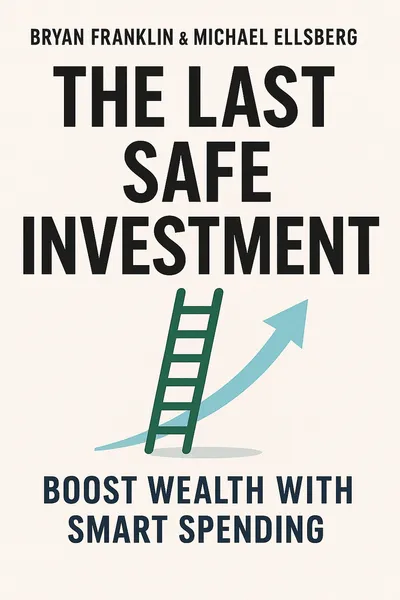
The last safe investment
Boost wealth with smart spending
Description
The conventional method of preparing for retirement, often referred to as "FACD" – Financial Advice Commonly Delivered, involves saving a significant portion of one's income and investing in unpredictable markets like stocks and real estate.
However, many find it challenging to save adequately, and the reliance on external market performance is risky. A more effective strategy is the "SAFE" approach – a Self-Amplifying Financial Ecosystem, which emphasizes investing in oneself. This involves enhancing one's career, controlling personal assets, and converting earnings into fulfilling life experiences, thereby increasing personal value and wealth over time.
Table of contents
01 Facd versus safe
When people offer financial guidance, they often emphasize the power of compound interest and suggest that by saving money now, such as forgoing a daily latte, you could afford a luxurious vacation upon retirement. This conventional financial wisdom, however, is not yielding the expected results for many. A more effective strategy is to invest in oneself through a Self-Amplifying Financial Ecosystem (SAFE), which is a more intelligent alternative.
The commonly dispensed financial advice has several flaws. A significant number of individuals have taken on debt to finance their education but are struggling to secure employment in their chosen fields. The burden of student loans in the United States has surpassed $1 trillion, with over a third of graduates falling behind on their loan repayments. The high cost of higher education is proving to be a financial catastrophe for many families.
Moreover, adhering to traditional financial advice often means investing in stocks, bonds, real estate, and other assets, effectively placing your financial destiny in the hands of others. If these investments underperform, your anticipated asset growth and future plans could be compromised, creating a strategic vulnerability.
Another issue with this advice is its reliance on willpower, expecting individuals to consistently do what they know is right, which is a rare discipline. Additionally, this approach is akin to a zero-sum game where one's financial gain is contingent on another's loss, a scenario that is not sustainable in the long run. As more people adopt this strategy, its effectiveness diminishes, making it increasingly difficult to realize gains.

02 Wealth building principles
The SAFE strategy advocates for cultivating three key disciplines to optimize the benefits derived from financial planning. This approach encourages mastering the art of systematic expenditure, making informed purchasing decisions that fulfill immediate needs and contribute positively to various interconnected aspects of life. Unlike conventional wisdom, which emphasizes saving as much as possible, SAFE promotes a more holistic view of spending to enhance life experiences across multiple domains.
In essence, there are six primary areas of life that most individuals value: health, relationships, financial stability, cultural engagement, the ability to provide value, and the pursuit of a meaningful legacy. Systematic spending requires a careful assessment of how each financial decision will benefit the intended area and its potential impact on the other five areas. By adopting this comprehensive approach, one becomes a systems engineer of their own life, strategically navigating financial choices with a broader perspective. This method transforms routine consumption into a form of investment.
For instance, consider the choice between spending $60 on a movie night with a partner versus organizing a documentary viewing with a group of industry professionals, followed by a discussion over pizza, also costing around $60. While the monetary outlay remains the same, the latter option represents an investment in social capital and intellectual engagement, rather than mere consumption.
Systematic spending challenges the traditional notion of investment as being limited to surplus funds after covering living expenses. It suggests that one's entire income should be viewed as investment potential. Paying rent, for example, is seen as an investment in securing a place to live for a month. This mindset shift allows individuals to recognize that they are investing their entire post-tax income year after year, not just the portion allocated to financial assets.
03 Key assets for wealth
Once you have mastered the three SAFE disciplines, your next step is to focus on developing the three genuine assets that are crucial for achieving true wealth. True wealth is not just about accumulating money; it's about having the ability to consistently create the external conditions you desire. These assets of true wealth continue to produce happiness even after you've stopped working. They are categorized into three types:
Traditionally, equity refers to partial ownership in something. This type of asset can be bought and sold, and its value remains unchanged as ownership transitions from one individual to another. However, adviser equity is distinct. It is personalized and unique to each individual. Adviser equity is where you contribute personally to someone else's career or business. This could involve giving advice, acting as a mentor, providing a sounding board, or simply being a friend, and they benefit financially from your advice. The impact you have determines the value of your adviser equity.
"Equity, or business ownership, may seem insignificant at the start of a company's journey, but it possesses the power to transcend the usual compensation boundaries, turning secretaries into millionaires and college dropouts into CEOs. If acquired before it becomes common or 'securitized' in the open markets—a process that diminishes its unique power—equity can facilitate your escape from traditional compensation structures. It offers the chance to be part of building something remarkable and to be rewarded based on the success of what has been built, rather than the effort involved in its construction." – Bryan Franklin and Michael Ellsberg
The allure of conceiving a new idea that evolves into a multi-billion-dollar product is strong, yet the SAFE plan does not necessitate such a feat. Instead, it encourages seeking opportunities to perform ordinary work in exchange for equity rather than fees or wages. This involves investing in your own skills and offering those skills to individuals who are likely to succeed in the future. As they succeed, you benefit from having equity in their ventures.
Conceptually, building adviser equity involves honing your personal abilities and skills until you excel in your field. Then, you identify businesses that could directly benefit from your skills. Instead of seeking employment or a consulting contract, you build relationships with the company's managers and owners. You offer to work for the company, providing valuable services in exchange for shares instead of fees.
Keep in mind a few key points: Your equity agreement can be formal or informal, with both types being equally effective. Emphasize that your contribution should be valued based on the impact you have on the business's future, seeking leverage where a small amount of timely advice leads to significant benefits. Diversify your investments, as it's better to own a small percentage in many companies than to own all of a failing one. Always be clear about the terms of your equity. For example, you might agree that when sales revenue hits $750,000 in any year, you receive a $25,000 check, or when the company acquires 10,000 paying subscribers, you get $5,000, or you receive 5 percent of all sales over $100,000.
Adviser equity can also enable you to enjoy a wealthy lifestyle before actually acquiring wealth. For instance, if you're skilled with motors and help a friend with their expensive ski boat, they might offer you unlimited use of the boat as thanks. This exchange, for a few hours of work, grants you access to a valuable asset without any financial investment, embodying a form of adviser equity. Although this type of equity is non-transferable, it's surprising how infrequently wealthy individuals utilize their luxury items. By adopting this approach, you can live a wealthy lifestyle without possessing wealth.
Additionally, keep an eye out for promising young individuals with bright futures. Offer to coach them in exchange for deferred or conditional adviser equity, explaining that you're willing to provide personal and professional career coaching for a small share of their future earnings. This can be an attractive proposition if you add value. However, it's essential to remember that the future is unpredictable, so it's wise to support a group of up-and-comers to increase your chances of success. The more formal or informal arrangements you have, the better your odds of having robust options available to you upon retirement.
Related books