The King's Two Bodies
The fiction that outlives the monarch
Description
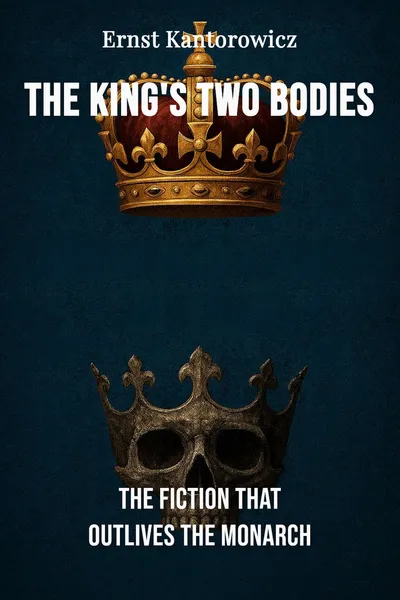
In February 1561, a group of English lawyers argued a dull-sounding land dispute before the courts, and in the process said something strange enough that it would still be read four centuries later. The case, known as the Duchy of Lancaster case, turned on whether a lease granted by the boy-king Edward VI was still valid after his death. To settle it, the Crown's lawyers reached for a distinction that sounds like metaphysics dressed as property law: the king, they said, has two bodies. One is a body natural, mortal, subject to infancy, illness and death like any other. The other is a body politic, invisible, ageless, incapable of error, and never dying.
That sentence is the seed of a book. In 1957 the German-born medievalist Ernst Kantorowicz, by then teaching in the United States after fleeing Nazi Germany, published a dense study called The King's Two Bodies, subtitled a study in medieval political theology. He took that odd Tudor courtroom formula and traced it backward through centuries of law, liturgy and theology, showing that it was not a lawyer's clever trick but the endpoint of a long effort to solve a genuinely hard problem: how can something as fragile as a single human being carry something as permanent as sovereignty?
The answer the Middle Ages built was a fiction — a deliberate, load-bearing lie that everyone agreed to treat as true. And fictions, once they work, tend to survive the thing they were invented to serve. The king is gone; the machinery he needed to explain his own permanence is still running. Kantorowicz followed that machinery from the coronation to the courtroom, and his book is really an account of how an idea outlasts the men it was made for.
The question we’re asking : How did medieval Europe convince itself that a mortal king could carry an immortal office, and what became of that idea once the kings were gone?What we’ll see : How a strange legal phrase was assembled out of theology, law and liturgy across five centuries — and where its logic quietly settled once the crown no longer needed it.
Table of contents
01Chapter 1 — The problem that killed no king
The problem Kantorowicz starts from is practical before it is philosophical. A kingdom is supposed to be continuous. Laws made under one ruler bind the next; debts owed to the crown do not vanish when the crown-wearer dies; the peace does not lapse between a king's last breath and his heir's first act. Yet every actual king is a person, and persons die, fall ill, go mad, or come to the throne as children who can barely sign their names. If sovereignty lived only in the man, then every death would be a legal earthquake, dissolving contracts and reopening every question the previous reign had closed.
The Tudor lawyers Kantorowicz quotes solved this by splitting the king in two. The body natural could be sick, underage, or dead. The body politic — the office itself — was perfect and perpetual, and it was mysteriously joined to the natural body while the king lived. Anything the king did in his political capacity was untouched by the defects of his mortal capacity. A grant made by a child-king was valid, because it was really the body politic that granted it, and the body politic is never a child. It is an audacious move: the law simply declares that the flaws of the human being do not reach the office he holds.

02Chapter 2 — How lawyers built a second body
The template was Christ. Medieval theology had long taught that Christ possessed two natures, human and divine, united in one person: the human nature could suffer and die on the cross while the divine nature remained impassible and eternal. Kantorowicz's central claim is that political thinkers spent centuries quietly transferring this Christological grammar onto secular rulers. What had been said of God incarnate came to be said of the king: two natures, one mortal and one enduring, mysteriously joined in a single figure. He calls the whole enterprise political theology precisely because its concepts are theological ones repurposed for the state.
The transfer happened in stages, and Kantorowicz maps them as shifting centers of gravity. There is an early, Christ-centered kingship, in which the ruler is holy because he images Christ, anointed like a priest. Then, as Roman law was rediscovered in the twelfth and thirteenth centuries, the sacred vocabulary migrates toward the law itself: the king becomes the living law, and later the servant of a law figured as almost divine. The jurists, working alongside and sometimes against the theologians, built an apparatus in which abstractions — the fisc, the crown, the realm — acquired a permanence no living person had.
03Chapter 3 — The corporation that never dies
That other idea was the corporation. Medieval canon and civil lawyers had developed a sophisticated theory of the corporate person — a group or institution treated in law as a single entity distinct from its members. A cathedral chapter, a university, a guild, a monastery: each could own property, sue, and be sued, and each persisted while its individual members came and went. Members died; the corporation did not. Kantorowicz shows that this legal creature, invented to handle churches and colleges, became the decisive tool for thinking about the king.
The insight was to treat the king as a corporation — but a peculiar one, a corporation with a single member at a time. The office is the enduring entity; each successive king is merely the current occupant, the way each generation of monks is the current expression of the abbey. When the man dies, the corporation does not; it simply awaits its next incumbent. This is what finally licenses the famous formula that Kantorowicz places at the heart of the story: the king is dead, long live the king. The sentence is only paradoxical if you think there is one king. There are two things — the mortal man who has died, and the undying office that has already passed, without interruption, to the next body.
04Chapter 4 — The body that became the state
Step back and the deep move of Kantorowicz's book comes into view: he is describing how sacred permanence was engineered into secular institutions, and that engineering long outlives the sacred part. The two-bodies fiction was assembled to explain the king. But what it actually produced was a general technique for making abstractions immortal — the crown, the fisc, the realm — and those abstractions did not need a king to survive. Strip away the anointed man in the middle and you are left with an enduring public entity, perpetual and impersonal, capable of holding rights across the deaths of everyone who ever served it.
That entity is what we now call the state. When we say the government owes a debt, or that the state cannot die, or that a treaty signed generations ago still binds, we are speaking the grammar Kantorowicz excavated. The modern state is a body politic that has finally shed its body natural: no single person embodies it, but the fiction of its perpetual personhood, its capacity to act, contract and endure beyond any individual, runs straight out of the medieval king's undying second self. The revolutions that removed the monarchs did not remove the concept; they moved it from the crown to the constitution, from the king's office to the office itself.
05Conclusion
The Tudor lawyers who argued over Edward VI's lease thought they were tidying up an inheritance dispute. What they were actually voicing was the last, secularized stage of a concept built over five centuries out of Christ's two natures, Roman law, the sanctified crown, and the never-dying corporation. Kantorowicz's achievement was to reassemble that genealogy and show that the king's second body was never a lawyer's flourish. It was load-bearing — the thing that let a fragile line of mortal men carry an office that could not be allowed to die with any of them.
Related books