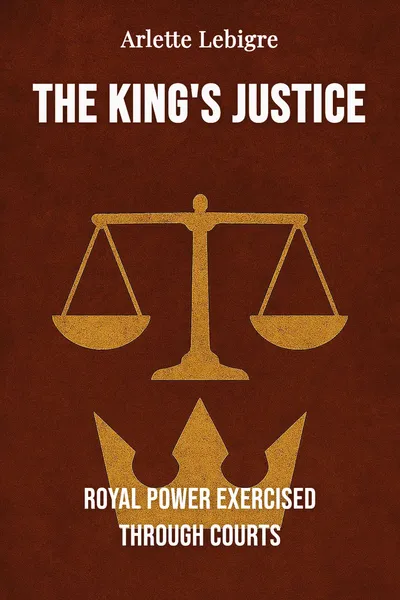
The King's Justice
Royal power exercised through courts
Description
In the France of the Middle Ages, a peasant robbed on a forest road or a widow cheated of her land did not, at first, expect the king to do anything about it. Justice was local, personal, and scattered. A lord judged his tenants, an abbey judged the men on its lands, a town judged its own. The king was one power among many, and often not the nearest one. When Arlette Lebigre traces the long story of royal justice, she begins from this fragmentation — a kingdom where the right to judge was carved up like farmland, held and inherited and sometimes sold, and where the crown's writ ran little further than its own domain.
And yet, over several centuries, that same crown made itself the source of all justice in the realm. Not by winning a single battle or passing a single law, but by patiently insisting that every sentence handed down anywhere was, in the last resort, handed down in the king's name. The lord who judged did so because the king let him. The appeal that overturned him rose to the king. Slowly, the courtroom became the place where royal power was felt most directly by ordinary people — more constant than the army, more intimate than taxes.
Lebigre's book follows how a diffuse, borrowed authority became the crown's single most effective tool for governing a country it could not otherwise reach. Justice, in her account, is not a soft counterweight to power. It is power itself, dressed in robes and speaking Latin, extending the king's hand into places no soldier could go.
The question we’re asking : How did the right to judge become the instrument through which French kings actually ruled?What we’ll see : How a scattered, feudal authority was gathered into the crown's hands and hardened into a permanent apparatus of law.
Table of contents
01Chapter 1 — Justice belongs to the king
The claim that anchors everything came before the reality could support it. In the coronation ceremony, the king was anointed and charged with a sacred duty: to defend the Church, protect the weak, and render justice. This was not a metaphor. To be king was, above all, to be a judge — the figure who set right what had gone wrong, who stood between the strong and those they might crush. Lebigre insists on how early and how deeply this idea took root. Long before the crown had the means to judge the whole kingdom, it had the theory that judging the whole kingdom was its business.
The image that carried this idea across the centuries is the one of Saint Louis under the oak at Vincennes, hearing his subjects' complaints in person, without intermediaries. Whether the scenes happened exactly as the chroniclers described matters less than what they meant. The king was supposed to be reachable, the last recourse for anyone wronged, the ear that no lord could close. Justice flowed downward from the sacred person of the monarch, and in principle it could always flow back up to him.

02Chapter 2 — Retaking what the lords had taken
The method was not conquest but appeal. If all justice belonged to the king, then a subject dissatisfied with his lord's court could, in principle, ask a higher court — a royal court — to look again. Each appeal was a small assertion of the crown's superiority: it said that the lord's word was not final, that above him sat the king. Lebigre shows how this modest procedural device became a solvent that dissolved feudal independence one case at a time. A lord who lost jurisdiction over a single appeal lost a little of what made him a lord.
The crown reinforced the pull with the notion of cas royaux — categories of offense reserved to the king's courts alone. Crimes that touched the security of the realm, counterfeiting the coin, treason, offenses against royal officers: these could not be judged locally at all. The list was elastic, and it grew. Each addition pulled another slice of authority out of noble hands and into royal ones, and there was no principled place for the expansion to stop.
03Chapter 3 — The judge who never leaves his desk
The oak at Vincennes could not survive the growth it inspired. A king who judged in person could handle a handful of cases; a king whose courts covered the realm needed a body of men to judge in his place. Out of the royal council emerged the Parlement, the sovereign court that ruled in the king's name without the king being present. Lebigre marks this as a decisive turn: royal justice ceased to be the act of a person and became the work of an institution. The king remained its source, but professionals now did the judging.
These professionals were a new kind of man. Not warriors and not, at first, great nobles, but jurists — trained in Roman law, fluent in the Latin of the courts, promoted for competence rather than birth. They formed a milieu with its own learning, its own pride, its own sense of belonging to the crown's service. Lebigre pays close attention to them, because they are the ones who turned the king's abstract right to judge into a daily, grinding reality of registers, procedures, and precedents. Justice became paperwork, and paperwork endures.
04Chapter 4 — A machine that outgrew its maker
Here Lebigre's account opens onto something larger than courtrooms. The apparatus the crown built to project its power did not stay a mere tool in the royal hand. Officers, courts, registers, and jurists multiplied until they formed a body with weight and momentum of its own — an administration that continued to function whether the king was strong or weak, watchful or distracted. What began as the extension of a person's will became a structure that no longer needed that person to keep running.
This is how the pursuit of justice quietly built the state. To judge the whole kingdom, the crown needed men everywhere, records of everything, revenue to pay for it all — and fines, confiscations, and the sale of offices supplied that revenue. Justice was never only about righting wrongs; it was a source of income and a network of loyal servants spread across the land. The courtroom turned out to be the crown's most efficient instrument of government precisely because it generated the money and the personnel that governing required.
05Conclusion
The story runs from a king who was supposed to judge under a tree to a kingdom governed by courts he could no longer fully control. Between the two lies the patient work Lebigre describes: the claim that all justice belonged to the crown, the appeals and reserved cases that drew authority upward, the officers sent into the provinces, and the jurists who made the whole thing turn day after day. Justice was not the gentle face of royal power. It was its cutting edge, the means by which a distant king reached into ordinary lives.
Related books