The Jaws Log
How Spielberg made a masterpiece
Description
In the spring of 1974, a screenwriter and actor named Carl Gottlieb boarded a ferry to Martha's Vineyard to do a rewrite on a shark movie nobody expected much from. He had a friend directing it — a twenty-six-year-old named Steven Spielberg — and a loose arrangement to punch up dialogue. He ended up staying the whole shoot, cast in a small role as the town editor, rewriting pages at night, and watching from the inside as a production came apart at the seams. When it was over, he wrote it all down. The book he produced, published in 1975, is called The Jaws Log, and it remains the only first-hand account of how the film actually got made.
That distinction matters more than it sounds. Jaws would go on to win three Academy Awards, become the highest-grossing film ever made to that point, and invent the summer blockbuster as a category. The finished movie is so assured, so precisely built, that it looks inevitable — as if Spielberg had seen the whole thing in his head and simply pointed the camera. Gottlieb was there for the version where nothing worked. The mechanical shark sank. The schedule tripled. The script arrived in fragments. The film we treat as a masterpiece of control was assembled, day by day, out of near-disaster.
What The Jaws Log preserves is the gap between those two things — the polished result and the chaotic making. Gottlieb wasn't a critic looking back or a journalist reconstructing from interviews. He was a participant with a notebook, close enough to the director to catch the decisions as they happened, far enough from the studio to say what a press release never would.
The question we’re asking : How did a broken, over-budget, half-improvised shoot on Martha's Vineyard turn into the film that reset Hollywood — and what does the man who was there tell us about it?What we’ll see : An insider's diary of a production that nearly collapsed, and how one director's response to the collapse became the making of a classic.
Table of contents
01Chapter 1 — The insider with a notebook
Carl Gottlieb came to Jaws sideways. He was a working writer and comic actor, part of the loose circle of young television people around Los Angeles in the early 1970s, and he knew Spielberg socially before he knew him professionally. When Universal put the film into production off Peter Benchley's 1974 bestseller, the script had already passed through several hands, including Benchley's own drafts and a pass by the playwright Howard Sackler. Spielberg wanted his friend on the island to keep working the pages while the cameras rolled. Gottlieb took a small acting part as Meadows, the local newspaper editor, which gave him a reason to be on set every day.
That double position — writer at night, minor cast member by day, friend of the director throughout — is what makes the book unusual. Gottlieb wasn't reporting from a press tent. He was in the rooms where the movie was being salvaged, eating dinner with Spielberg and Richard Dreyfuss and Roy Scheider, close enough to hear how the decisions got made and why. When he writes about the script, he's describing pages he helped write. When he writes about a scene falling apart, he was often standing in it.

02Chapter 2 — A movie shot before it was written
The single fact that runs through Gottlieb's account, and that most viewers of the finished film never suspect, is that Jaws went into production without a finished screenplay. Benchley's novel had subplots that everyone agreed didn't belong in the movie — an affair between the police chief's wife and the biologist, a mafia thread — and cutting them left holes that had to be filled while shooting was already underway. Pages were being rewritten the night before they were filmed, sometimes the morning of. Gottlieb describes evenings of writing and rewriting with Spielberg, testing lines, throwing out whole scenes that the day's weather or the day's broken equipment had made impossible.
03Chapter 3 — The shark that refused to work
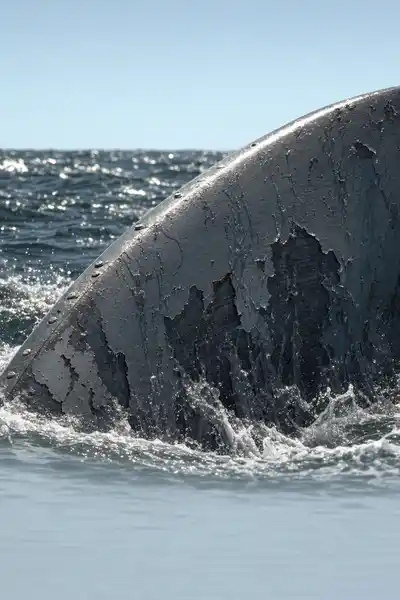
The mechanical shark is the villain of Gottlieb's book in a way it never quite is in the film. Three pneumatic sharks were built — the crew nicknamed the rig Bruce — and they had been tested in a Hollywood tank, never in the open Atlantic. The salt water went to work on them immediately. Hydraulics corroded, electronics flooded, the skin swelled and peeled, and the whole apparatus that the entire production had been designed around turned out to be, for long stretches, unusable. Gottlieb records the daily grind of it: hours lost waiting for the shark to be dry-tested, scenes abandoned, morale sinking with the machine.
The decision to shoot on the real ocean rather than in a controlled tank compounded everything. Boats drifted out of frame. Sailboats wandered into the background of shots. The water changed color and light hour to hour, which meant footage that didn't cut together. A schedule budgeted for around fifty-five days ran to roughly a hundred and fifty-nine. The costs roughly doubled. On the island the film had picked up a grim nickname — people were calling it "Flaws" — and Gottlieb doesn't hide how close the whole thing came to being shut down.
04Chapter 4 — The book that saw the machine being built
Step back from the shoot and The Jaws Log becomes something larger than the story of one film — it becomes a rare document of what a movie is before it is finished. The version of Jaws that entered the culture is a monument: three Oscars, a record-breaking summer, the birth of the modern blockbuster. Monuments erase their own construction. They present themselves as having always existed in their final form. Gottlieb's book exists precisely to hold open the door on the scaffolding before it came down.
That is why it reads differently from the making-of features and anniversary retrospectives that came later. Those are assembled in hindsight, by people who know the ending, and hindsight smooths everything into destiny — of course Spielberg withheld the shark, of course the score was genius, of course it worked. Gottlieb was writing without knowing the ending. In his pages the withholding is a scramble, the delays are terrifying, and nobody on the boat is sure they aren't making a flop. He preserves the contingency that success later hides.
05Conclusion
The shoot that Carl Gottlieb chronicled ended in October 1974, months late and roughly twice over budget, with most of the people on the island still bracing for failure. When Jaws opened the following June, it did the opposite of failing so completely that it rewrote the economics of an entire industry. Gottlieb had already turned in his book by then, which means The Jaws Log describes a masterpiece nobody yet knew was one — the last honest account before the legend closed over the facts.
Related books