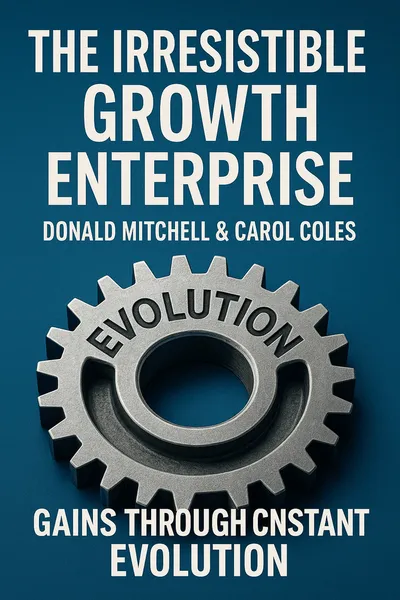
The irresistible growth enterprise
Gains through constant evolution
Description
Occasionally, powerful forces emerge that fundamentally change the business landscape. While many companies struggle to maintain the status quo against these forces, the most successful ones adapt their strategies to leverage these changes, achieving breakthrough improvements in performance.
The primary obstacle to harnessing these forces is often the organization's entrenched mindset towards change. To overcome this, a two-phase approach is needed: First, recognize why companies resist change instead of embracing it, as traditional thinking can block progress.
Second, establish new practices that align the organization with these forces for optimal benefit, involving a continuous eight-step process for sustained growth. Organizations that consistently adapt to these forces become leaders in their fields, ready to thrive regardless of future challenges.
Table of contents
01 Stage 1: understanding organizational resistance
Every business entity is embedded with certain habitual behaviors and thought processes that may become barriers to enhanced performance when confronted with new, overpowering trends. The most effective organizations are perpetually vigilant to ensure these ingrained patterns do not obstruct their capacity to adapt and innovate in the face of such emerging forces.
To set the stage, it's essential to clarify a few concepts: An "irresistible force" refers to a potent trend that can significantly sway the trajectory of a business. It's an external factor that, while beyond direct control, exerts a tangible influence on a company's success.
A "stall" represents a complacent mindset that presumes the current state of affairs will persist indefinitely. Businesses fall into a stall when they base their strategies on the assumption that the status quo will remain unchanged.
"Stallbusting" is the act of challenging conventional thinking and the established ways of doing things.
A "2,000 percent solution" signifies a revolutionary approach to a business process that is twenty times more effective than the traditional method. This could mean a process that is twenty times faster, more efficient, or longer-lasting.
An "irresistible growth enterprise" is an organization that not only aims to survive in the market but to expand exponentially. Such growth is achieved by devising and implementing one or more 2,000 percent solutions. By aligning with the direction of an irresistible force, these enterprises experience substantial growth. Many of the world's most valuable companies are irresistible growth enterprises that have consistently and accurately aligned with strong, enduring commercial forces.
When faced with a new irresistible force, businesses often react emotionally rather than logically, attempting to delay the impact of change rather than realigning to capitalize on the new opportunities presented by the force.
The eight most common stalls are:
This occurs when a company pursues a goal only to discover an irresistible force is pulling it in a completely different direction, leading to a state of inaction while management decides whether to embrace this new path. To overcome this stall and regain momentum, it's crucial to answer pivotal questions:
What are the foundational values of this organization? Are our current operations in harmony with these values, and if not, what's the reason? What scenarios can we envision that would restore productive activity?
By recognizing the irresistible force as a crosswind, managers can realign their organizations with their core values, considering the influence of the irresistible force.
Many businesses operate under the illusion that the future is predictable with high precision. Over time, they may continue to act as if their initial assumptions were correct, failing to adjust their actions to reflect actual developments. This is akin to navigating with an outdated map.
To navigate past this stall, organizations must ponder thought-provoking questions:
What actions should we take if we encounter setbacks instead of the expected successes? How can we involve independent parties to review our business plans? How can we incorporate real-world feedback into our planning processes? What are the underlying causes of the current irresistible forces, and what can we expect in terms of their duration and direction? How can we limit our future commitments and create better contingency plans to quickly pivot if necessary?
Businesses succumb to the wishful thinking stall when they assume the future can be forecasted with certainty. Introducing ambiguity and flexibility into planning and developing contingency plans is an acknowledgment of the unpredictable nature of the future. It's also vital to reduce risks, seek independent perspectives, and maintain a focus on external business conditions.

02 Stage 2: habit formation for realignment
To experience significant growth, merely avoiding conflict with an unstoppable force is not sufficient. Businesses must continuously adapt to these forces, abandoning old habits for new, more efficient ones. An eight-step method has been developed to foster new business habits that align with and leverage emerging unstoppable forces.
Continual environmental assessment is crucial for businesses aiming to successfully navigate unstoppable forces. Recognizing these forces requires a habit of monitoring and measuring everything with real-time feedback. Businesses should establish a baseline of meaningful metrics that include customer feedback on products and services, supplier insights on demand for alternatives, competitor actions, operations of international partners, potential changes in government regulations, and information from peer companies or local business communities.
The critical inquiries for a business involve identifying the unstoppable forces affecting the company and its stakeholders, understanding these forces, recognizing signs of their increasing or decreasing strength and impact, comparing the actual impact of these forces against initial perceptions, and determining how this discrepancy should influence future analysis of unstoppable forces.
The initial step aims to enhance organizational awareness of available measurements, laying the groundwork for the development of more precise and focused measures. The ultimate goal of measurement is to improve anticipation of future conditions, enabling businesses to position themselves advantageously.
Leading indicators, akin to economic barometers, predict future trends. They are crucial for learning to make better decisions, preparing in advance, planning efficient resource allocation, and uncovering new cause-and-effect relationships. To develop unique sets of leading indicators, businesses should consider common public indicators, discover proprietary indicators invisible to competitors, identify consistent patterns in data and company performance, understand the time lag between indicator changes and business environment changes, assess the variability of these time lags, determine the necessary advance warning from indicators, and explore ways to enhance the indicators and reduce response time to them.
Related books