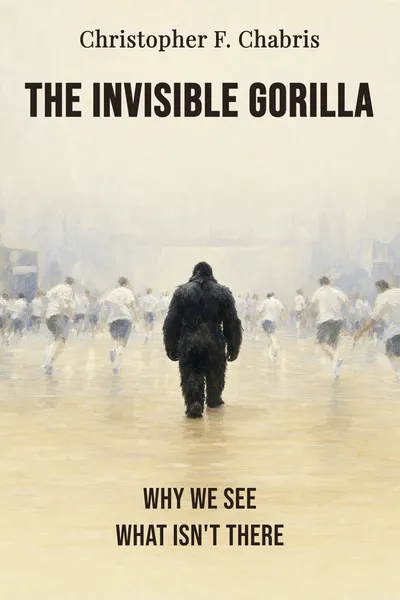
The Invisible Gorilla
Why we see what isn't there
Description
In the late 1990s, two psychologists at Harvard filmed a short, deliberately amateurish video. Two teams, one in white shirts and one in black, weave around each other passing basketballs. The instructions are simple: count how many times the players in white pass the ball. Halfway through, a woman in a full gorilla suit strolls into the middle of the frame, faces the camera, thumps her chest, and walks off. She is on screen for a full nine seconds. When the video ends and people report their count, they are then asked a second question: did you notice the gorilla? About half say no. Not "I wasn't sure." No gorilla at all.
The experiment, run by Christopher Chabris and Daniel Simons and published in 1999, became one of the most famous demonstrations in the history of psychology. It is funny, it is repeatable, and it lands the same way every time — the people who miss the gorilla are certain, until the replay, that nothing unusual happened. What makes it more than a party trick is the claim Chabris and Simons build on top of it in their 2010 book. The gorilla is not an oddity of one dumb video. It is a small, clean model of how the mind works all the time.
We walk around convinced that we see the world as it is, that our memories are recordings, that confidence signals competence and that our brains can be tuned up like an engine. Chabris and Simons spent years assembling the evidence that each of those convictions is, in a specific and measurable way, wrong. Their subject is not stupidity. It is the confident, well-functioning mind of a normal adult, and the systematic gap between what it thinks it is doing and what it is actually doing.
The question we’re asking : Why are we so sure we see, remember and understand the world accurately, when the evidence says we constantly miss what is right in front of us?What we’ll see : How a suit-wearing gorilla exposed a whole family of everyday illusions, and why the feeling of being right is the least reliable guide we have.
Table of contents
01Chapter 1 — The gorilla nobody saw
The basketball video demonstrates what the two researchers call the illusion of attention: the belief that we notice whatever is important or unexpected in front of us. In reality, when we focus our attention on one thing, we go effectively blind to a great deal of everything else. The gorilla is visible, large, moving, doing something absurd — and roughly half the viewers who are busy counting passes never register it. The counting isn't the problem. Any demanding task will do it. Attention is a spotlight, and outside the beam, the world goes surprisingly dark.
What unsettled Chabris and Simons was not the missing half. It was the reaction of the people who missed. Told a gorilla had been there, they didn't say "I must have overlooked it." They refused to believe it, insisting the researchers had swapped the tape. The illusion isn't just that we miss things; it's that we have no sense we might be missing anything at all. We feel like we're taking in a rich, continuous picture of our surroundings, when we're really sampling a thin slice and filling in the rest.

02Chapter 2 — The memory that never happened
If attention feels like a wide-angle lens, memory feels like a recording. We experience our vivid memories as replays, faithful down to the detail, especially the emotionally charged ones. Chabris and Simons call this the illusion of memory, and it may be the most disorienting of the set, because it strikes at the events we are surest about. Ask people where they were when they heard about a national shock — the Challenger explosion, the attacks of September 11 — and they will describe the scene with total conviction. Researchers who collected those accounts within a day, then again years later, found the two versions frequently diverged, sometimes wildly. The confidence never wavered. Only the details changed.
03Chapter 3 — The confidence trap
The third illusion is the one that greases all the others: the illusion of confidence. We read confidence — in ourselves and in other people — as a reliable sign of competence and accuracy. The person who speaks without hedging, who remembers without doubt, who acts without hesitation, seems to know. Chabris and Simons show that the link is far weaker than we assume, and that confidence and skill can even run in opposite directions.
Some of the sharpest evidence concerns people who don't know how little they know. Those who perform worst on tests of reasoning, grammar or humor tend to overrate themselves the most, because the very competence needed to do the task well is the competence needed to judge how well you did. Meanwhile, real experts often hedge, because they can see the edges of their own knowledge. The result is a social world where the loudest, surest voice frequently belongs to the least qualified, and we mistake the volume for the signal.
04Chapter 4 — Six illusions, one blind spot
Attention, memory and confidence are three of the six everyday illusions the book catalogs; the others concern knowledge, cause and potential. We overrate how deeply we understand things we use daily — most people can't actually explain how a zipper or a toilet works, yet feel they could until asked. We see causes where there are only patterns, which is how a discredited claim linking vaccines to autism could take hold and help childhood diseases like measles stage a comeback. And we're seduced by the illusion of potential — the promise that listening to Mozart or playing brain-training games unlocks dormant mental power, a promise the evidence does not support.
What Chabris and Simons are really after is the thing underneath all six. Each illusion is a specific instance of a single mismatch: the mind we believe we have is not the mind we actually operate. We think we see comprehensively, remember faithfully, know deeply, judge confidence accurately, read causes correctly, and can upgrade ourselves easily. On every count, the intuition overstates the reality. And crucially, the illusions are invisible from the inside. Nothing about missing the gorilla feels like missing anything. That's what makes them illusions rather than mere errors — they come with a built-in sense that everything is fine.
05Conclusion
The gorilla works because it is a clean, undeniable proof staged in nine seconds: you were sure you'd have seen it, and you didn't. Everything else in the book radiates out from that small humiliation. The Boston officer who ran past the beating, the flawless-seeming 9/11 memories that quietly rewrote themselves, the confident investor and the confident witness, the vaccine scare built on a phantom cause — each is a version of counting passes while something large walks through the frame.
Related books