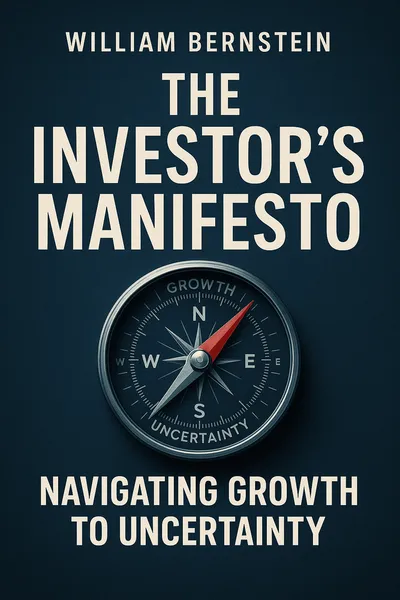
The investors manifesto
Navigating growth to uncertainty
Description
The 2008-2009 financial crisis has fundamentally altered the investment landscape for the long term. Counterintuitively, this turmoil has created major buying opportunities for disciplined investors as battered stocks and bonds eventually recover. Those with courage, patience and liquidity stand to reap significant returns. Retirement savers face particular challenges, as traditional pensions are increasingly replaced by complex, expensive and poorly performing defined-contribution plans.
The average investor lacks the expertise and temperament to execute competent lifetime financial planning. However, by mastering key skills like asset allocation, rebalancing, tax efficiency and reasonable expectations, individuals can avoid becoming victims of this looming crisis. Regularly reviewing basic investment principles provides a framework for sound decision making when markets inevitably fluctuate.
Table of contents
01Greed blinds investors to risk and return
Investing inherently involves a tradeoff between risk and return. Prior to the 2009 market downturn, many investors lost sight of this key relationship, falsely assuming markets would only continue rising. The harsh reality of losses imposed itself, demonstrating that greater potential returns necessarily entail higher risks - especially during periods of fear like the present. However, for savvy investors aware of the risks, volatile times also present opportunities, provided one knows what they are doing.
As investor William Bernstein noted, emotions often undermine sound financial decisions, whereas cool reason preserves capital. The primal urge for excitement leads many to speculation when most returns come from boring allocations across diverse markets. Segregating a small portion of a portfolio for entertainment purposes may satisfy this urge without jeopardizing one's nest egg. But excitement in finance is generally antithetical to prudent growth.
At its core, investing serves two logical aims: funding retirement or pursuing outsized gains. These divergent goals demand different strategies. Retirement portfolios favor conservative assets like bonds to preserve capital. Speculative portfolios contain riskier bets with chance of windfall returns. Neither precludes losses, but the risks and outcomes differ substantially.

02Diversify broadly for protection from ignorance
Picking stocks that outperform the market over the long run is extremely difficult, even for professional investors. Numerous studies have shown that most actively managed mutual funds fail to match the returns of low-cost, passively managed index funds over 10-15 year periods. This applies to both institutional and individual investors. While some fund managers may have short-term success due to luck, very few are able to consistently beat the market throughout their careers.
So, what does it take for an individual investor to succeed in the long run? There are four key requirements: 1. Genuine interest in the investing process: You need to enjoy poring over financial statements, analyzing economic trends, and deciding which companies to invest in. Most people find finance about as enjoyable as a trip to the dentist. 2. Math and statistics skills: Investing requires numeracy - the ability to work with numbers, understand relationships between variables, and calculate probabilities. A gut feeling for investments is not enough. 3. Understanding financial history and investor psychology: Knowing about historical bubbles, manias, panics, and crashes will help you recognize when human emotions are driving asset prices too high or too low. 4. Emotional discipline: You need to stick to your planned investment strategy no matter what. This means ignoring sensationalist news headlines, not getting caught up in the latest hot stock tip, and staying the course during market declines.
03The industry targets your wealth as its own
The financial services industry is fraught with conflicts of interest that can negatively impact retail investors. Investment banks face inherent conflicts between their research and underwriting functions. Auditors who also provide consulting services may be biased in their assessments. Credit rating agencies that advise the companies they rate encounter dilemmas in providing objective analyses. Banks that combine commercial and investment services struggle to balance different priorities. While conflicts exist across finance, their presence alone does not guarantee misconduct. However, history provides many examples of financial institutions failing to manage competing interests fairly. This can undermine public trust and market efficiency. Strong governance and aligned incentives are crucial to navigating these hazards responsibly.
Several factors make eliminating conflicts challenging. Financial institutions seek synergies from combining complementary business lines. But consolidation can foster competing agendas between divisions. Firms try limiting internal conflicts via compensation structures or information barriers. But solutions have proven imperfect and incentives remain misaligned in some cases. Conflicts also emerge from the nature of financial information itself. Investors could spend significant resources analyzing investment quality and manager behavior. However, others can free-ride off this work, disincentivizing further expenditures. And gathering information entails large fixed costs, making it more efficient for specialist institutions to shoulder this burden. Consequently, investors delegate screening and monitoring to intermediaries like research analysts and credit rating agencies.
04Weird things happen – know market history well
Financial markets have a long and storied history filled with booms, busts, manias, panics, and unexpected events. As an investor, it is important to study this history to better navigate turbulent and irrational market conditions. Strange things can happen in financial markets that can completely change previously successful strategies. The best approach is to take a long-term view and recognize familiar patterns from the past. Use your knowledge of financial history to avoid getting caught up in temporary madness and stay focused on your long-term goals.
Understanding financial history provides useful context for the theories and models economists use today. Some key events include companies needing external capital and obtaining it through loans or selling equity. Loans and bonds offer fixed interest rates and legal recourse if payments are missed, while equity is riskier and demands higher returns. During times of upheaval, both stock and bond prices can experience dramatic declines, setting the stage for higher future returns. However, losses can sometimes be permanent. Irrational market bubbles periodically emerge, such as the nifty fifty bubble in the 1970s and the dot com bubble in the 1990s. These bubbles inevitably burst as markets correct.
05Portfolio design and management determine returns
The primary decision an investor makes is determining the allocation of investment capital between stocks and bonds. This allocation sets the risk-return profile for the portfolio. Predicting which asset classes will outperform is impossible, so diversification is key. What matters is not the performance of individual assets but rather the overall portfolio return. The allocation should align with one's age and risk tolerance.
Before constructing a portfolio, keep several points in mind. Firstly, cultivate the habit of saving before investing. Investing involves deferring current spending for future returns. Thus, develop lifelong saving habits as the foundation for investing. Assume you can never save enough. Secondly, build an emergency fund covering six months of living expenses before investing, for contingencies like job loss or illness. Keep this in an interest-bearing account allowing penalty-free withdrawals. Also set aside any planned near-term expenditures like a house down payment in safe assets like certificates of deposit, avoiding equities with price fluctuations. Thirdly, diversify from the start, rather than waiting for a large portfolio. Diversify as much as possible in all investments. Fourthly, companies fail frequently through mergers, spin-offs or closures. Maintain a broad portfolio for true diversification over an investing lifetime. Finally, while winners are ideal, losers and failures occur. Focus on overall portfolio returns rather than individual assets. Overconfidence is the worst enemy, with financial markets largely random. Do not imagine predictive abilities. Design allocations based firmly on age and risk tolerance.
Related books