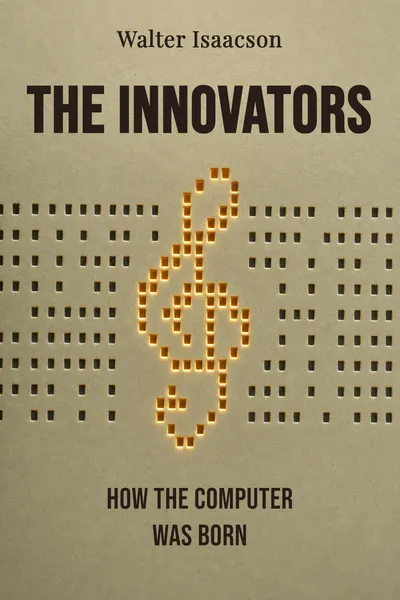
The Innovators
How the computer was born
Description
In 1843, a twenty-seven-year-old Englishwoman named Ada Lovelace sat down to translate a French article about a machine that did not yet exist. The machine was Charles Babbage's Analytical Engine, a proposed contraption of brass gears and punch cards that Babbage never managed to build. Lovelace's translation ran to a few pages. Her own footnotes, appended at the end, ran to more than three times the length of the original. Buried in those notes was a sequence of operations for calculating Bernoulli numbers — what many now call the first published algorithm meant for a machine — and a stranger, wilder idea: that a device built to crunch numbers might one day manipulate anything that could be written as symbols. Music. Words. Images. She saw a calculator and imagined a computer.
This is where Walter Isaacson chooses to start The Innovators, his 2014 history of how the computer and the internet were built. It is a deliberate choice. The obvious version of this story stars a handful of famous men — a garage, a eureka moment, a founder on a stage. Isaacson tells a different one. His book is populated by mathematicians, engineers, tinkerers, code-breakers, hobbyists and executives, spread across a century and a half, most of whom needed each other to get anywhere at all. The through-line is not a single invention. It is a way of inventing.
Isaacson had just come off his blockbuster biography of Steve Jobs, a book about one towering figure. The Innovators reads almost like a rebuttal to the genre that made him famous. Instead of one life, dozens. Instead of the myth of the lone visionary, a long argument about collaboration — about what happens when the person who dreams and the person who builds are forced into the same room.
The question we’re asking : How did the computer and the internet actually get built — and who really deserves the credit?What we’ll see : A century-and-a-half relay of dreamers and engineers, from a Victorian countess to a Silicon Valley garage, and the pattern that connects them all.
Table of contents
01 Chapter 1 — The countess who saw the machine could sing
Ada Lovelace is where Isaacson plants his flag, and it is worth understanding why. She was the daughter of Lord Byron, the Romantic poet, though her mother steered her hard toward mathematics precisely to keep the poet's supposed madness at bay. What she ended up with was both: a mind that could follow Babbage's gearwork and a temperament that could ask what the gears were really for. She called her own approach poetical science, and it is exactly the hybrid Isaacson keeps returning to across the whole book.
Babbage was the engineer's engineer, obsessed with his Difference Engine and then his more ambitious Analytical Engine, a general-purpose calculating machine driven by punched cards borrowed from the Jacquard loom that wove patterned silk. He saw a very powerful number-cruncher. Lovelace, reading his plans, saw further. In her notes she argued that if the machine could be fed symbols and rules, it need not be limited to quantities at all — it could in principle compose elaborate music or manipulate any content that followed logical relations.

02 Chapter 2 — No lone genius, only good teams
If Lovelace supplies the vision, the middle of the book supplies the correction to how we usually tell invention stories. Isaacson is almost stubborn about it. Again and again he takes a moment we've been taught to attribute to one hero and shows a team, an argument, a borrowing, a handoff. The digital age, he insists, was not conjured by solitary geniuses in flashes of insight. It was assembled by collaborators, over decades, each building on the last.
Take the transistor, the tiny switch at the heart of every modern device. It came out of Bell Labs in 1947, and it is usually filed under the name William Shockley. But Isaacson shows that the actual working device was built by John Bardeen and Walter Brattain, and that Shockley's controlling behavior later helped drive his own best people away. Bell Labs mattered as much as any individual — a place designed so theorists and experimentalists and even telephone-pole engineers ate lunch together, so that ideas could cross the gap between the person who imagined a thing and the person who could make it real.
03 Chapter 3 — The war that turned math into hardware
The dormant ideas of Lovelace and Babbage were finally forced into metal by the pressures of the twentieth century — and above all by war. Isaacson gives real weight to the machines built in the 1940s to compute artillery tables and to break enemy codes. Necessity, funding and urgency did what a century of leisurely theorizing had not: they turned the abstract dream of a programmable machine into humming rooms of vacuum tubes.
At the center stands Alan Turing, the British mathematician who in 1936 had defined, on paper, a universal machine that could in principle compute anything computable. During the war Turing helped crack German codes at Bletchley Park, work that fed the development of code-breaking machines and demonstrated what electronic computation could do under real stakes. His theoretical model and his practical war work bracket the whole transition from idea to instrument.
04 Chapter 4 — The digital revolution was a relay race
Step back from the individual episodes and Isaacson's larger argument comes into focus. The computer and the internet were not invented; they were accumulated. His preferred image is a relay race, a baton passed across generations — from Lovelace's notes to Turing's proof to Bell Labs' transistor to the microchip to the personal computer to the network that stitched them together. No single runner wins a relay. The whole point is the handoff.
The internet itself is his cleanest case. It grew out of ARPANET, a project funded by the United States Defense Department in the late 1960s, but Isaacson stresses that its DNA was a peculiar marriage: military money, academic researchers, and a countercultural, hacker-ish ethos that prized openness and shared access. Packet-switching, the idea of chopping messages into pieces that find their own way through a network, was arrived at independently by several people. The web that Tim Berners-Lee built on top of it in 1989 he deliberately gave away, unpatented. Collaboration was not incidental to the network. It was the network's founding principle.
05 Conclusion
The book ends more or less where it began, back with Ada Lovelace and her insistence that the machine could only ever do what we know how to order it to perform. A century and a half of relay running later, Isaacson lands on the same note: the most fertile ground has always been the collaboration between human and computer, not the contest between them. The great leaps came when someone stood at the seam where the arts meet engineering, where the dreamer and the builder are forced to talk.
Related books