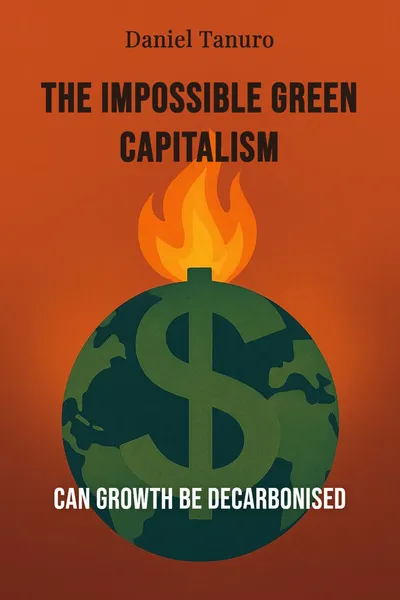
The Impossible Green Capitalism
Can growth be decarbonised
Description
In 2007, a Belgian agronomist and long-time activist named Daniel Tanuro began pulling together the argument that would become his best-known book, published in French in 2010 as L'impossible capitalisme vert. The setting was the years right after the Stern Review and Al Gore's documentary, when a comforting story had taken hold across boardrooms and environment ministries alike: yes, the climate was in trouble, but markets, carbon prices and clean technology would fix it without anyone having to change much. Green growth, the story went, meant we could keep expanding output indefinitely while emissions fell. Tanuro spent the book taking that promise apart.
His training mattered. An agronomist reads the economy through soil, energy flows and material limits rather than through GDP charts, and from that angle the reassuring numbers looked different. Efficiency was improving, yes — but total consumption of energy and raw materials kept climbing. Wind turbines and solar panels were multiplying, yet coal, oil and gas kept setting records. The curves the green-growth story needed to see bending were, in the real world, still rising. Something in the promise wasn't adding up, and Tanuro wanted to name exactly what.
His answer is uncomfortable, and it is not really about technology. Tanuro accepts that solar and wind work, that grids can be rebuilt, that heat pumps beat gas boilers. What he denies is that any of this can be squared with an economy whose organising rule is perpetual accumulation. The clash, he argues, is not between good tech and bad tech. It is between physics and a system that must grow or collapse.
The question we’re asking : Can an economy built on endless growth actually cut emissions fast enough to matter, or does the growth itself make decarbonisation impossible?What we’ll see : How Tanuro tests the green-growth promise against thermodynamics, material limits and the logic of accumulation — and where that test leads him.
Table of contents
01Chapter 1 — The word capitalism refuses to say
The green-growth consensus Tanuro confronts had a genuine appeal. It asked nobody to give anything up. Governments could keep promising rising living standards, firms could keep chasing quarterly returns, and the planet would still be saved — through a clever bit of what economists call decoupling. Decoupling means breaking the historic link between economic output and environmental damage: producing more while polluting less. In its strong form, it promises that GDP can keep climbing while emissions and material use fall in absolute terms. That is the version the whole edifice rests on.
Tanuro's first move is to insist on the difference between relative and absolute decoupling. Relative decoupling is easy and real: we get more output per tonne of carbon every year, because technology improves. But relative gains can coexist perfectly with rising total emissions, as long as output grows faster than efficiency does. And output, under capitalism, is supposed to grow — that is the point of the system. So the efficiency dividend gets swallowed by expansion. We become cleaner per unit and dirtier overall at the same time.

02Chapter 2 — The physics that don't negotiate
The agronomist's instinct is to check the promise against physical reality, and this is where Tanuro's book does its hardest work. Economics likes to treat production as a flow of value; thermodynamics treats it as a flow of energy and matter, and matter obeys laws that no price signal can suspend. Every good produced requires energy to make and materials to build from, and both leave the system degraded — dissipated as heat, dispersed as waste. An economy is, physically, a machine for turning concentrated resources into diffuse ones. You cannot run that machine faster forever on a finite planet.
This has a sharp consequence for renewables, which Tanuro supports but refuses to romanticise. Solar and wind capture flows of energy rather than burning stocks, which is genuinely better. But the devices that capture those flows are built from stocks — steel, copper, aluminium, rare earths, lithium, concrete — mined, smelted and transported using, for now, mostly fossil energy. Building a renewable system at the scale a growing global economy demands means an enormous surge of mining and manufacturing, precisely the extractive activity that carries a heavy carbon and material cost. The transition is not free of the very physics it hopes to escape.
03Chapter 3 — Why efficiency keeps failing us
If the physics are so unforgiving, why did anyone believe efficiency would save us? Partly because efficiency really does work at the level of the individual machine. A modern engine, furnace or light bulb wrings far more useful work from each unit of energy than its predecessor. The mistake, Tanuro argues, is assuming those local gains add up to a falling total. They rarely do, and the reason has a name that predates the climate debate by a century and a half.
The economist William Stanley Jevons noticed in 1865 that as steam engines grew more efficient, Britain burned not less coal but more. Cheaper, more effective use of coal made it worth using in more places, for more things, by more people. The efficiency lowered the effective price, and demand expanded to fill the gap and then some. This rebound effect has been documented across the economy ever since: fuel-sipping cars encourage longer commutes, efficient lighting spreads to every corner we once left dark, cheaper flights fill more planes. Under a system driven to grow, efficiency does not cap consumption — it removes a brake on it.
04Chapter 4 — Beyond the growth reflex
Step back from the mining figures and the rebound curves, and Tanuro's real subject comes into view. The climate question, as he frames it, is not fundamentally an engineering problem to be optimised. It is a question about what an economy is for. A green-growth economist asks how to keep the machine running while cutting its emissions. Tanuro asks why we assume the machine must keep running at ever-higher speed at all — and who benefits from the assumption. That shift, from optimisation to purpose, is where the book earns its title.
Because once you stop treating growth as a law of nature, the impossibility softens. It is impossible to decarbonise capitalism, on Tanuro's account, but not impossible to decarbonise an economy. What has to give is not physics and not technology but the accumulation imperative — the rule that output must expand indefinitely regardless of need. This is the door to degrowth, or as he sometimes puts it, a planned reduction and redistribution of production: producing less overall, but producing what actually serves human need, and sharing it far more fairly than a growth economy ever does.
05Conclusion
Tanuro's book landed in a debate that has only sharpened since 2010. The renewables he backed have grown far faster and cheaper than almost anyone predicted, which is real cause for hope. Yet the totals he told readers to watch have kept climbing: global emissions and global material extraction both hit new highs in the years after publication, even as efficiency improved and clean capacity soared. The relative decoupling arrived on schedule. The absolute decoupling, the one the green-growth promise actually needs, still hasn't shown up at anything like the required speed.
Related books