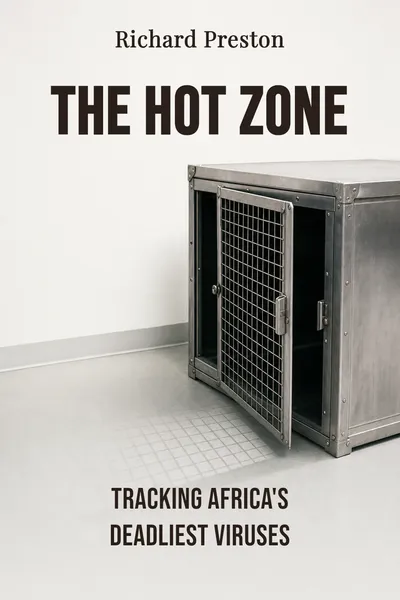
The Hot Zone
Tracking Africa's deadliest viruses
Description
In the autumn of 1989, a monkey started dying in a nondescript building in Reston, Virginia, a suburb about fifteen miles from the White House. It was one of a shipment of crab-eating macaques imported from the Philippines and held in a commercial quarantine facility. Then another monkey died, and another. The company called in a veterinary pathologist, tissue samples travelled to the Army's biodefense laboratory at Fort Detrick, and a young civilian researcher looked into an electron microscope and saw something long, threadlike, and coiled — a shape she recognized, and did not want to be seeing. It looked like Ebola.
That building, and the frantic secret operation the Army mounted to contain what was inside it, is where Richard Preston's The Hot Zone begins and ends. Published in 1994, the book was a work of narrative nonfiction that read like a thriller, and it did something no medical textbook had managed: it made a general readership feel, in their stomachs, what a filovirus is. Preston had interviewed the soldiers, doctors, and survivors, walked the sites, and reconstructed the scenes down to the smell of the rooms. The result put words like Ebola and Marburg into ordinary conversation.
Before the Reston monkeys, though, Preston traces the family of viruses back to where they first surfaced in humans — a factory in Germany, a hospital in what is now the Democratic Republic of the Congo, a cave in the Rift Valley of East Africa. He follows the people who caught these things and the handful who went looking for them on purpose. The book is partly a detective story and partly a warning, and it is careful never to let us forget that the pathogens at its center are real and still out there.
The question we’re asking : What are the filoviruses Preston tracked, where did they come from, and why did a book about them frighten so many readers?What we’ll see : How a suburban monkey scare pulled Preston back through the African outbreaks that first revealed Marburg and Ebola — and what the hunt for their source suggests about us.
Table of contents
01 Chapter 1 — A monkey house in the Washington suburbs
The Reston story is the spine of the book, and Preston plays it for every ounce of dread it holds. The dying macaques carried something that looked, under the microscope, exactly like Ebola Zaire — at the time understood to kill roughly nine out of ten people it infected. What made it unbearable was the geography. This was not a remote clinic in Central Africa. This was a strip-mall office park in Virginia, air-conditioning ducts feeding a building where monkeys were coughing and hemorrhaging, and healthy animals in rooms far from the sick ones were dying too. The virus seemed to be moving through the air.
Fort Detrick's disease people, working with the Centers for Disease Control, faced a decision with no clean options. If a lethal, airborne Ebola strain had arrived in the United States, the monkey house had to be sterilized and every animal killed — a biohazard operation run by soldiers in space suits, quietly, in a building the neighbors thought was empty. Preston follows Nancy Jaax, an Army veterinary pathologist who had spent years working with the virus at maximum containment, and a cast of colleagues who suit up and go in knowing that a single torn glove could be fatal.

02 Chapter 2 — The virus that came down from the caves
To explain what had almost happened in Reston, Preston reaches back to the first time this family of viruses met modern medicine. In 1967, workers at vaccine-production plants in Marburg and Frankfurt, in West Germany, and in Belgrade began falling gravely ill. They handled kidney cells from African green monkeys shipped from Uganda. The new agent, named Marburg virus after the German town, killed seven of the roughly thirty-one people it infected and left doctors baffled: it was unlike anything in the books, a thread-shaped particle that attacked the whole body.
Marburg was the first known filovirus. Ebola arrived on the record later, in 1976, in two nearly simultaneous outbreaks — one in southern Sudan, one near the Ebola River in northern Zaire, the country now called the Democratic Republic of the Congo. The Zaire outbreak centered on a mission hospital at Yambuku, where nuns reused a small number of syringes across many patients, turning the clinic into an amplifier. The virus that emerged there was ferocious, and it gave its name and its reputation to the whole feared lineage.
03 Chapter 3 — What a filovirus does to a body
Much of the book's grip comes from Preston's clinical, unflinching account of what these viruses do. He describes the course of a severe filovirus infection in detail that many readers found hard to shake: high fever, then bleeding from multiple sites, connective tissue and internal organs failing as the virus replicates through the body. His prose lingers on the physical reality — the transformation of a person into something the virus has hollowed out. Some of his most vivid phrasings, like the body "crashing and bleeding out," entered popular vocabulary through the book.
Later virologists have pushed back on parts of this picture, arguing that Preston dramatized the goriest presentations and that most fatal cases die of shock and organ failure rather than the near-total liquefaction his most extreme passages evoke. Preston built his scenes from the worst cases and the memories of shaken witnesses, which sharpened the horror. The correction matters for accuracy, but it does not change the core fact the book conveyed: filoviruses kill a large fraction of the people they infect, and in the 1980s and early 1990s medicine had almost nothing to offer against them.
04 Chapter 4 — The line between the wild and us
Step back from the individual outbreaks and Preston is pressing one larger idea throughout the book: these viruses are not freak accidents but a kind of feedback from ecosystems we are steadily pushing into. His filoviruses live somewhere in the forests and caves of tropical Africa, in host animals that had rarely crossed paths with dense human populations. When roads, logging, hunting, and the trade in wild animals bring people deeper into those places, the viruses gain new routes into us. The Reston monkeys, imported for commercial use, are the same logic running in reverse — the wild delivered to a Virginia suburb by the animal trade.
Preston frames this in almost planetary terms, at one point casting emerging viruses as something like the immune response of a stressed biosphere reacting to human expansion. It is a metaphor, and he knows it, but it captures the through-line of his reporting: the more humanity spreads into previously isolated ecosystems, the more often we will meet organisms that evolved entirely without us. The threat, in this reading, is not a single monster virus but a rising rate of contact — a numbers game we keep making worse.
05 Conclusion
The monkey house in Reston was demolished; the strain found inside it, Ebola Reston, turned out to be harmless to people, and the workers who tested positive stayed healthy. The catastrophe Preston's team had braced for did not come. That anticlimax is, in a way, the whole point of the book. The virus had arrived, spread, and behaved almost exactly like a killer — and the only thing standing between a scare and a disaster was a difference in a strain that nobody had chosen and nobody fully understood.
Related books