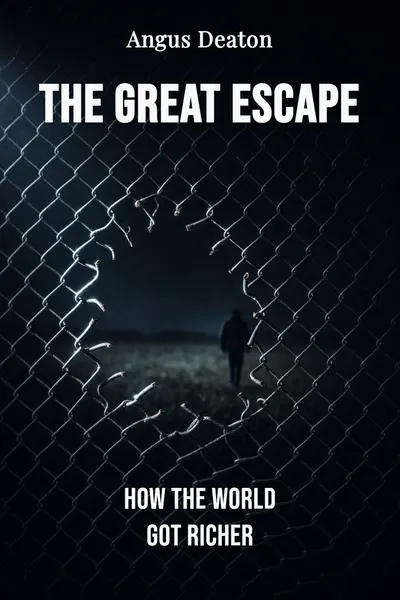
The Great Escape
How the world got richer
Description
Somewhere in the middle of the eighteenth century, a child born in England could expect to live to about thirty-five. A child born there today can expect to reach roughly eighty. In between sits one of the strangest stretches of the human record: a species that spent almost all of its existence poor, sick and short-lived suddenly, over a few generations, got taller, richer, healthier and far less likely to bury its own children. Angus Deaton, a Scottish-born economist who spent his career at Princeton and won the Nobel in 2015, calls this the great escape — borrowing the title of the 1963 war film about prisoners breaking out of a camp.
The borrowing is deliberate, and it carries the whole argument. In the film, some men get out and some do not. That is the part we tend to forget when we tell the cheerful version of the story. Deaton's book is built around the idea that escape and inequality are two names for the same event. The moment some people broke free of early death and grinding want, they pulled away from everyone still trapped behind them. A world where nobody escapes is equal and miserable. A world where some do is better and, by that very fact, more unequal.
That tension runs through everything Deaton examines: money and lifespan, rich countries and poor ones, the well-meaning cheques the West writes to the rest. He is an economist who trusts numbers but distrusts the tidy conclusions people draw from them, and he keeps catching the story mid-sentence, where it gets complicated. The result is neither a celebration nor a lament. It is closer to an honest accounting of what humanity has managed to pull off, and at whose expense the pulling-off still leaves people out.
The question we’re asking : If the world has genuinely got richer and healthier, why does that same progress keep widening the gaps between us?What we’ll see : How well-being outran poverty over two centuries, why bodies register the escape as clearly as bank accounts, and where our instincts about helping the poor tend to go wrong.
Table of contents
01Chapter 1 — The escape that left others behind
Deaton's starting point is a fact that sounds almost too large to feel: for most of history, almost everyone was poor, and most children died young. Then, over the past two and a half centuries, that ceased to be true for a growing share of humanity. Life expectancy in the wealthiest countries roughly doubled. Extreme poverty, once nearly universal, fell to a minority of the world's population. Whole diseases that used to empty households became rare. This is the material of the escape, and Deaton insists we start by taking its scale seriously rather than treating it as background.
But he refuses to stop at the good news, because the good news is exactly what creates the problem he cares about. Escapes are uneven. Britain and northwestern Europe got out first, then North America, then, at very different speeds, much of the rest of the world. Each early departure opened a gap between those who had escaped and those who had not. So the same process that lifted living standards also produced the vast differences between nations that define the modern map — a country where a child almost certainly survives sitting beside one where survival is still a gamble.

02Chapter 2 — When the body tells the story of the wallet
Where much of economics measures well-being in income, Deaton spent a career arguing that the body keeps a separate, stubborn ledger. Health is not simply a luxury that money buys once you are rich enough. It is one of the two great dimensions of the escape, running alongside wealth and sometimes moving on its own schedule. He is fascinated by how the two relate — because they clearly do relate, and just as clearly do not track each other neatly.
The evidence is everywhere in the numbers. Richer countries generally have longer lives, and within countries the well-off outlive the poor, often by years. Height itself tells part of the tale: populations that grew richer and better-fed grew literally taller, generation by generation, so that a person's stature encodes the conditions of their childhood. Deaton treats these bodily facts as data with the same weight as GDP, because they measure something GDP misses — whether a life was long, and whether it was lived in a functioning body.
03Chapter 3 — Why the aid we send often misses
Having spent two chapters on how the world escaped, Deaton turns to the obvious moral question: can those who got out help those still behind? Here he becomes deliberately awkward, because the intuitive answer — rich countries have money, poor countries lack it, so transfer the money — is the one he most distrusts. Foreign aid, in his account, has a far worse record than its supporters admit, and the reasons are structural rather than a matter of good or bad intentions.
His central worry is about what aid does to the relationship between a government and its people. Ordinarily a state has to raise money from those it governs, and that need forces a kind of accountability: taxpayers who fund a government expect something back, and can withdraw support if they get nothing. A government floated on outside money owes its survival not to its citizens but to donors abroad. The incentive to build the courts, roads and clinics that make a society work weakens precisely where it is most needed, because the cash arrives regardless.
04Chapter 4 — The gap that progress keeps opening
Step back from the particular arguments and a single shape emerges from Deaton's book. Every escape opens a gap, and the gap is not an accident of the escape but its signature. This is the idea that lets him hold together things that usually get argued about separately — the health of nations, the wealth of nations, the failures of aid. In each case the same mechanism is at work: someone moves forward, distance opens, and the distance itself becomes the next thing to reckon with.
This reframes what inequality even is. In the usual debate, inequality is treated as a wrong to be corrected or a price to be tolerated, as though it were a policy that could in principle be switched off. Deaton's version is less tractable and more honest. Inequality is what forward motion looks like when it is uneven, and forward motion is always uneven, because knowledge and prosperity spread through the world unevenly. To wish the gaps away entirely is, at some level, to wish the escape had never happened.
05Conclusion
The film Deaton borrows his title from ends without a clean victory: some men reach freedom, most are recaptured, several are killed. He chooses it precisely because the human story so far has that same mixed shape. Two and a half centuries of escape have made the world richer, healthier and longer-lived than anyone before 1750 could have imagined, and they have scattered that good fortune with a hand so uneven that the gaps it left define our age. Both are true. The book's discipline is to refuse the comfort of choosing between them.
Related books