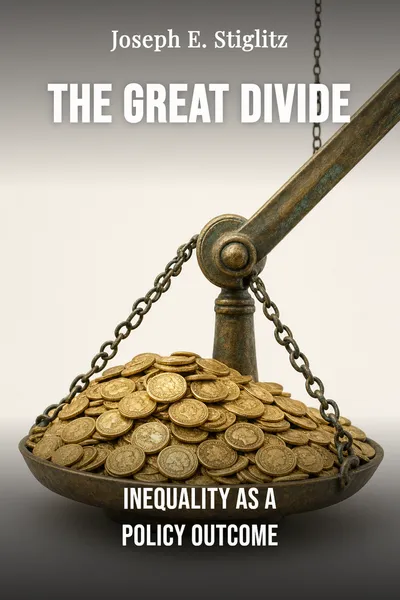
The Great Divide
Inequality as a policy outcome
Description
Somewhere in the aftermath of the 2008 crash, a familiar story started to wobble. For decades, the standard account held that a rising economy lifted everyone, that the gap between top and bottom was the price of a system that worked, and that anyone unhappy with their place could work their way up. Then the numbers came in. The top one percent of American earners had captured a large share of the gains of the previous three decades, while median wages had barely moved. The recovery, when it arrived, went overwhelmingly to the people who had least needed rescuing.
Joseph Stiglitz, who won the Nobel Prize in economics in 2001 and had served as chief economist at the World Bank, spent the years after the crash arguing that this was not an accident of markets or a natural law of technology. It was, he insisted, a choice — a long series of them, made in tax codes, courtrooms, trade deals, and central banks. The Great Divide, published in 2015, gathers those arguments into a single case: that the level of inequality a country lives with is the outcome of its politics, not the verdict of its economy.
That reframing changes what inequality is. If it is fated — the inevitable product of globalization and machines — there is little to do but adapt. If it is written into the rules, the rules are the thing to look at. Stiglitz's project is to move the conversation from lament to design, from asking how bad the gap has become to asking who benefits from keeping it that way.
The question we’re asking : Is the gap between the very top and everyone else something that happened to America, or something America decided?What we’ll see : How an economist takes apart the idea that inequality is nobody's fault, and follows the trail to the rules that produce it.
Table of contents
01Chapter 1 — The number that stopped meaning what we thought
For most of the postwar period, Americans could tell a reassuring story with a single statistic: the economy grew, and wages grew with it. Between the late 1940s and the early 1970s, productivity and household incomes climbed together, and the gains were shared broadly enough that the arrangement felt like a law of nature. Then, sometime in the 1970s, the two lines came apart. The economy kept expanding. Most paychecks stopped keeping pace.
Stiglitz keeps returning to what happened to the top and the bottom in the decades that followed. The share of national income going to the top one percent roughly doubled over that stretch, and the very top — the top one-tenth of one percent — did even better. Meanwhile a full-time male worker at the median was, by some measures, earning less in real terms in the 2010s than his counterpart had four decades earlier. The average had risen; the typical person had not moved. That gap between average and typical is the whole story hiding inside a cheerful GDP figure.

02Chapter 2 — The market was never the whole story
The dominant explanation for the widening gap was, and still is, impersonal. Globalization sent manufacturing jobs abroad. Technology rewarded the highly skilled and hollowed out the middle. Under this account, inequality is the exhaust of progress — regrettable, maybe, but nobody's fault and nothing anybody chose. Stiglitz does not deny that trade and technology reshaped the labor market. He denies that they wrote the outcome by themselves.
His argument is that the same forces hit every advanced economy, yet the results diverged sharply. Germany traded and automated too, and kept far more of its manufacturing base and a tighter income distribution. If globalization and machines were destiny, all rich countries would land in roughly the same place. They did not. What differed was policy — how each country taxed, how it protected workers, how it bargained over the gains from trade, how it treated unions. The technology was shared. The choices were not.
03Chapter 3 — Rent, not reward
The word Stiglitz leans on hardest is rent-seeking. In economics, a rent is income you collect not for producing something of value but for controlling something others need — a monopoly, a patent, a preferential tax carve-out, a loophole. Rent-seeking is the effort spent capturing a larger slice of the pie rather than baking a bigger one. His central claim about American inequality is that a great deal of the money at the very top is rent, not reward for productivity.
The examples are concrete. Pharmaceutical firms that lobby to prevent the government from negotiating drug prices. Financial institutions whose profits swelled while they were, in his telling, misallocating capital and eventually needing rescue. Executives whose pay ratcheted upward through boards they effectively controlled, disconnected from the performance of their companies. Industries that write the regulations meant to constrain them. In each case, the wealth is real, but it flows from position and influence rather than from anything that grew the economy.
04Chapter 4 — What inequality does to everyone else
Step back from the tax tables, and the larger claim comes into view: a society's level of inequality is a set of rules it writes about itself, and the rules reach far beyond the paycheck. Stiglitz's most unsettling argument is that extreme inequality does not stay contained in the income distribution. It seeps into the institutions that were supposed to be neutral — courts, legislatures, regulators, even the central bank — and reshapes them to protect the arrangement that produced it. Money buys influence, influence rewrites the rules, and the new rules generate more money. The loop is self-reinforcing.
The casualty in that loop is democracy itself. When a small group can shape trade agreements, tax policy, and financial regulation, the formal equality of one-person-one-vote thins into something closer to one-dollar-one-vote. Stiglitz argues that Americans had come to accept, quietly, a politics in which outcomes tracked wealth — and that this acceptance is corrosive precisely because it feels natural. A country can keep its elections and its constitution and still hollow out the substance of self-government if the rules are consistently written for those who fund the writing.
05Conclusion
The number that opened this — the top one percent pulling away while the median stood still — reads differently once you follow it back to its sources. It is not the residue of machines and foreign competition doing their impersonal work. It is the visible trace of decades of choices: which industries got to write their own rules, which taxes rose and which fell, whose bargaining power was protected and whose was allowed to erode. The gap is a ledger of decisions, and every decision had authors.
Related books