The Great Crash 1929
When markets forget to think
Description
In the late summer of 1929, an American with a few hundred dollars and a brokerage account could feel, plausibly, that he was getting richer while he slept. The stock market had been climbing for years, and by the last stretch of the boom it was climbing in a way that seemed to owe nothing to earnings, dividends, or any dull fact about the companies underneath. Shares of Radio Corporation of America, which paid no dividend at all, ran up past 500. Taxi drivers offered tips. Clerks watched the ticker on their lunch breaks. The feeling in the country was that a corner had been turned, and that prosperity had stopped being something you worked toward and become something you simply held.
Then, over a handful of days in late October, the whole thing came apart. On October 24 — Black Thursday — nearly thirteen million shares changed hands in a market with no floor beneath it. The following Tuesday, October 29, was worse: sixteen million shares, fortunes erased in an afternoon, the ticker running hours behind the actual carnage. What had felt like a permanent new plateau turned out to be the top of a very tall building. The decline did not stop that week, or that year. It kept going, in fits, until 1932.
Decades later, the economist John Kenneth Galbraith went back to that autumn to ask a question that is less about finance than about people. Not simply how the market rose and fell — the numbers are in the record — but how a large, literate, reasonably shrewd society talked itself into believing that the ordinary rules had been suspended, and then spent months insisting, against the evidence, that nothing was really wrong.
The question we’re asking : How does a whole society talk itself into a bubble, and why does it keep doing it?What we’ll see : How the boom took hold, the machinery that magnified it, the collapse itself, and what recurs long after the wreckage is cleared.
Table of contents
01 Chapter 1 — A nation that decided to get rich
Galbraith is careful about where he starts, because the tempting story — that the crash was caused by the crash — explains nothing. The interesting thing is the mood that came first. By the mid-1920s the United States had money looking for somewhere to go and a growing conviction that the stock market was the place. The Florida land boom had already offered a rehearsal: people bought lots they never saw, sold them at a profit to people who also never saw them, and for a while everyone involved felt clever. When Florida collapsed around 1926, the appetite did not die. It moved north, to Wall Street.
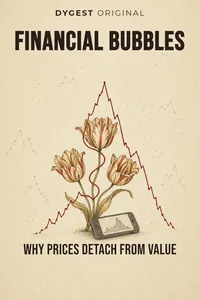
What made the market mania different, in Galbraith's telling, was that it needed almost no justification. A speculative boom does not require good news; it requires only the belief that prices will keep rising, which becomes true for exactly as long as enough people believe it. Buying pushed prices up, rising prices drew in more buyers, and the whole arrangement fed on itself. The companies underneath the shares became close to irrelevant. What people were really buying was the expectation of selling, later, to someone more optimistic still.

02 Chapter 2 — The machinery of leverage
A mood alone does not move a market that far. Galbraith spends real time on the machinery that turned optimism into altitude, and the first piece was borrowing. An investor could buy stock on margin, putting down a fraction of the price and financing the rest with a broker's loan. When shares rose, the gains landed on the small sum actually staked, so profits looked enormous. The catch, invisible on the way up, was symmetrical: a modest fall in the stock could wipe out the whole stake and trigger a demand for more cash. Brokers' loans ballooned through the late 1920s, drawing money from banks, corporations, and even foreigners, all lured by the interest rates the frenzy could pay.
03 Chapter 3 — The days the numbers stopped meaning anything
The market had wobbled before, and each time it had recovered, which taught precisely the wrong lesson. September 1929 brought a nervous, sliding sort of trading, but the true break came in the last full week of October. On Thursday the twenty-fourth, selling arrived in a wave that the market could not absorb; prices fell through levels at which buyers were supposed to appear, and none did. Nearly thirteen million shares traded. At midday a group of leading bankers met at J.P. Morgan and pooled money to steady things, and one of them walked onto the floor to buy visibly. It worked for an afternoon.
It did not work for the week. On Monday the market sagged again, and Tuesday, October 29, was the day the machinery fully reversed. Roughly sixteen million shares changed hands into a void; margin calls forced holders to sell whatever they could at whatever price, which drove prices lower, which forced more selling. The ticker ran hours behind, so investors did not even know how poor they were until evening. Galbraith notes, with grim relish, the human details: the rumors of ruined speculators, most of them false, and the far less dramatic truth of quiet, enormous losses spread across the country.
04 Chapter 4 — Why the mania was never really about 1929
Step back from the specific autumn and Galbraith's larger claim comes into focus: the crash of 1929 was not a freak of that decade but an instance of something that recurs. The particulars change — Florida swamp, radio stocks, and, in the readers' own eras, whatever comes next — but the pattern holds. There is an object of speculation, a story about why the old rules no longer apply, a self-feeding rise, and, layered underneath, some form of leverage that hardly anyone examines while the party is loud. The scenery is always new. The play is old.
The most durable thing he identifies is the shortness of financial memory. A speculative disaster is followed by a period of caution and reform, and then, as the generation that was burned ages out and a fresh crop arrives with money and confidence, the lessons fade. Someone reinvents an instrument that magnifies gains, someone explains why this time is different, and the cycle begins again. Galbraith's point is not that people are stupid but that the incentives during a boom reward the credulous and punish the skeptic, right up until the moment they violently reverse.
05 Conclusion
The market that had felt like a permanent plateau in September 1929 kept falling until 1932, taking with it savings, banks, and the confident theory that prosperity had become self-sustaining. Galbraith's account keeps returning to the human middle of it — not the ticker but the people watching it, first sure they could not lose and then sure the worst was already behind them. Both certainties were the same habit of mind, wearing different clothes. The machinery of margin and trusts supplied the amplification, but the fuel was ordinary optimism let off its leash.
Related books