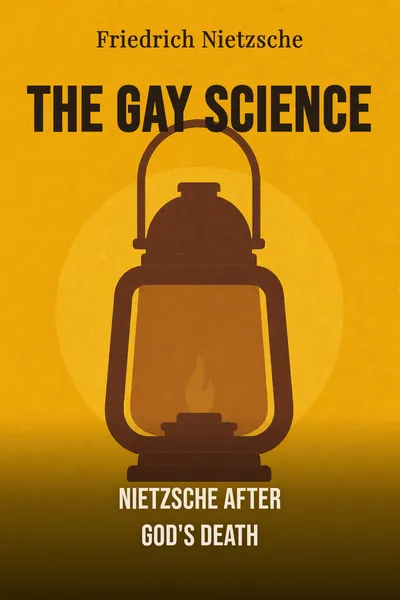
The Gay Science
Nietzsche after God's death
Description
In the summer of 1882, Friedrich Nietzsche was living between Genoa and the Swiss Alps, mostly alone, his eyes failing, his health a daily negotiation. He was thirty-seven, out of the academic world he had left years earlier, and writing in short bursts between headaches. What came out of that stretch was a book he called Die fröhliche Wissenschaft — usually rendered in English as The Gay Science, in the older sense of gay, meaning joyful, high-spirited, quick. The title is borrowed from the troubadours of medieval Provence, for whom the gaya scienza was the art of song. Nietzsche wanted a philosophy that sang.
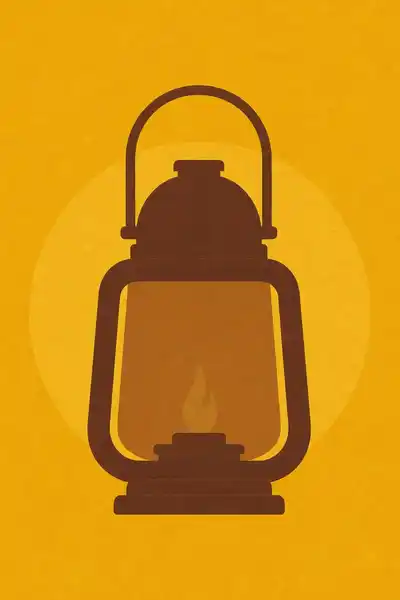
Inside that cheerful frame he placed one of the most unsettling lines in modern thought. A madman runs into a marketplace carrying a lantern in broad daylight and announces that God is dead — and that we have killed him. The scene is not triumphant. The madman is frightened by what he has said, and the crowd only stares, because they have not yet grasped what they have done. Nietzsche was not reporting an atheist victory. He was describing a wound that Europe had inflicted on itself without noticing, and asking what happens next.
That pairing — the lightest possible tone around the gravest possible subject — is the whole design of the book. It is written in hundreds of short aphorisms, some a sentence long, some a few pages, jumping from morality to music to the weather to eternity. The looseness is deliberate. Nietzsche is trying to show that thinking after the loss of old certainties need not collapse into despair. It can become quicker, braver, even funny.
The question we’re asking : If the foundation everyone leaned on is gone, what does honest thinking look like the morning after?What we’ll see : How a book about the death of God turns out to be a book about how to live cheerfully once nothing is guaranteed.
Table of contents
01 Chapter 1 — The madman with a lantern
The famous passage, aphorism 125, is short and strange. A man lights a lantern in the bright morning, runs to the market, and cries out that he is looking for God. The bystanders, many of them unbelievers already, laugh at him. So he turns on them: God is dead, God remains dead, and we have killed him — you and I, all of us together. Then his tone shifts from accusation to vertigo. How did we drink up the sea? Who gave us the sponge to wipe away the whole horizon? What were we doing when we unchained the earth from its sun?
The point of the scene is that the crowd doesn't understand. They think atheism is a comfortable position, a thing you simply hold, like an opinion about the weather. Nietzsche's madman knows better. The death of God is not the removal of one belief among many; it is the removal of the ground under a whole civilization's sense of meaning, value, and direction. Christianity had supplied Europe with its measure of good and evil, its reason for truthfulness, its confidence that history was going somewhere. Pull the source out, and everything built on it starts to wobble.

02 Chapter 2 — A science that laughs
The title is a promise about method, not just mood. For Nietzsche, most philosophy up to that point had been solemn, and he distrusted solemnity. He thought heavy seriousness was often a mask — a way of protecting a belief from examination by making it feel too sacred to poke. The gay science is the opposite habit: an approach to knowledge that stays light on its feet, ready to laugh at its own conclusions, willing to test ideas rather than kneel before them.
He treats truth itself this way. In a set of aphorisms he asks why we even want the truth, and why we assume it must be good for us. Perhaps life needs illusions, perspectives, useful errors as much as it needs facts. This does not make Nietzsche a liar's advocate. He was ferociously committed to honesty — he thought the will to truth was the last and most demanding legacy of the Christian conscience, the value that, followed all the way, ends up dissolving the faith that produced it. Truthfulness, pushed hard enough, killed God. That is the joke and the tragedy at once.
03 Chapter 3 — The heaviest weight
Near the end of the book, in aphorism 341, Nietzsche sets a thought experiment he calls the heaviest weight. Imagine a demon slips into your loneliest hour and tells you that this life, exactly as you have lived it, will return again and again — every pain, every joy, every small and shameful detail, in the same order, endlessly, with nothing new ever added. Eternal recurrence. Would you throw yourself down and curse the demon? Or would there be a moment when you could answer: you are a god, and I have never heard anything more divine?
The idea is not offered as a cosmological fact to be proved. It works as a test. It asks how you feel about your life when you strip away every promise of reward beyond it — no heaven to make the suffering worthwhile, no final judgment to balance the books, no progress toward a better future to redeem the present. Just this, forever. Most religions and philosophies had offered some elsewhere that made the here-and-now bearable. Nietzsche removes the elsewhere and asks whether you can still love what remains.
04 Chapter 4 — Living as if we were free
Step back from the aphorisms and a single problem organizes the whole book: what kind of thinking can stand up on its own, once nothing external is holding it up? For most of Western history, thought leaned on a guarantee — God, or nature, or reason understood as a cosmic order — that made truth trustworthy and values solid. Nietzsche's wager in The Gay Science is that we can learn to think without that crutch, and that the result might be better rather than worse. But it requires a particular temperament, and cultivating that temperament is really what the gay science is.
The cheerfulness of the title, seen this way, is not decoration. It is an intellectual position. A mind that has lost its foundations can respond with dread, resentment, or a frantic search for a replacement idol — a nation, a movement, a system promising the certainty religion used to provide. Nietzsche saw all of these coming and distrusted them. The alternative he proposes is a kind of earned lightness: the ability to hold your convictions firmly enough to live by them and loosely enough to laugh at them, knowing you built them yourself.
05 Conclusion
The madman put out his lantern and walked away saying he had come too early. That image holds the book together. Nietzsche believed he was writing for a future that had not yet arrived — for readers who would feel, more sharply than his contemporaries, both the freedom and the vertigo of having no guaranteed ground. The Gay Science is his attempt to greet that future without terror, to turn a loss into an opening, and to prove that the gravest subject in the world could be handled with a light hand.
Related books