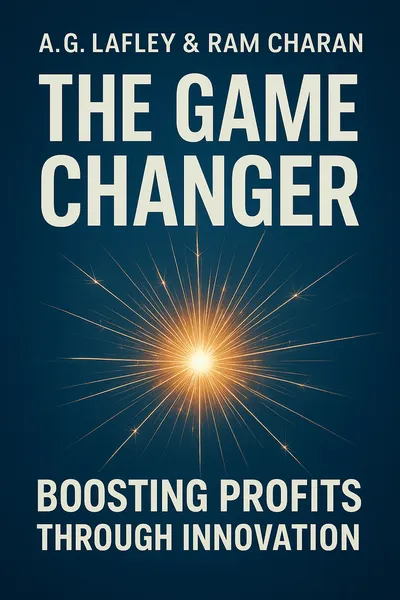
The game changer
Boosting profits through innovation
Description
Real innovation integrates new ideas into how a business operates to drive revenue growth and profits. There are eight essential elements that enable innovation: - Leadership commitment - External partnerships - Employee empowerment - Appropriate funding and incentives - Organizational structures that support innovation - Customer centricity - Iteration through rapid experimentation - Cross-functional collaboration
Companies must align these elements to create an environment conducive to developing, testing, and implementing new ideas. With the right organizational context, innovation can change the market landscape and differentiate a business to put it on a path to long-term prosperity. As A.G. Lafley states, "Innovate or die" captures the imperative for companies to continually create game-changing value.
Table of contents
01 Innovation centers on the customer
Innovation is driven by understanding customer needs. Successful companies innovate not by developing ideas in isolation, but by directly engaging with customers to understand their aspirations, frustrations, and emotional connections. Consider Nokia's experience launching mobile phones in India in 1996. Rather than assuming what worked in Western markets would succeed in India, Nokia formed a local team to study the Indian context. They learned that phones would need to be extremely durable and affordable, with features like dustproofing and flashlights tailored to local conditions. Since established retailers were initially unwilling to carry this new product category, Nokia created a vast distribution network of local mobile phone stands similar to produce stands. This relentless focus on the Indian consumer allowed Nokia to dominate the Indian mobile phone market within a decade.
Procter & Gamble tells a similar story with the launch of its Downy Single Rinse fabric softener in Mexico in the early 2000s. Despite P&G's strong brand equity, its fabric softener had low, stagnant market share. Studying Mexican consumers revealed frustrations with laundry given inconsistent water supply and infrastructure. P&G developed a concentrated, single-rinse formula that allowed consumers to add fabric softener at the end of the wash cycle for easier rinsing using less water. This product concept originated from observing a consumer need, not an isolated brainstorm. Since launch, Downy Single Rinse has proven highly successful in Mexico.

02 Mission and principles
To spur innovation, motivation grounded solely in metrics falls short. Inspiration that stems from bettering customers' lives breeds purposeful action. Values translate such purpose into momentum. Upon assuming P&G's CEO role in June 2000, A.G. Lafley confronted crisis. Within six months leading up to Lafley's appointment, P&G's stock had plunged 50 percent, amounting to over $50 billion in lost market capitalization. The day after Lafley took charge, profit warnings forced him to temper quarterly earnings expectations, triggering further stock declines. To rally the company's morale and redirect its focus forward, Lafley re-centered attention on P&G's raison d'être and ethos. He reminded teams that despite recent blows to confidence, P&G remained a global leader in its space. Lafley then posed two refocusing questions:
03 Ambitious benchmarks
Goals provide direction and motivate action. Well-designed goals strike a balance between stretch targets that inspire and realistic objectives that guide resource allocation. Both dimensions are necessary for innovation. In setting strategy, Procter & Gamble's leadership team began by defining three external positioning goals:
First, P&G would aim to grow organic sales at twice the rate of market growth. By setting sights on aggressive share gains, they hoped to focus innovation on big ideas that deliver superior consumer value. Second, they set a goal to deliver double-digit earnings growth through productivity and portfolio improvements. This objective would force discipline in prioritizing resources to the most profitable opportunities. Finally, organic growth would be the priority over acquisitions. This established an innovation culture focused on developing new brands and products internally rather than buying growth externally.
04 Sound game plans
Innovation lies at the heart of business strategy. By putting innovation front and center, companies can make better decisions about where to focus their efforts. Goals dictate strategies to a large degree. Clear strategy reduces complexity and confusion, defining not only what businesses a company will pursue but also what it will avoid. Consider the case of P&G. Three key goals allowed P&G to shape a straightforward strategy:
First, P&G would concentrate on sustaining growth in its four core categories – fabric care, hair care, baby care and feminine care – through continuous innovation. Greater emphasis would go toward P&G's largest markets, biggest customers and most powerful brands. Second, P&G aimed to shift its portfolio toward fast-expanding, high-margin, asset-efficient businesses in established markets. The rationale was that innovation could fulfill unmet customer needs in ways that improve the experience. Third, P&G targeted low-income consumers in fast-developing markets. By 2007, P&G served over 3 billion customers globally, up from 2 billion in 2000, with most new customers outside the U.S.
05 Distinctive capabilities
Procter & Gamble identified five core capabilities that formed the foundation of its competitive advantage: consumer understanding, branding, innovation, go-to-market ability, and global scale. While valuable individually, the true power came from combining these strengths into an unbeatable business model. For example, when P&G acquired the Max Factor fragrance business in 1992, it went to work applying its core capabilities. It used its consumer knowledge to shift from a manufacturer-driven to consumer-driven approach, closely linking brand aspirations to target consumers. Powerful innovations were fueled by customer input, not just product changes - incorporating fresh fragrances, packaging, marketing, and shopping experiences.
06 Enabling organizational structures
Innovation is not a mechanical process that can be project managed. Rather, it is a social endeavor that requires adaptable organizational structures tailored to a company's specific strategy and innovation model. There is no one-size-fits-all approach. Six key criteria can guide companies in designing the optimal structure to drive innovation:
1. Separate versus integrated development teams 2. Full-time versus part-time innovation staffing models 3. Necessary external expertise 4. Funding mechanisms and resourcing 5. Cross-functional coordination for commercialization 6. Top management focus beyond daily operations.
07 Consistent development processes
Innovation requires systematic processes to move ideas to commercialization. Well-defined stages, criteria, and metrics provide structure rather than leaving innovation to chance. With full schedules, asking people to add innovating without support systems will not work. Five key components facilitate innovation: idea generation, idea selection, development, commercialization, and diffusion. A disciplined, transparent system increases success in developing ideas into products. Company-specific customization is necessary, as is an innovation manager with budget to provide coaching. Assessing ideas' potential, enabling access to help, and facilitating viability conversations are crucial responsibilities. Annual idea fairs bubble up innovations; leaders stating innovation budget/plans send the message it is valued.
08 Interconnected organizational culture
Innovation thrives in companies with a “can do” culture that embraces change generated by new ideas. Contrary to the myth of the lone genius, innovation happens through collaboration. To make innovation systematic, integrate it into daily work rather than leaving it to chance encounters. Effective innovation teams balance creative thinkers who generate ideas with pragmatic project leaders who drive execution. Someone must oversee bringing innovations to market on time by coordinating tasks and addressing operational issues. The team leader plays a crucial role as a “pragmatic dreamer” who elicits wild ideas but also examines their feasibility. Companies use different approaches to enable such teams, from skunkworks to research centers to multidisciplinary teams focused on specific problems.
09 Inspiring leadership
Effective leaders bring together all aspects of innovation and motivate people to move forward. Leaders balance possibilities and practicalities, treating innovation as a systematic process. Sustained organic growth requires innovation at the core of business. Making this happen falls to leaders. With the right behaviors and focus, leaders can develop the innovation culture that drives growth. Leaders modelling collaborative, curious, courageous, and open behaviors gives permission for others to do the same, nurturing an innovation culture. By continually exhibiting these traits in their own work, the ground becomes fertile for innovation to take root and flourish.
Leaders also perform unique roles that add value: setting an inspirational vision requiring innovation, encouraging experimentation, integrating innovation into operations, and ensuring teams work on projects with reasonable chances of marketplace success. How leaders execute these responsibilities makes or breaks innovation potential. Additionally, leaders need willingness to take risks, make connections, and balance skills to keep the right things happening. To build a leadership pipeline, organizations can: formally evaluate innovation performance with consistent scorecards, promoting top talent; identify early potential and test through increasingly important projects; provide coaching, training, and stretch assignments; and openly reward and recognize achievements, motivating others.
Related books