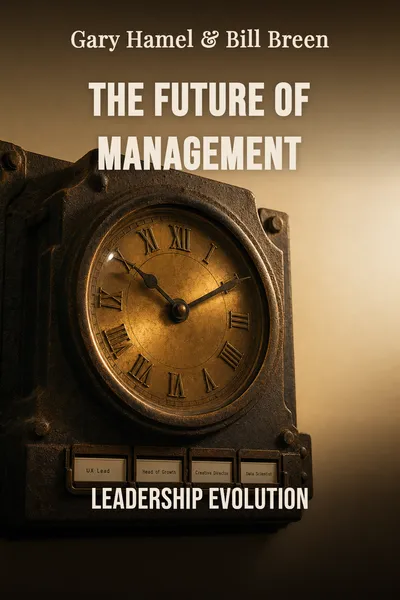
The future of management
Leadership evolution
Description
The essence of enduring business success isn't found in operational efficiency, technological advancements, or innovative business models, as these can be eclipsed by competitors. The real driver of sustained success is management innovation - the pursuit of novel ways to engage talent, manage resources, and strategize. Traditional management principles, focused on control and efficiency, are outdated in today's dynamic and creative business environment. It's crucial to envision and shape the future of management, moving beyond old paradigms to foster management practices that meet the demands of our times.
Management, having stagnated like the combustion engine, needs evolution for better resource coordination and goal achievement. This evolution is vital, as the limitation of an organization is not its operational or business model, but its management model. The aim is to guide you in becoming a pioneer of 21st-century management, innovating in management to secure a lasting competitive edge for your company.
Table of contents
01 Significance of management innovation
Management stands as the cornerstone of all organizational achievements and operations. It's a logical deduction, then, to posit that for businesses to flourish amidst the tumultuous markets of the 21st century, innovative and superior management methodologies are imperative. The only strategy to outmaneuver newcomers and competitors is for companies to discover more effective management techniques. A novel management paradigm is essential. In comparison to the significant transformations witnessed in the marketplace, the domain of business management appears to be ensnared in a temporal stasis. Little has evolved since the dawn of the 20th century, which elucidates the ease with which CEOs transition between companies.
Despite a widespread consensus on the functions of management, historical evidence underscores that whenever an organization, or even a nation, has innovated in management, it has thrived at the expense of its competitors. For instance, General Electric pioneered the integration of sound management with scientific discovery in the early 1900s, securing more patents than any other American company throughout the first half of the 20th century. DuPont revolutionized the concept of return-on-investment calculation in 1903, enabling it to emerge as one of America's industrial behemoths. Procter & Gamble, in the early 1930s, institutionalized brand management, thereby transforming into a consumer brands powerhouse. Toyota's relentless pursuit of efficiency through employee engagement propelled it to the pinnacle of the automotive industry. Visa innovated by creating the world's first "virtual" company, a network facilitating competition among banks while sharing a common infrastructure, standards, and brand, processing over $2 trillion annually.

02 Examples of management innovation
Several corporations are at the forefront of pioneering management innovation, with Whole Foods Market, W.L. Gore, and Google standing out as exemplary case studies. Whole Foods Market, with its 194 stores as of 2007, generating $6 billion annually, is based on the simple yet powerful premise that consumers are willing to pay more for food that is beneficial to their health, tastes good, and is environmentally friendly. The company distinguishes itself not just through its range of organic and natural products but through its unique management practices. These practices include allowing frontline employees to choose inventory, giving teams veto power over new hires, transparency in salaries, and fostering a sense of ownership among employees. This approach has enabled Whole Foods to thrive in the competitive U.S. supermarket industry by empowering employees with decision-making authority and aligning the interests of all stakeholders through financial transparency and a policy that limits executive pay.
W.L. Gore & Associates, founded in 1958 by Wilbert L. Gore, generates $2.1 billion in sales and employs over 8,000 people. The company is remarkable for its lack of hierarchical structure, allowing employees the freedom to engage with anyone and take on projects that interest them. Leaders are chosen based on their team-building skills, and new employees are guided by sponsors rather than assigned a boss. This environment fosters product innovation, with employees given discretionary time to explore their own ideas, leading to the development of over 1,000 products. Compensation at Gore is determined by peer review, focusing on contribution rather than seniority, which supports a culture of innovation and collaboration.
03 Envisioning management's evolution
To foster groundbreaking ideas in management, it's essential to adopt a structured approach and methodology. While there's always a chance for spontaneous "eureka" moments, assembling the right foundational elements significantly enhances the likelihood of success. In the realm of management innovation, three critical components should be gathered:
The most formidable adversary of innovation is often tradition - the entrenched "this is how we've always done it" mindset. Those deeply embedded in the existing management framework or climbing the hierarchical ladder tend to resist change, preferring to maintain the status quo. It becomes challenging to adopt an outsider's perspective after years of dedication to ascending within the organizational structure.
Gary Hamel points out that when decision-making power is concentrated at the top, a handful of senior executives can restrict the organization's ability to evolve, based on their own readiness or capacity for change. These veterans, having either constructed the current business model or ascended through the ranks by refining it, find their identities and competencies tightly interwoven with the existing system, making it difficult for them to envision alternatives. Consequently, they may overlook or undervalue information that questions the prevailing strategy.
To pave the way for management innovation, it's necessary to methodically dismantle the prevailing management dogmas that obscure new possibilities. This involves selecting a significant management challenge, such as industry evolution, innovation, or employee engagement, and gathering a group of colleagues to brainstorm. Each participant should jot down their beliefs about the issue at hand, which are then collectively analyzed to differentiate between descriptions of the current state and visions for the future. This process helps identify beliefs rooted in habit rather than immutable human nature.
04 Crafting management's future
Several enterprises have begun to pave the way for the future of management, and although their initial experiences may not be universally applicable, they offer valuable insights. These insights could provide hints about the future trajectory of management practices. Here are some key takeaways that are emerging:
Companies are embarking on various initiatives to overhaul their management structures. This transformation, which involves integrating new management concepts into practical processes, is still in its pioneering stages, but certain critical insights are becoming evident
To construct a management system that is both resilient and sophisticated enough to meet all your needs, it's imperative to have a comprehensive grasp of the challenges your company encounters. Without investing the necessary time and effort to thoroughly understand these challenges, you risk settling for a superficial solution that lacks the substance to be effective. Meticulous analysis and diagnosis are crucial.
When you begin to develop innovative management systems, avoid dismantling existing structures. Instead, aim to create new management processes that complement the old ones. As people gradually adapt to the new systems, these will naturally become more dominant, while the legacy systems will diminish in relevance. This dual-track approach allows your company to maintain focus on current operations while simultaneously constructing the business operations of tomorrow. By managing this transition with care, you encourage managers to handle the usual trade-offs with thoughtfulness and equilibrium.
New management processes will not materialize fully formed. Instead, you will need to build them incrementally through a process of trial and error. Setbacks and unforeseen challenges are inevitable, but if you view each setback as an opportunity to gain knowledge and refine your approach, you will succeed. Avoid attempting too much at once, as this is bound to fail. Stakeholders, including senior management, will be curious about your progress. Simply stating that things are "fine" will not suffice. You must be able to articulate your progress in terms that resonate with the CFO and shareholders. To do this, develop precise and relevant metrics that allow you to measure and confirm the impact of your management innovations.
Changing a company's management DNA is a long-term endeavor. Considering that your current management processes took years to establish, it's reasonable to expect that altering deeply ingrained management behaviors will also require time. When building new management capabilities, persistence is key. Avoid starting with the redesign of your company's most customer-centric and profitable management processes, or those central to management compensation. Initiating changes in these areas will likely provoke significant resistance. It's more effective to begin with smaller, lower-risk projects. Perfect your approach on a smaller scale before attempting to modify more significant aspects of your management processes.
Related books