The Founders
Eight minds that built civilization
Description
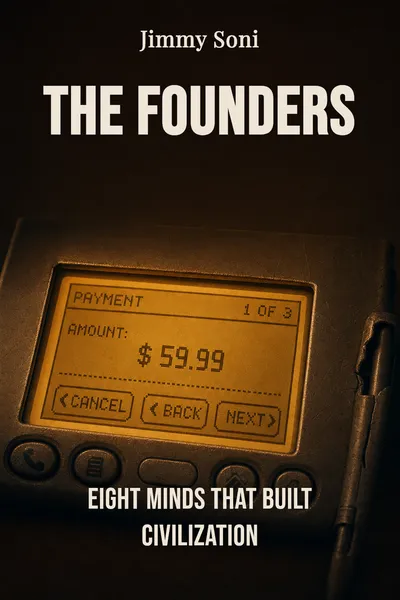
In the late 1990s, on a few floors of office space in Palo Alto, a group of young, mostly broke, mostly anxious engineers and operators were trying to build a way to beam money between Palm Pilots. The idea was half-baked, the name kept changing, and the company was hemorrhaging cash so fast that at one point it was losing roughly ten million dollars a month. Most of the people in the room had no track record. Several were immigrants who had arrived in the United States with almost nothing. A few would later be described, not entirely as a joke, as nearly unemployable anywhere else. The product they eventually shipped was called PayPal.
Jimmy Soni, in The Founders, tells the story of how that improbable group built a payments company, survived fraud, lawsuits, a brutal merger, and the bursting of the dot-com bubble, and finally sold to eBay in 2002 for about $1.5 billion. That alone would be a decent business story. What makes it strange is what happened next. The people from that one company went on to start or run Tesla, SpaceX, LinkedIn, YouTube, Yelp, Palantir, and a chain of venture funds — a cluster so dense it earned a nickname, the PayPal Mafia.
Soni's book is not really a celebration of those later companies. It is an attempt to reconstruct the actual chaos of the early days, before anyone was a billionaire, when the outcome was genuinely in doubt. The question underneath the whole thing is less about software than about people: what was in that room, and why did it travel so far?
The question we’re asking : How did one small, struggling startup end up seeding a whole generation of the companies that now define Silicon Valley?What we’ll see : How an unlikely team came together, what nearly destroyed it, and why the network it forged outlasted the company itself.
Table of contents
01 Chapter 1 — The losers who happened to be right
The people at the center of Soni's book did not look like winners when they arrived. Peter Thiel had failed to land a Supreme Court clerkship and washed out of a New York law firm in a matter of months, a setback he later described as the best thing that happened to him. Max Levchin, a Ukrainian immigrant, had already watched several of his own startups die before he turned twenty-three. Elon Musk had sold an earlier company, Zip2, but was widely regarded inside it as difficult to work with. Soni is careful not to retrofit these biographies into destiny. At the time, these were mostly people who had recently been told no.
What they shared was less talent on paper than a particular relationship to risk. Many were immigrants or children of immigrants, which Soni treats as more than a demographic footnote — having already gambled everything once to get to America, the leap into a doomed-looking startup felt smaller than it would to someone with more to lose. Levchin slept on the floor of the office. The culture rewarded people who would simply not stop working on a problem until it broke.

02 Chapter 2 — The unlikely chemistry of a founding team
The PayPal we remember was not one company but two that crashed into each other. Confinity, Thiel and Levchin's outfit, was building digital payments in the same building, more or less, as a banking startup called X.com, founded by Musk. The two were competing so directly, and burning money so recklessly to win users, that in early 2000 they did the only sane thing and merged. The merger was tense from the first day. Two sets of founders, two cultures, two egos-per-square-foot, fused under deadline pressure.
Soni lingers on how badly the team fit together on paper. Thiel was a libertarian intellectual who liked debating philosophy. Levchin was a security obsessive who thought in code. Musk wanted to build a financial supermarket and bet the company on bold moves. Around them gathered a cast of operators — Reid Hoffman, who became the diplomat smoothing over disputes, David Sacks, Keith Rabois, Roelof Botha, among many others — most of them young, opinionated, and convinced they were smarter than the person sitting next to them.
03 Chapter 3 — The fights, the firings, and the fortunes
The merged company nearly destroyed itself from the inside. The most dramatic episode comes in 2000, when a faction of the company, with Thiel and others involved, moved against Musk while he was out of the country on his honeymoon. The board replaced him as CEO and installed Thiel. Soni handles this without melodrama, which makes it more striking: the coup was not personal hatred so much as a cold judgment that the company would die under its current direction. Musk, remarkably, stayed on as an investor and adviser and did not torch the relationships — a detail that matters for everything that came later.
Beneath the leadership drama was an existential business threat. PayPal was being attacked relentlessly by fraudsters who had discovered the company was effectively wiring money around the world with weak controls. Losses from fraud at one point ran high enough to threaten the whole enterprise. Levchin's team responded by building one of the first serious machine-learning systems for fraud detection, a tool they nicknamed Igor. The company's survival turned out to hinge less on marketing than on the unglamorous engineering of trust.
04 Chapter 4 — What a founding team really is
Step back from the deals and the drama, and the PayPal story stops being about a payments company at all. The product was, in the end, replaceable; payments online would have happened with or without this particular team. What was not replaceable was the network the experience created — a few hundred people who had been through a genuine crucible together and emerged with money, scar tissue, and a shared confidence that they could build hard things from scratch. Soni's real subject is that network, not the software.
Notice how the diaspora actually worked. Thiel seeded much of it with capital and conviction, backing Hoffman's LinkedIn, the founders of Yelp, and a young Mark Zuckerberg. Musk poured his PayPal proceeds into SpaceX and Tesla. Hoffman built LinkedIn; Steve Chen, Chad Hurley, and Jawed Karim built YouTube; Sacks, Rabois, Botha, and others fanned out into companies and venture funds that financed the next wave. They hired each other, invested in each other, and vouched for each other. The trust forged under fire became the actual asset.
05 Conclusion
The company that came out of those Palo Alto floors no longer exists in the form Soni describes; it was folded into eBay, spun back out years later, and became a routine part of how the internet handles money. Measured only as a business, it was a success but hardly a singular one. Measured by who was in the room, it was something closer to a once-in-a-generation accident — a payments startup that turned out to be a launchpad for Tesla, SpaceX, LinkedIn, YouTube, and a swath of Silicon Valley's investing class.
Related books