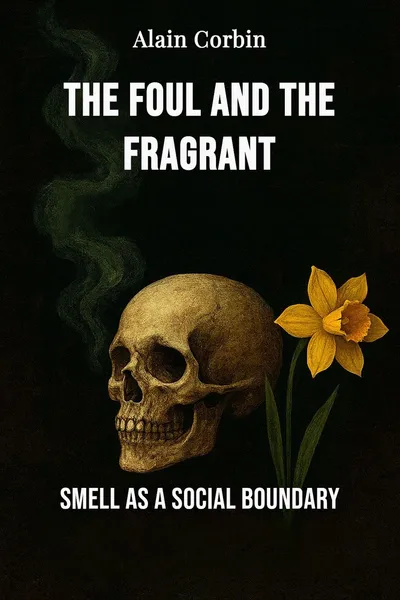
The Foul and the Fragrant
Smell as a social boundary
Description
In the France of the eighteenth century, the air itself was a subject of dread. Doctors, administrators and ordinary people alike believed that disease travelled on smell — that the stench rising from swamps, cesspools, cemeteries and crowded bodies carried the seeds of fever and death. Paris in the 1780s was a city where the smell of the Cemetery of the Innocents was so overpowering that neighbours complained their cellars had turned rotten, and where the authorities eventually emptied the graves and hauled the bones to the catacombs. Smell was not a nuisance to be tolerated. It was, in the reigning theory of the time, a threat to life.
The historian Alain Corbin took this half-forgotten anxiety and made it the spine of a history. Published in French in 1982 as Le Miasme et la Jonquille, his book follows the nose across roughly a century and a half of French life — from the great deodorizing campaigns of the Enlightenment to the perfumed intimacy of the bourgeois home. It is a history written not through wars or elections but through what people could stand to breathe, and what they could no longer bear.
What Corbin noticed is that the threshold of tolerance kept shifting. Smells that had been ordinary became unbearable; a nose grew sharper, more easily offended, more alert to the odour of other people. And once a society decides that certain smells are intolerable, it has quietly decided something about the people who carry them. That is where the story turns from chemistry to something closer to a map of who belongs.
The question we’re asking : Why did an entire society decide, over a century and a half, that smell had become intolerable — and what did that decision do?What we’ll see : How the war on odour ran from the reeking city to the perfumed body, and hardened into a line drawn between people.
Table of contents
01Chapter 1 — The nose that would not be ignored
Corbin begins with a paradox we tend to overlook: for most of history, people simply lived inside smells that would floor us. Cities were open sewers. Human and animal waste sat in courtyards, tanneries and slaughterhouses fouled whole neighbourhoods, and the dead were buried in shallow parish ground that leaked into the air of the living. What changed, in the second half of the eighteenth century, was not the quantity of stench but the willingness to endure it. The nose grew impatient.
Behind that impatience sat a theory. The reigning medical doctrine held that illness spread through miasma — corrupted, foul-smelling air rising from putrefaction. If you could smell rot, you were, in a real sense, breathing the disease. This made odour a matter of survival rather than delicacy, and it gave doctors and administrators a mandate to hunt down every source of stink in the name of public health. Smell became a diagnostic instrument, the cheapest available way to detect danger.

02Chapter 2 — When science taught the city to fear its air
The deodorizing effort of the Enlightenment was, in Corbin's telling, one of the great unremarked reform movements of the age. Administrators treated stench as an enemy of the state. They drained marshes, moved the dead beyond the city walls, paved and flushed streets, and demanded that hospitals be redesigned so that air could move rather than stagnate over the sick. The reeking, over-crowded ward became a symbol of everything an enlightened government was supposed to fix.
This was also a war against confinement. The most feared smells were the ones produced by bodies pressed together in closed space — the prison, the ship's hold, the poorhouse, the tenement. Doctors described the heavy, sweetish odour of the crowd as if it were a substance you could weigh, and they were not entirely wrong to worry: typhus and other fevers did rage in exactly these places. But the interpretation ran through smell, and so the remedy was framed as clearing the air.
03Chapter 3 — The private body and its new perfume
The second half of Corbin's history moves indoors, into the bourgeois home and onto bourgeois skin. As the public air was cleaned up, attention narrowed to the individual. The rising middle class began to treat its own body as something to be managed, monitored and, above all, deodorized. Sweat, breath and the ordinary secretions of living became sources of private shame in a way they had not been before.
The tastes in perfume shifted to match. Corbin traces a movement away from the heavy animal scents of the old aristocracy — musk, civet, ambergris, smells that mimicked the body rather than masking it — toward the light, clean, floral notes of the nineteenth century: rosewater, lavender, the vegetal freshness that suggested purity rather than seduction. The new bourgeois wanted to smell not of the body but of the garden, of something washed and restrained. The jonquil of Corbin's French title stands for exactly this delicate, disciplined fragrance.
04Chapter 4 — Deodorizing as a way of keeping distance
Step back from the individual scenes and Corbin's larger argument comes into focus: the long campaign against smell was, underneath the medicine, a way of drawing lines between people. Odour is the most intimate of the senses and the hardest to argue with. You cannot reason with a smell you find repellent; you simply recoil. That made it an unusually powerful, and unusually deniable, instrument of social separation.
Once the bourgeoisie had trained itself to be clean and lightly scented, the smell of the poor became the mark of the poor. The labouring body, the crowded quarter, the sickroom — these were now sensed as offensive, and the offence carried a verdict. To smell bad was to be read as disorderly, dangerous, not quite fully civilized. The reformer who wanted to deodorize the slum was expressing genuine concern for public health and, at the same time, rehearsing his own distance from the people who lived there. The two motives were braided together and impossible to separate.
05Conclusion
Corbin's history runs from the emptied graves of the Cemetery of the Innocents to the lavender-scented drawing room of the respectable nineteenth-century family, and the through-line is a single sense growing steadily more exacting. What began as a fear of the city's poisoned air ended as a fear of the human body — and, more precisely, of other people's bodies. The miasma of the title was supposed to be the enemy; the jonquil was supposed to be the cure. In practice, the movement from one to the other traced the rise of a class that learned to define itself by what it could no longer bear to smell.
Related books