The Flaw
Money creation as a political question
Description
On January 1, 1999, eleven European countries locked their exchange rates and handed the keys to their currencies to a single institution in Frankfurt. Three years later the notes and coins arrived in wallets from Lisbon to Helsinki. The euro was presented as the crowning achievement of European integration — a shared money for a shared future, a technical upgrade that would finally put an end to the messy competitive devaluations of the twentieth century. For a decade it worked well enough that few people asked what, exactly, had been agreed to. Then the debt crisis of 2010 arrived, and the questions came all at once.
The French economist and philosopher Frédéric Lordon spent years arguing that the euro was not a neutral piece of financial plumbing. In his book The Flaw, he treats the single currency as a case study in a much older and more uncomfortable truth: that money is never just an economic instrument. It is a political relationship. Who creates it, who controls its supply, who decides when to expand it and when to squeeze it — these are questions about power, not about accounting. And the euro, Lordon contends, was designed precisely to make those questions disappear.
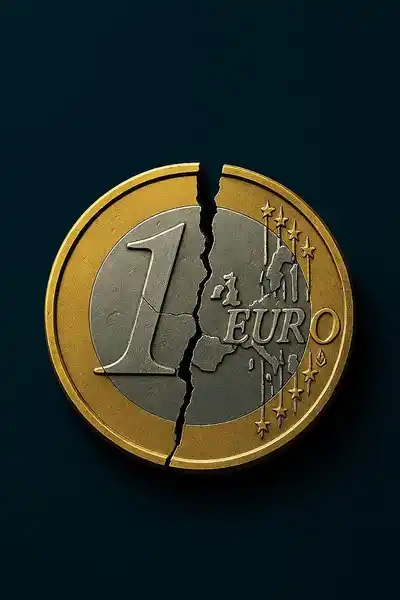
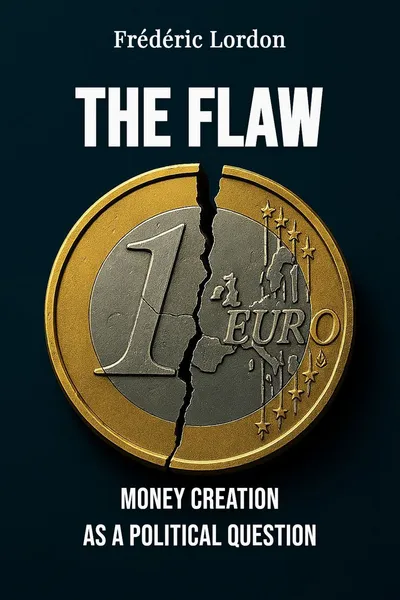
That design choice is the flaw of the title. Not a bug in the software, not a miscalculation by economists who forgot a variable, but a deliberate architecture built to place monetary decisions beyond the reach of any electorate. The interesting part is not that the euro had problems. Every currency has problems. The interesting part is what those problems revealed about a promise that had been quietly made on everyone's behalf — the promise that money could be run by rules instead of by politics.
The question we’re asking : What did European governments actually give up when they adopted a shared currency, and can money ever really be depoliticized?What we’ll see : How a monetary union built to escape politics ended up putting sovereignty itself back on the table.
Table of contents
01Chapter 1 — The euro was built to escape politics
The euro was born out of distrust — specifically, distrust of governments. Through the 1970s and 1980s, European economies had lived with high inflation, and the dominant lesson drawn from that decade was that politicians could not be trusted with the printing press. Left to their own devices, the reasoning went, elected officials would always be tempted to inflate away debts, buy votes with cheap money, and run the currency into the ground before the next election. The solution was to take the decision out of their hands.
This is the intellectual foundation Lordon keeps returning to. The architecture of the euro was drawn up by people who genuinely believed that monetary policy should be insulated from democratic pressure — that a good currency was one no minister could touch. The German model of an independent central bank, forged from the trauma of Weimar-era hyperinflation and refined during the postwar decades, became the template. The Bundesbank answered to no government, and by many measures it worked. When the single currency was designed in the early 1990s, that model was written into its bones.

02Chapter 2 — A currency with no state behind it
Every currency in history had rested on something. Behind the dollar stood the United States — a treasury that could tax, a government that could spend, a political community that could decide, in a crisis, to pool its resources and stand behind its money. The euro was different. It was a currency without a corresponding state. There was a central bank in Frankfurt but no European treasury, no shared budget of any real size, no common fiscal authority that could act on behalf of the whole. Seventeen governments shared a money while keeping their national finances separate.
Lordon sees this as the deepest structural problem, and it follows directly from the depoliticization project. A real fiscal union would have required real political union — a European democracy capable of taxing Germans to help Greeks, or borrowing collectively in everyone's name. That would have meant genuine transfers of sovereignty, debated and legitimated by voters. The euro's designers wanted the currency without the political community that a currency normally implies. They built the roof and skipped the foundation.
03Chapter 3 — When the debt crisis exposed the missing piece
The test came in late 2009 and 2010. A new Greek government revealed that the country's deficits had been far larger than reported, and lenders reacted the way lenders do when they suddenly doubt they will be repaid: they demanded higher interest to keep holding Greek debt, then began refusing to hold it at all. Because Greece could not create euros, it had no way to reassure the market on its own. Borrowing costs spiraled. Within months the same fear had spread to Ireland, Portugal, Spain, and Italy — countries with very different problems, all sharing the same missing backstop.
This is the moment Lordon's argument had been building toward. The crisis was not simply the story of one country that had spent too much. It was the structural flaw revealing itself. A currency without a state had no automatic mechanism for defending its members when confidence collapsed. The European Central Bank was legally forbidden from directly bankrolling governments, and no shared treasury existed to spread the burden. What had been presented as prudent rules turned out to be, in a crisis, a set of locked doors.
04Chapter 4 — Who gets to decide what money is
Step back from the eurozone's particular troubles and Lordon's larger claim comes into focus: money creation is always a political question, and no amount of institutional design can make it otherwise. A currency is a promise held together by collective belief, and someone always decides how much of it exists, on what terms, and for whose benefit. To hand that decision to an independent central bank governed by fixed rules does not remove the decision — it assigns it. The euro did not prove that money can be depoliticized. It proved that the attempt to depoliticize money is one of the most consequential political decisions a society can make.
This reframes the whole debate about the single currency. The usual argument treats the euro as an engineering problem — get the rules right, add a bit more fiscal coordination, tighten the banking union, and the machine will run smoothly. Lordon's point is that no set of rules can be neutral, because every rule encodes a choice about who bears the cost of monetary stability. Keeping inflation low protects creditors and savers; it can come at the expense of workers and debtors. Prioritizing employment does the reverse. There is no view from nowhere. Choosing one mandate over another is taking a side.
05Conclusion
The euro that arrived in wallets in 2002 was sold as a technical achievement, a piece of shared infrastructure that would put an end to the old currency squabbles of a divided continent. Lordon's reading is that it was something far more ambitious and far less honest: an attempt to run a currency without the political community that currencies normally rest on, and to disguise a profound choice about power as a neutral matter of sound management. The crisis that began in 2010 did not create that flaw. It merely forced it into the open, where it had been all along.
Related books