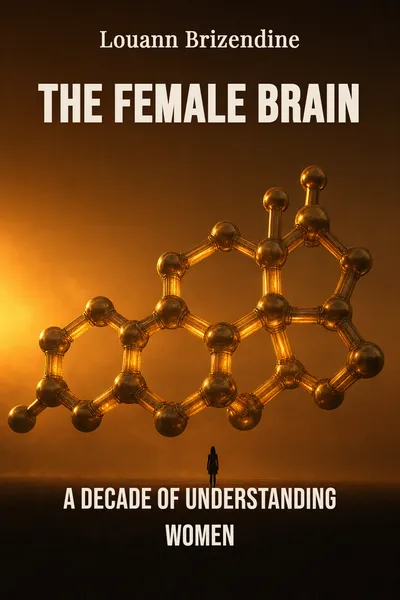
The Female Brain
A decade of understanding women
Description
In 2006, a psychiatrist at the University of California, San Francisco, published a slim book with a provocative premise. Louann Brizendine had spent years running a clinic devoted to women's moods and hormones, and she had grown tired of a scientific default she considered simply wrong: that the human brain is essentially male, and that the female version is a variation on the theme. Her book, The Female Brain, argued the reverse of the assumption — that a woman's brain is its own thing, shaped hour by hour by a chemistry that shifts across a day, a month, a lifetime.
The book landed hard. It became a New York Times bestseller, sold close to a million copies, was translated into more than thirty languages, and eventually loaned its title to a romantic comedy with Whitney Cummings and Sofia Vergara. Ten years on, Brizendine returned to it, and the claim had not softened. The female brain, she maintained, runs on hormones the way a city runs on weather — invisible, constant, decisive. Estrogen, progesterone, oxytocin, testosterone: not background noise, but the script.
That framing is where the book gets both its reach and its trouble. It reads a woman's life as a sequence of chemical chapters, each one reorganizing perception, mood, and desire. It is a confident story, told with clinical anecdotes and a warm bedside manner. Whether the science underneath is as settled as the storytelling suggests is a question that has followed the book since the first edition.
The question we’re asking : What does Brizendine mean when she says the female brain is a thing of its own, and how far does the biology actually carry the claim?What we’ll see : How one clinician turned a career of case notes into a hormonal biography of women — and what a decade of readers, and critics, made of it.
Table of contents
01Chapter 1 — The brain that isn't unisex
Brizendine opens with a correction. For most of the twentieth century, she argues, medical research treated the male body as the standard subject and read female biology as a deviation from it. Drug trials ran on men. Neurology assumed one brain, occasionally disturbed by female hormones. Her book plants itself against that habit. Men and women share almost all their neural circuitry, she grants — but the circuits are weighted differently, and the difference, in her telling, is not decoration. It shapes what a brain notices, fears, and wants.
The specific claims are where readers either lean in or raise an eyebrow. Brizendine describes regions she says run larger or busier in women — the areas tied to language, to reading emotion on a face, to tracking the mood of a room. She points to a memory center she says is more active, and a fear-and-anger center she says is comparatively smaller. The picture she draws is of a brain tuned toward connection, communication, and the detection of threat to relationships before threat to the body.

02Chapter 2 — A childhood already wired
The story begins before birth. Brizendine describes a fetal brain that starts on a shared plan and then, around the eighth week, either gets a surge of testosterone that reshapes it toward the male pattern or does not, and continues toward the female one. From that fork, she argues, a lot follows. The girl brain, in her account, arrives primed for the social world — attuned early to faces, to voices, to the emotional traffic between people.
The book leans on developmental observations to make the case. Baby girls, she reports, tend to hold eye contact longer and read expressions sooner. Toddler girls talk earlier and, on average, more. In play, she describes a pull toward turn-taking and consensus, a discomfort with the raw dominance games she associates with boys. None of this, she is careful to say some of the time, means a girl cannot climb, compete, or lead. It means, in her framing, a default setting that the world then amplifies.
03Chapter 3 — The chemistry of love and desire
If puberty is the book's turning point, adult love is its centerpiece. Brizendine reads romance as a hormonal event with distinct phases, and she describes them with the relish of a clinician who has watched them play out in hundreds of patients. Early attraction, in her account, floods the brain with dopamine and a stress chemistry that feels like exhilaration — sleeplessness, obsession, the sense that nothing else matters. It is intense, and by design it does not last.
Then comes the hormone the book keeps returning to: oxytocin. Released by touch, by closeness, by orgasm, it is her chemistry of attachment, the molecule she credits with turning attraction into bond. Brizendine argues that women's brains are especially responsive to it, which she uses to explain a familiar asymmetry — the tendency, she says, for physical intimacy to fold more quickly into emotional attachment. It is a tidy explanation, and one many readers found they recognized in their own lives.
04Chapter 4 — When the hormones step back
The book's later chapters follow the chemistry into middle and older age, and this is where its argument turns most interesting — and most double-edged. Pregnancy and motherhood, in Brizendine's telling, remodel the brain wholesale, oxytocin and other hormones rewiring priorities around the infant with a force she describes as biological, not chosen. Then, decades on, menopause pulls the estrogen back out. And here she makes a claim that unsettles the tidy story of the earlier pages.
When estrogen recedes, she argues, the brain that was tuned toward pleasing, soothing, and reading everyone else's moods is partly released from that tuning. Many women, in her clinical experience, report the change as a kind of clarity — a new bluntness, a lowered tolerance for managing others, a redirection of energy outward. The same hormonal machinery that the book spent chapters describing as the source of connection is now described, in its absence, as the source of a hard-won freedom.
05Conclusion
Ten years after it first appeared, The Female Brain remains what it was at the start: a clinician's confident biography of women told through their chemistry, from the fetal fork to the quiet after menopause. Its through-line never wavers — that the female brain is its own instrument, retuned again and again by hormones that most of medicine had long treated as noise. Brizendine's gift is the bedside voice that turns endocrinology into recognizable life, the reason a million readers saw themselves in her case notes and a film borrowed her title.
Related books