The Fatal Conceit
When planners overreach
Description
In 1988, at the age of eighty-eight, F.A. Hayek published a slim, combative book called The Fatal Conceit: The Errors of Socialism. It was meant to be the opening volume of a larger project — a grand debate he imagined staging between socialism and its critics — and though the fuller plan never came, this first installment stood on its own as a final statement. Hayek had spent his life, from Vienna to London to Chicago to Freiburg, arguing one idea from a dozen angles: that the most valuable things humans possess were never planned by anyone. Here, near the end, he wanted to name the mistake he thought lay beneath a century of ruinous experiments.
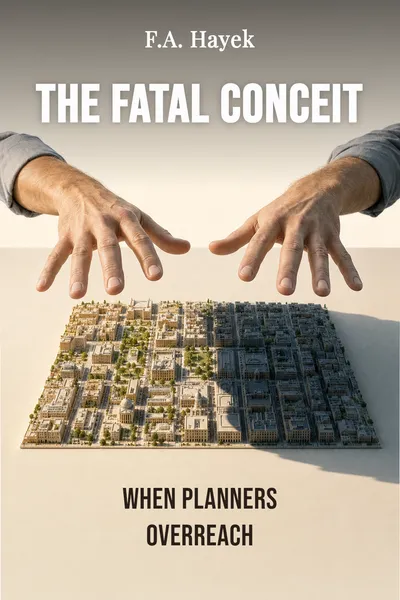
The mistake he named is in the title. The fatal conceit is the belief that, as he put it, man is able to shape the world around him according to his wishes — that because we can reason, we can design the whole of society the way an engineer designs a bridge. Socialism, for Hayek, was the purest expression of that belief. And his charge was unusually blunt: socialism was not merely unwise or unkind, it was mistaken on factual and even logical grounds, and its repeated failures across the twentieth century flowed directly from those errors rather than from bad luck or bad men.
What makes the book more than a Cold War pamphlet is where Hayek locates the error. Not in politics, but in a theory of knowledge — in a claim about what a human mind can and cannot know. He is asking how an economy of millions of strangers manages to feed a city no one is running, and why the people most confident they could run it better tend to break the thing they touch.
The question we’re asking : If no one designed the market, where does its order come from — and why does the confident planner keep failing to improve on it?What we’ll see : How Hayek traces prices, morals and coordination back to a knowledge no single mind can hold, and why that makes the planner's confidence a fatal one.
Table of contents
01 Chapter 1 — The order nobody designed
Hayek opens with a distinction that carries the whole argument. There are made orders — things a mind conceived and built, a house, a factory, an army — and there are grown orders, patterns that emerge from countless separate actions without anyone intending the result. Language is one. Money is another. Common law is a third. And the market, in his telling, is the largest grown order of all. It looks designed because it works so well, and that appearance is exactly the trap.
The Greeks, he notes, had already sensed the split, dividing what exists by nature from what exists by human convention. Hayek's point is that this leaves out a whole middle category — things that are the result of human action but not of human design. A footpath worn across a field was made by feet, not by a surveyor, yet it finds a sensible route all the same. The economy is that footpath scaled to billions of feet. No committee drew it; it accumulated.

02 Chapter 2 — Where the moral rules came from
Before the market can work, Hayek argues, people have to behave in certain ways they did not choose and cannot fully justify — keeping promises, respecting property, honoring contracts with strangers. These rules feel like common sense, but he insists they are anything but obvious. For most of human existence we lived in small bands where everyone knew everyone, where sharing was survival and trading with outsiders was suspect. The instincts bred into us over that long span were instincts of solidarity, not of extended cooperation.
The rules that let strangers cooperate came later, and they came the hard way. Hayek describes them as evolved rather than reasoned — practices that spread not because anyone proved they were right but because the groups that happened to adopt them grew, fed more people, and outlasted the groups that did not. Private property, in this account, was never a moral argument that won. It was a habit that worked, carried forward by the societies it strengthened, long before any philosopher tried to defend it.
03 Chapter 3 — Why the mind cannot hold the market
At the core of the book sits a claim about knowledge that Hayek had been refining for decades. The information an economy needs to function — who wants what, how badly, what can be made from which materials at what cost, where a shortage is opening up tomorrow — does not exist in any one place. It is scattered across millions of heads, much of it fleeting, much of it never spoken, some of it not even conscious. No planner, however brilliant, however well-equipped with data, can assemble it, because most of it cannot be written down at all.
The market's genius, on this view, is that it never needs to. The price of a thing quietly gathers what a thousand strangers know and dumps the summary into a single number. When tin grows scarce somewhere in the world, its price rises, and everyone who uses tin adjusts — without knowing why, without needing to know. The signal travels; the knowledge behind it stays put and stays private. Prices, Hayek says, are a communication system for information no one possesses in full.
04 Chapter 4 — The trap of the visible hand
Step back from the argument about prices and something larger comes into view. What Hayek is really diagnosing is a temptation of reason itself — the pull to trust only what we can consciously explain, and to treat whatever resists explanation as arbitrary, wasteful, or ripe for redesign. He gives it a name borrowed from the philosopher he most admired and most distrusted at once: rationalism, in the overreaching sense, the conviction that a mind can grasp the whole of what it is embedded in and improve it from the outside.
The fatal conceit, on this reading, is not a policy error but a category error about the human situation. We are products of an order we did not make and cannot fully understand, and the same faculty that lets us understand anything at all tempts us to believe we understand everything. Reason, Hayek insists, is itself a grown thing, shaped by the very traditions it later presumes to judge. The demand that civilization justify itself to reason is the demand that a stream turn around and audit the spring it came from.
05 Conclusion
Hayek finished The Fatal Conceit as an old man returning one last time to the question that had occupied his entire life: how a civilization of strangers holds together without anyone holding it. His answer, stripped down, is that it holds because no one is in charge — because prices carry knowledge no mind could gather, and because inherited rules do work we cannot consciously reconstruct. The conceit he names is the refusal to accept this, the belief that what we cannot explain we may as well replace.
Related books