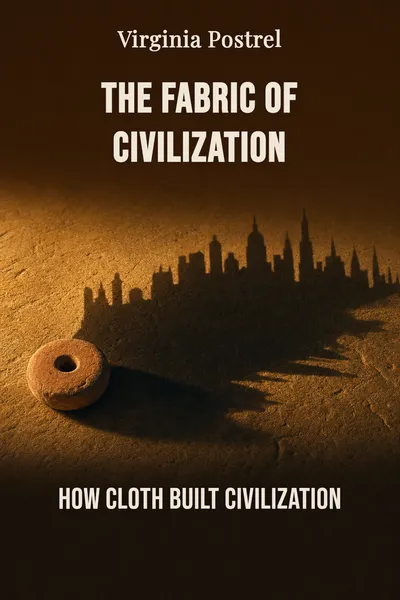
The Fabric of Civilization
How cloth built civilization
Description
Look at what we're wearing right now. A shirt, a pair of jeans, socks — objects so unremarkable we register them only when a seam gives out or a sleeve rides up. And yet each one is the endpoint of one of the longest and most demanding technical projects our species has ever undertaken. Before there were cities, before writing, before the wheel, people were already spinning fiber into thread and weaving thread into cloth. The materials rotted, so the archaeological record is thin, but the tools survive: spindle whorls, loom weights, bone needles going back tens of thousands of years. Someone, very early, figured out how to turn a fluffy handful of plant or animal fiber into something long, strong, and continuous. That trick is stranger and harder than it looks.
This is the argument Virginia Postrel builds in The Fabric of Civilization, published in 2020. Her claim is not the soft one — that clothes matter to us emotionally, that fashion says something about who we are. It's the hard one: that the making of cloth drove agriculture, mathematics, chemistry, banking, and industry, and that textiles were the demanding technology pulling human ingenuity forward for millennia. We think of cloth as the backdrop against which history happens. Postrel flips it. Cloth, she argues, is a good part of the machinery of history itself.
The reason we miss this is precisely because textiles won. A technology that succeeds completely disappears into the ordinary. We don't marvel at thread for the same reason we don't marvel at the alphabet: it's everywhere, it's cheap, and it works. Postrel's project is to make the familiar strange again — to walk us back through the fiber, the thread, the cloth, the dye, the trade, and the consumer, and show how much civilization got built along the way.
The question we’re asking : How did something as ordinary as cloth end up shaping agriculture, mathematics, trade, and the industrial world?What we’ll see : How Postrel traces civilization through the long, demanding history of making, coloring, trading, and finally forgetting cloth.
Table of contents
01 Chapter 1 — Thread came before the wheel
Postrel opens where the story actually begins, which is not with weaving but with fiber. Wool, cotton, flax, and silk each had to be coaxed out of a living thing that did not evolve to give it to us. Wild sheep have coarse, molting hair, not the fluffy fleece we know; the woolly sheep is a human invention, bred over centuries until the animal produced a fiber it could no longer shed on its own. Cotton had to be selected until its fibers grew long enough to spin. The domestication that gave us textiles ran in parallel with the domestication that gave us food, and Postrel makes the case that fiber, not just calories, was part of why early people bothered to farm at all.
Then comes the part we never think about: the sheer quantity of thread. Spinning by hand — with a spindle and a weighted whorl, twisting fiber into a continuous strand — is astonishingly slow. Postrel cites the arithmetic that makes the point land. A single Greek trireme's sail, or the clothing for an ordinary household, or the linen wrappings of an Egyptian mummy, each represented staggering hours of spinning, almost all of it done by women, almost all of it invisible in the historical record. For most of human history, spinners were the largest category of skilled labor on the planet, and they were never idle.

02 Chapter 2 — The math hidden in a bolt of cloth
If thread is the raw material, pattern is where cloth starts talking to mathematics. Postrel is drawn to the moment weaving stopped being a single crosswise pass and became something combinatorial. Once you can raise some warp threads and not others, in programmable sequences, you can produce twill, damask, brocade — patterns that repeat, mirror, and interlock according to rules. Managing those rules meant thinking in terms we'd now call algorithmic: this set of threads, then that set, then back again, counted precisely across the width of the cloth.
She traces this thread forward to one of its most famous descendants. The drawloom, which let weavers produce elaborate figured silks, required an assistant to lift specific groups of threads for each pass — a slow, error-prone job. In early nineteenth-century Lyon, Joseph-Marie Jacquard perfected a system that stored the pattern on a chain of punched cards, the holes and blanks telling the loom which threads to raise. The pattern had become information, physically separable from the cloth and reusable at will. It is not a coincidence, Postrel notes, that this arrangement fed directly into the imagination of computing — Charles Babbage owned a woven silk portrait of Jacquard produced on such a loom, and the punched card lived on for another century and a half.
03 Chapter 3 — Dyes, contracts, and the machinery of trade
Undyed cloth is useful; colored cloth is desirable, and desire moves goods across the world. Postrel devotes real attention to dye because it turns out to be some of the most sophisticated chemistry practiced before the chemical age. Getting a color to bind to fiber and stay there — through washing, through sunlight — required mordants, fermentation, precise timing, and closely guarded recipes. Indigo demanded a controlled vat that reduced the pigment so it could enter the fiber and then oxidize back to blue on contact with air. Tyrian purple came from a Mediterranean sea snail in quantities so small that the color became a byword for imperial wealth. These were not decorations; they were valuable, tradeable outputs of hard-won knowledge.
04 Chapter 4 — When we stopped seeing what we wear
Step back from the anecdotes and Postrel's real subject comes into focus: cloth is the technology we forgot was a technology. Every step she describes — the domesticated fiber, the endless spinning, the programmable loom, the chemistry of dye, the credit that moved bolts across the sea — was once a frontier where the smartest available effort was concentrated. The Industrial Revolution itself began in textiles, with the spinning jenny, the water frame, and the power loom, because that was where the demand and the difficulty were greatest. Cloth was the hard problem of its age, over and over.
What changed is that the problem got solved so thoroughly it vanished from view. Postrel's account of contemporary fashion — the global supply chains, the fast-fashion cycle, the labor conditions, the sustainability strain — reads differently once you've walked the long history. The reason a T-shirt can cost a few dollars is that thousands of years of accumulated ingenuity, plus a century of industrial and chemical refinement, have made the miraculous routine. Abundance is the achievement. It's also what lets us treat cloth as disposable and its makers as invisible.
05 Conclusion
By the end, the ordinary shirt has stopped being ordinary. Postrel has walked us from the bred-for-fleece sheep to the punched card, from the indigo vat to the Medici ledger, and the effect is cumulative: cloth stops being the backdrop and becomes one of the load-bearing walls of the human project. The materials rotted away, which is why the story went untold for so long, but the fingerprints are everywhere — in our numbers, our chemistry, our banks, our factories.
Related books