
The Extended Phenotype
When genes shape other bodies
Description
In 1982, six years after The Selfish Gene made him famous, Richard Dawkins published a book he described as the thing he would most want to be remembered for. It was not written for the general reader; it was aimed at his fellow biologists, and it carried a title that sounds like a riddle: The Extended Phenotype. The phenotype is the visible animal — the beak, the tail, the color of a moth's wing, everything genes build out of flesh. Dawkins wanted to argue that this list stops too soon. Genes, he claimed, do not stop at the skin.
The claim is stranger than it first sounds. A spider's web, a beaver's dam, the elaborate case a caddis-fly larva glues together from grains of sand — none of these are made of the animal's cells, yet all of them are shaped, generation after generation, by natural selection acting on genes. And if selection can favor a gene for a slightly better web the same way it favors a gene for a slightly longer leg, then the web is as much a product of the gene as the leg is. The dam belongs on the same list as the tail.
From there the book pushes into territory that unsettles our intuitions about where one creature ends and another begins. Once genes are allowed to reach outside the body, they can reach into other bodies too — and that is where the argument stops being a curiosity about webs and dams and becomes a claim about who, exactly, is in charge.
The question we’re asking : What does it mean to say a gene's real effect is not the body it sits in, but the world it changes around it?What we’ll see : How a single idea about where the animal ends redraws the map of adaptation, from a beaver's dam to a parasite steering a host it has never touched.
Table of contents
01Chapter 1 — The animal in the mirror is the wrong unit
We tend to think of evolution as a story about animals. The fastest gazelle survives, the brightest peacock breeds, and their traits get passed on. It is a comfortable picture because it matches what we see: whole creatures competing, mating, dying. Dawkins spent much of his career trying to dislodge it, and The Extended Phenotype is the sharp end of that project. The organism, he argues, is not the thing natural selection really cares about. It is a vehicle — a temporary machine that genes build and then discard.
The reasoning is simple once stated. Genes are what persist. A gazelle lives a decade at most; the genes inside it are copies of copies stretching back millions of years and, if things go well, forward millions more. Selection can only remember what replicates, and organisms do not replicate — they die. Genes do. So when we ask why an animal has a particular trait, the honest answer is that the gene for that trait outcompeted its rivals over deep time. The animal is the scoreboard, not the player.

02Chapter 2 — A beaver dam is a body part
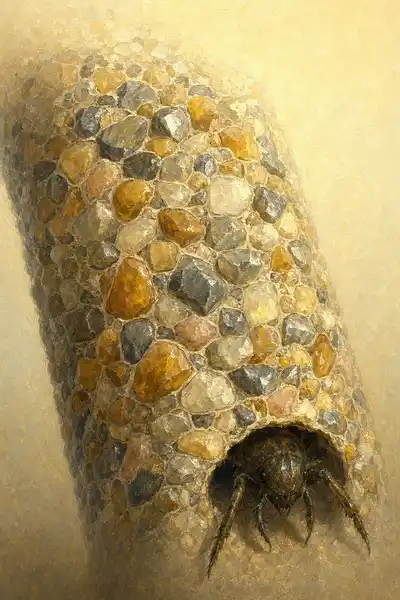
Consider the caddis-fly larva. It lives at the bottom of streams and builds itself a protective tube, cementing together stones, sand grains or fragments of shell in a pattern specific to its species. The case is a marvel of engineering, and every detail of it — the size of grain preferred, the way pieces fit — is under genetic control, refined by selection over countless generations. A larva with genes for a stronger case survives better and leaves more offspring, who inherit those same building instructions. The case is not made of the larva's cells. But it is built by the larva's genes just as surely as its gut is.
Dawkins asks why we would treat this case any differently from a snail's shell. The shell is secreted by the animal's own tissue, so we happily call it phenotype. The caddis case is assembled from stones the animal gathers, so we hesitate. Yet from selection's point of view there is no difference. Both are structures that a gene reliably produces, both affect the animal's survival, and selection acts on both identically. The stone tube is a genetic product that happens to be made of stone rather than of flesh. The boundary we drew at the skin turns out to be arbitrary.
03Chapter 3 — The gene that steers another animal
If genes can build structures outside the body, the next step is unavoidable and far more disturbing: they can reach into other bodies. Parasites, Dawkins argues, are the clearest case. A fluke that needs to move from a snail into a bird, for instance, does better if the snail behaves in ways that get it eaten by that bird — crawling into exposed places, losing its usual caution. And there are parasites that do exactly this. The fluke's genes, expressed through the fluke, alter the snail's behavior. The changed behavior is a phenotype of the fluke's genes, even though it manifests in the snail's nervous system.
The examples multiply once the framing is in place. Certain wasp larvae cause their caterpillar hosts to stand guard over the wasp's cocoons. Some parasites make their intermediate hosts conspicuous and reckless, all but delivering them to the predator that is the parasite's next home. In each case a gene sitting in one animal produces an effect in another animal's body, and that effect is favored by selection precisely because it helps the gene inside the parasite make more copies of itself. The host has been turned, partly, into an instrument of another creature's genome.
04Chapter 4 — Where does the body end?
Step back and the book's real target comes into view: our confidence that an organism is a natural, self-evident unit. We treat the individual animal as obviously the right thing to talk about — bounded by its skin, driven by its own interests, the hero of its own evolutionary story. The extended phenotype dissolves that confidence. If a gene's effects run out into stones and dams and rival nervous systems, then the skin is not a meaningful boundary. It is just the place where one kind of chemistry gives way to another.
This does not mean the organism is an illusion. Dawkins is careful here: most of the time the genes riding inside a body really do share a common interest, because they all leave through the same exit — the same eggs and sperm. That shared exit is what makes a body cohere, what makes it behave like a single agent pursuing a single goal. The organism is real, but it is a consequence, not a starting point. It is what you get when a great many genes happen to be in the same boat and rowing the same way. Where their interests diverge — as with parasites, or with stretches of genome that cheat their own host — the illusion of a unified individual cracks.
05Conclusion
Dawkins called The Extended Phenotype his best idea, and it is easy to see why he prized it over the more famous book that preceded it. The selfish gene told us to look past the organism to the replicator inside it. The extended phenotype tells us to look past the organism in the other direction too — outward, to everything the replicator changes in the world beyond its cell walls. The web, the dam and the manipulated host stop being oddities and become the natural end of a single logic: genes are favored for their effects, and effects do not respect the edge of a body.