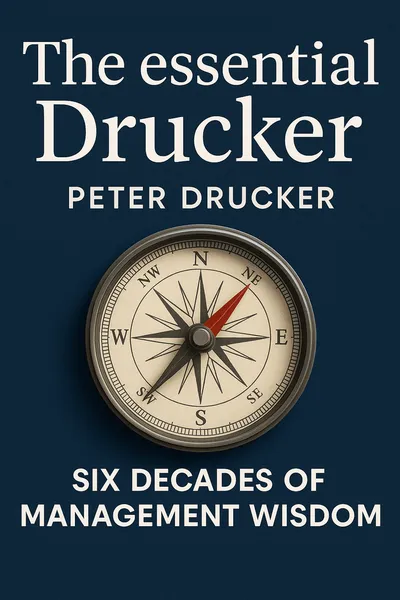
The essential drucker
Six decades of management wisdom
Description
Global markets will operate without barriers, allowing information to flow freely. Consumer power will increase significantly due to their access to vast amounts of information. Manufacturing's role in the economy will continue to diminish, while knowledge workers will emerge as the predominant force in the new economy.
The challenges of future management will primarily be addressed by individuals rather than governments. Understanding and skillfully managing the available tools will be crucial for navigating the future effectively.
Table of contents
01 Exploring drucker's management insights
Peter Drucker, a distinguished authority in management, has always stressed the critical nature of personnel management and decision-making within an organization. He pointed out that decisions related to staffing are not only pivotal but also have a long-lasting impact, making them complex to reverse. Drucker highlighted the dangers of neglecting these aspects, such as diminished performance and a potential erosion of respect within the organization.
To improve the effectiveness of staffing and promotional decisions, it is recommended that managers deeply analyze the nature of the job, recognizing that its requirements might change over time. This approach necessitates the selection of individuals who are not only competent for the current challenges but are also adaptable to future ones, rather than solely focusing on past achievements.
It is advised to consider a wide range of candidates, ideally between three to five qualified individuals, with an emphasis on identifying their strengths. This is because future performance cannot be constructed on weaknesses. Engaging in conversations with each candidate's former colleagues can offer valuable insights into their ability to foster future leaders and managers.
Moreover, it is crucial to clearly outline the job responsibilities and to conduct follow-ups a few months after the role has been assumed, as the skills and actions that secured the position may significantly differ from those required for ongoing success in the role.

02 Drucker's perspective on the individual
Communication within an organization is not just a mere instrument; it embodies the operational essence and vitality of the organization itself. Peter Drucker, a distinguished management theorist, asserted that communication transcends the simplistic notion of a one-directional flow from one person to another. Instead, it is a vibrant interchange within a collective 'us', highlighting the pivotal role of shared experiences in fostering effective communication. Drucker elucidates that organizational communication is not just a conduit to achieve objectives but the primary mechanism through which an organization functions.
Drucker delineates four fundamental tenets that form the bedrock of business communication. The first principle posits that communication is fundamentally about perception; it only exists when there is an individual to receive and interpret the message. In the absence of a recipient, communication is reduced to mere noise.
The second principle suggests that communication is molded by expectations, as recipients are predisposed to interpret messages through the lens of their anticipated outcomes. The third principle states that communication inherently imposes demands on its recipient, compelling them to act, embrace a new belief, or experience a change. The fourth and final principle distinguishes between communication and information, noting that while they are interrelated, they are not synonymous. Information is defined by its logical structure and relies on the medium of communication to be effectively disseminated and understood.
03 Drucker's views on society
The twentieth century was marked by unparalleled social transformations, reshaping the very essence of life in developed, market-driven societies in both profound and unprecedented ways. As the century drew to a close, every facet of society—be it employment, the workforce, societal structures, or political dynamics—had experienced transformative shifts in both quality and quantity. These shifts were markedly different from the conditions at the century's inception and anything previously witnessed in human history. The changes have redefined the configuration, processes, challenges, and structures of society.
Looking forward, the twenty-first century seems set to continue this trajectory of social, economic, and political upheaval, especially in its early decades. The era of social transformations is far from concluding, and the challenges that lie ahead may prove to be even more daunting than those we have already faced. However, our ability to address the future's looming issues is contingent upon our capacity to confront the challenges posed by the developments that have already taken place. If the twentieth century was characterized by social transformations, then the twenty-first century must prioritize social and political innovations.
A notable shift observed in the twentieth century was the significant decline in the number of farmers, who once constituted the predominant group in every country, dwindling to a mere 5 percent of the population and workforce. This period also saw the disappearance of live-in domestic servants. The economic status of blue-collar workers experienced a dramatic rise mid-century, only to face a sharp decline towards the century's end. Emerging prominently were knowledge workers, set to become the most significant segment within the workforce and population of most developed nations. This marks the beginning of the knowledge society, ushering in an era of unparalleled competitiveness. In this new dynamic, countries, regardless of their historical backgrounds, have the opportunity to participate.
Related books