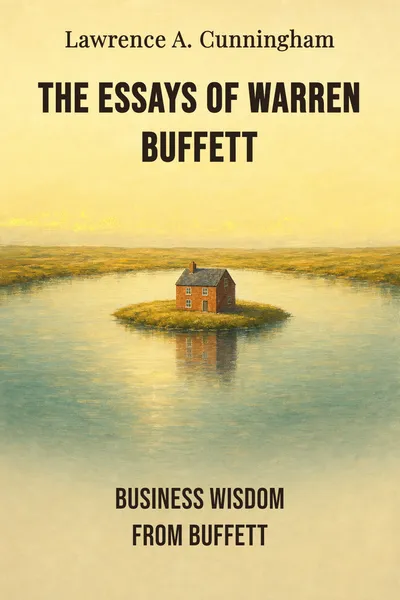
The Essays of Warren Buffett
Business wisdom from Buffett
Description
Every spring, a document arrives that people who otherwise never read annual reports sit down and read cover to cover. It is the letter Warren Buffett writes to the shareholders of Berkshire Hathaway, the insurance-and-everything-else conglomerate he has run since the mid-1960s. The letters are long, plainspoken, funny in a dry Midwestern way, and stuffed with jokes about baseball, bridge, and his own mistakes. What they are not is the usual corporate prose — the fog of "synergies" and "going forward" that most companies bury their investors under. For decades the letters circulated as an underground syllabus, photocopied and passed around business schools and trading desks by people who had figured out that the man was teaching, not just reporting.
In the mid-1990s, a law professor named Lawrence A. Cunningham did something obvious that nobody had done: he took the scattered letters, cut the year-by-year repetition, and arranged the passages by theme. The result was "The Essays of Warren Buffett," a book that reads less like a corporate archive and more like a coherent philosophy of business — investing, accounting, corporate governance, mergers, the whole architecture of owning things well. Buffett endorsed it, which mattered, because the book's whole claim is that these letters add up to a system, not a scrapbook.
That claim is worth taking seriously. A man who became one of the wealthiest people alive did not do it with a secret formula or a proprietary machine. He did it, on his own telling, with a handful of ideas he keeps repeating because they keep working — and because most of the financial world keeps ignoring them. The interesting thing is how few of those ideas there are, and how stubbornly plain they sound.
The question we’re asking : What are the few ideas Buffett keeps returning to across thirty years of letters, and why do they still sound heretical to most of finance?What we’ll see : A tour through the mind of an investor who treats candor, ownership, and the gap between price and value as the whole of the discipline.
Table of contents
01Chapter 1 — The letters nobody wrote like this
Cunningham's first move is to notice the form before the content. The annual letter is a genre with rules, and the rules are mostly about saying as little as possible while sounding reassuring. Buffett broke every one of them. He reports the bad years as plainly as the good ones, names the acquisitions that disappointed him, and tells shareholders when he thinks Berkshire's own stock is overpriced — the opposite of what a manager whose bonus rides on the share price is supposed to do. The candor is not a personality quirk. It is the argument.
The logic runs like this: if you want owners who behave like owners, you have to give them the information owners would want, in language they can actually use. Buffett writes to his shareholders the way he'd write to a family member who had put money into the business and lives far away — someone who deserves to know how things really stand, not to be managed. He has said he imagines writing to his sisters, smart but not fluent in accounting jargon. So the letters explain rather than announce.

02Chapter 2 — Price is what you pay, value is what you get
At the center of the essays sits one distinction Buffett repeats until it becomes reflex: price is what you pay, value is what you get. They are not the same number, and the entire discipline of investing lives in the gap between them. A stock has a price set every day by a market of nervous strangers; a business has a value set by the cash it can be expected to produce over its life. When the price wanders well below the value, you buy. When it doesn't, you wait. The waiting is most of the job.
Buffett inherited this frame from Benjamin Graham, his teacher at Columbia, and dramatizes it with Graham's figure of Mr. Market — a manic business partner who shows up every day offering to buy your share or sell you his, sometimes euphoric, sometimes despairing. The trick is to treat his moods as opportunities rather than instructions. His depression is your discount; his mania is your exit. What you never do is let his emotions become yours, which is precisely what most investors, watching prices tick, cannot help doing.
03Chapter 3 — Owners, not stockholders
Much of the book is really about governance — the awkward relationship between the people who own companies and the people who run them. Buffett's stance is that Berkshire's shareholders are owners of a business, not holders of a ticker symbol, and he designs everything around that idea. He wants investors who plan to stay for decades, who read the letters, who think about the underlying business rather than the daily quote. He would rather have fewer of the right shareholders than more of the wrong ones.
This turns out to have sharp consequences for how managers should be paid and judged. Buffett is scathing about stock options that reward executives for a rising market they didn't create, and about compensation consultants whose incentives point one way. He argues that managers should be measured against the capital entrusted to them — what return they earn on the money they keep — not against the froth of the share price. Retained earnings, in his framework, are only justified if each dollar kept creates at least a dollar of value; otherwise it should be paid out.
04Chapter 4 — The company as a partnership of one
Step back from the individual lessons and the essays reveal something larger than an investing method. They describe a way of running a business as if it were a partnership among people who trust each other, in an era that had largely replaced trust with process. Buffett's whole edifice — the candor, the long horizons, the refusal to game quarterly numbers, the light hand with subsidiary managers — is a bet that ownership works better than administration. He treats the people who run Berkshire's businesses as partners he chose and then leaves alone, and he treats his shareholders as partners who deserve the truth.
That bet cuts against most of what modern corporate life rewards. The machinery of public markets pushes toward quarterly targets, toward optimizing the share price, toward the appearance of control through metrics and meetings and consultants. Buffett's letters are a sustained argument that this machinery mistakes motion for progress and confuses the price of a thing with its worth. His edge, he suggests repeatedly, is not intelligence but temperament — the patience to do nothing, the willingness to look wrong for years, the discipline to ignore Mr. Market's daily performance.
05Conclusion
The letters still arrive each spring, and people still read them who read nothing else of the kind. What Cunningham did was show that the yearly installments were never separate reports but chapters of a single long argument about how to own things well. Read in theme rather than in sequence, they hold together as a philosophy: buy value below price, keep the horizon long, tell the truth about the numbers, and treat the people on both sides of the business as partners rather than instruments.
Related books