The Empathy Exams
Can we truly understand suffering
Description
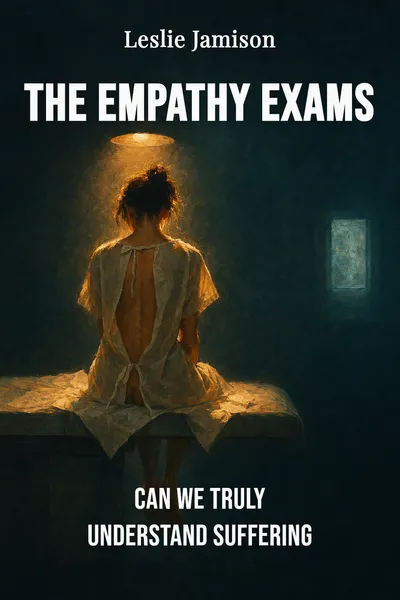
Before she was an essayist, Leslie Jamison had a job most people have never heard of. She was a medical actor — a standardized patient, in the clinical term — hired to play sick so that medical students could practice on someone who wouldn't actually die from their mistakes. She memorized scripts of symptoms, learned to perform a specific abdominal pain or a particular grief, and then graded the students afterward on a checklist. One of the boxes she had to tick measured whether the young doctor had said something that acknowledged her distress. Empathy, in other words, had been turned into a line item, a competency you could pass or fail.
That job became the opening essay and the spine of "The Empathy Exams," the 2014 collection that won the Graywolf Press Nonfiction Prize and turned Jamison into one of the more talked-about American essayists of the decade. The book moves restlessly: from her own abortion and a heart surgery, to incarcerated men, to a sufferers' convention for a disease that most doctors insist isn't real, to the brutal Barkley ultramarathon. What holds the pieces together isn't a topic. It's a stubborn, recurring question about what it actually takes to feel something true about another person's pain.
Empathy is one of those words that has gone soft from overuse — a virtue everyone claims, a thing we assume good people simply possess. Jamison refuses to let it stay comfortable. She treats it as suspect, effortful, and easy to fake, and she keeps catching herself faking it. The book is less an argument that empathy is good than an investigation into how hard it is, and how often the wanting to feel it substitutes for the feeling itself.
The question we’re asking : What does it actually take to feel another person's pain — and can empathy be taught, performed, or graded?What we’ll see : How a writer turned her own wounds and other people's suffering into a long interrogation of a word we use too easily.
Table of contents
01 Chapter 1 — The woman who got paid to be sick
The title essay begins with the strangeness of the job. Jamison was one of a pool of standardized patients at a medical school, each assigned a fictional case with a name, a history, and a body in trouble. There was Stephanie Phillips, a young woman with seizures rooted in an unspoken grief; there were chest pains and abdominal complaints, each scripted down to the wince. The students filed in, ran through their questions, and left, and Jamison filled out an evaluation that scored, among other things, whether they had managed to sound like they cared.
The setup is almost too neat a metaphor, and Jamison knows it, which is partly why she resists making it tidy. Empathy here is a checkbox: "Voiced empathy for my situation/problem." Either the student said the line or they didn't. But she keeps noticing the gap between the box and the thing — between a doctor performing concern and a person feeling it — and she's honest that she can't always tell which she's witnessing, or even which she herself produces when she tries.

02 Chapter 2 — The wound as the place where feeling enters
A thread runs through the collection that Jamison eventually names outright: the wound. Her essays are populated by damaged bodies, including her own. She was punched in the face on a street in Nicaragua and had her nose broken. She drank too much. She cut herself as a younger woman. She writes about these things without the redemptive arc readers are trained to expect — no neat recovery, no lesson learned and filed away.
This insistence on the open wound is deliberate, and it's where the book courts its biggest risk. The culture is suspicious of women who write about their own pain, quick to file it under self-indulgence or attention-seeking. Jamison addresses that suspicion head-on in the closing essay, "Grand Unified Theory of Female Pain," which catalogs how women's suffering has been dismissed as performance, hysteria, or vanity for centuries — and then refuses to apologize for writing about it anyway. To be wounded, she suggests, is not the same as to be weak, and to speak the wound is not the same as to wallow.
03 Chapter 3 — The diseases nobody can find
The book's most unsettling essay, "Devil's Bait," follows Jamison to a conference in Austin for people who suffer from Morgellons — a condition whose sufferers report fibers and crawling sensations emerging from their skin, and which most of the medical establishment classifies as a delusion rather than a physical disease. The Centers for Disease Control studied it and found no underlying pathogen. The patients, meanwhile, live in genuine torment, scrutinizing their own bodies, collecting specimens, and being told by doctor after doctor that nothing is there.
Jamison goes in unsure of what she believes, and she stays unsure, which is the whole point. She is not there to adjudicate whether the fibers are real. She's there to take the suffering seriously regardless of its source. Pain that originates in the mind, she insists, is still pain; a wound that no scan can locate still hurts. The question of whether the disease is "real" turns out to be a trap that lets the rest of us off the hook of having to care.
04 Chapter 4 — Empathy as labor, not instinct
Step back from the individual essays and a single argument emerges across "The Empathy Exams." Empathy, for Jamison, is not a feeling you either have or lack, the way you might have or lack perfect pitch. It's a labor — a deliberate, repeated act of imagination that takes effort and can be done badly. This reframing is quietly radical in a culture that treats empathy as a personality trait, something the good are born with and the cold are missing.
If empathy is work, then several things follow. It can be practiced, which is why the medical students rehearse it and why Jamison keeps trying and failing and trying again. It can be faked, which is why the checkbox exists and why she can't always trust her own warm feelings. And crucially, it isn't owed automatically by the depth of someone's suffering; it has to be chosen, extended outward even when the sufferer is unappealing, or unconvincing, or asking for more than we want to give.
05 Conclusion
The book closes the loop it opened. The woman grading medical students on whether they voiced empathy spends the rest of the collection discovering that she can't reliably grade herself. Across the abortion, the broken nose, the Morgellons conference, the prison letters, Jamison keeps catching her own feeling in the act of performing, keeps finding the checkbox harder to honestly tick than it looked. The standardized-patient script turns out to apply to everyone: we are all, in some sense, acting out our concern and hoping it lands as the real thing.
Related books