The Doors of Perception and Heaven and Hell
The mind's unmapped frontiers
Description
On a bright May morning in 1953, in his house in the Hollywood Hills, Aldous Huxley swallowed four-tenths of a gram of mescaline dissolved in a glass of water and sat down to wait. He was fifty-eight, half-blind since adolescence, already famous for Brave New World and a shelf of essays. A researcher named Humphry Osmond, who had brought the drug, stayed to observe and take notes. Huxley expected an inner light show, the kind of geometric visions the literature had promised him. What he got instead was stranger and, to him, far more important.
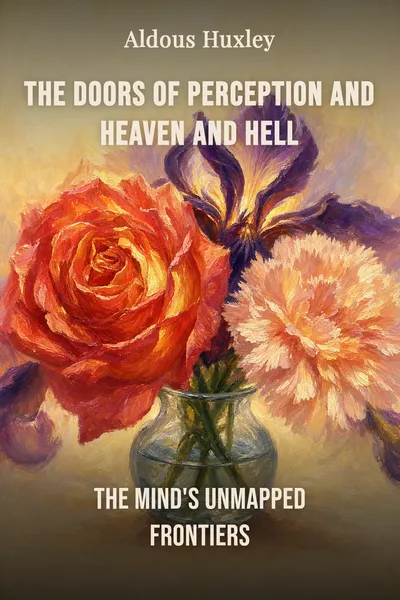
He looked at a small vase on his desk — a rose, a carnation, an iris — and the flowers seemed to blaze with their own existence. He looked at the creases in his gray flannel trousers and found them infinitely interesting. Chairs became sculptures of pure being. For several hours the world shed its familiarity and stood there, he wrote, as Adam might have seen it on the morning of creation. When it was over, Huxley set out to explain what had happened — not as a thrill-seeker, but as a man who had spent decades reading the mystics and now believed he had walked, briefly, through a door they described.
The two short essays he produced, published in 1954 and 1956, took their titles from a line by William Blake: if the doors of perception were cleansed, everything would appear as it is, infinite. Huxley wanted to know what those doors actually were, why they stay mostly shut, and what lies on the other side. He was not selling a drug. He was mapping a territory he thought most of us never visit.
The question we’re asking : What did Huxley see under mescaline, and why did he decide it revealed something true about the mind rather than merely distorting it?What we’ll see : How one drugged afternoon led a novelist to a whole theory of consciousness, its narrow openings, and the countries that lie beyond them.
Table of contents
01 Chapter 1 — A gram of mescaline on a May morning
The experiment was not a whim. Huxley had been corresponding with Humphry Osmond, a psychiatrist then working in Saskatchewan who was studying mescaline — the active alkaloid of the peyote cactus, long used in the rituals of Native American churches — as a possible key to understanding schizophrenia. Osmond noticed that the drug produced states resembling certain mental illnesses, and wondered what that resemblance might teach. Huxley, who had read everything from the medieval mystics to William James on the varieties of religious experience, volunteered himself as a subject. Osmond arrived at the house on May 3, 1953, mixed the dose, and settled in with a notebook and a recording setup to catch whatever Huxley might say.
Huxley admitted a private worry beforehand. He was a visual thinker starved of vision — his eyes had been badly damaged by an illness in his teens — and he half-expected mescaline to flood him with the vivid inner imagery he had never quite managed to summon on his own. It did nothing of the kind. The transformation happened outward, in the ordinary objects of the room. About half an hour in, he glanced at the little vase of flowers he had brought to the breakfast table and stopped being able to see them as flowers-in-a-vase. They had become, he said, what Adam saw: naked existence, the miracle of bare being.

02 Chapter 2 — The flowers that stopped being ordinary
The center of the whole experience, for Huxley, was those flowers. Under mescaline they no longer arranged themselves into a pleasant still life. Each blossom glowed with what he could only call its own inner light, breathing yet motionless, a thing charged with significance so dense that words kept sliding off it. He reached for the vocabulary of the mystics because ordinary language had nothing ready. This, he decided, was the "is-ness" the Buddhists meant, the "Suchness" of a thing simply being itself, without reference to any use it might have or any category it might fill.
That last point became his obsession. Normally, he argued, we do not really see objects at all. We see labels. A chair is "a chair" — something to sit on, quickly filed and dismissed so the mind can get on with the business of living. Perception is ruthlessly practical; it strips the world down to what we can use and name. Under mescaline that machinery of usefulness switched off, and the world came flooding back in its full, useless, overwhelming glory. He looked at the folds of his own trousers and found in the play of light and shadow a labyrinth of endless, luminous detail.
03 Chapter 3 — Why the brain works as a filter, not a window
To make sense of all this, Huxley borrowed a theory from the philosopher Henri Bergson, refined by the writer C. D. Broad. The idea runs against common sense. We tend to assume the brain's job is to gather information — to let the world in. Huxley proposed the opposite. The brain and nervous system, he suggested, are mainly eliminative. Their function is to protect us from being overwhelmed by the mass of everything we could perceive and remember, keeping out almost all of it and admitting only the trickle useful for staying alive on the surface of this particular planet.
In this picture, each of us is potentially "Mind at Large" — capable of perceiving everything that is happening everywhere — but the brain acts as a "reducing valve," narrowing that torrent down to the measly stream our survival requires. Language and culture finish the job, packing the stream into concepts and words, a system so convenient that we mistake it for reality itself. What we call the real world is, on this view, a heavily edited digest, useful precisely because it leaves so much out.
04 Chapter 4 — The far countries of the mind
Step back from the flowers, and this is the larger map Huxley was drawing. The mind, he came to believe, is less like a single lit room than like a continent, most of it unexplored. Beyond the small clearing of everyday awareness lie regions we visit rarely if ever — the antipodes of the mind, he called them in the second essay, borrowing the image of the strange fauna the old explorers found on the far side of the earth. We can no more reach these zones by wanting to than a person could stroll to Australia. They have their own geography, and consciousness travels there on its own terms.
In Heaven and Hell he tried to chart that geography. The visionary world, he argued, has recurring features across cultures and centuries: preternatural light, jewel-like color, vast luminous landscapes, a sense of significance beyond words. It is no accident, he thought, that paradise has always been described in terms of gems and gold and radiance — the treasures of every religion and myth are attempts to render, in earthly materials, the glow of the mind's remoter provinces. But the same continent has an infernal hemisphere, where the light becomes glare and beauty curdles into dread. Heaven and hell, in his reading, are real psychological places, and the road to one runs close to the road to the other.
05 Conclusion
The afternoon ended as afternoons do. The flowers went back to being flowers, the chair went back to being furniture, and Huxley wrote it all down while the memory was still hot. What he left behind was not a drug manual but a small, strange atlas: a claim that ordinary waking consciousness is one door among many, that the brain spends most of its energy keeping the world out rather than letting it in, and that the regions it excludes are neither empty nor unreal. He had gone looking for inner fireworks and come back with a theory of the mind.
Related books