The Discoverers
How we came to know the world
Description
In 1983, the historian Daniel Boorstin published a doorstop of a book called The Discoverers, and he opened it not with a hero or a shipwreck but with something far stranger: the problem of knowing what time it is. Before we could chart the stars or the coastlines, he argued, we had to invent a way to divide the day, name the year, and agree on where the week began. His book runs roughly seven hundred pages and covers everything from the water clock to the microscope, and yet it holds together around one quiet, almost mischievous idea — that the story of how we came to know the world is really the story of how we stopped being fooled by ourselves.
Boorstin was the Librarian of Congress when he wrote it, a man surrounded by the entire recorded output of human curiosity, and he had a taste for the overlooked. He was less interested in the famous eureka moments than in the slow, unglamorous machinery that made discovery possible at all: the calendar, the compass, the printing press, the habit of writing down what you saw instead of what you were told to see. His discoverers are not only Columbus and Newton but the anonymous monks who rang the bells, the clockmakers, the mapmakers who left blank spaces where legend used to be.
What gives the book its charge is the argument buried inside the anecdotes. Boorstin insists that the enemy of knowledge was rarely simple ignorance. More often it was the opposite — a dense, confident, beautifully organized body of received wisdom that told people they already understood the world, and so had no reason to look again. That is the thread worth following through his sprawling account.
The question we’re asking : How did we actually come to know the world — and what kept getting in the way?What we’ll see : A tour through Boorstin's unlikely heroes — the clock, the map, the human body, and the hardest thing of all to give up.
Table of contents
01Chapter 1 — The clock came before the telescope
Boorstin makes a decision that surprises most readers: he begins the history of discovery with time, not space. Before anyone could sail anywhere useful or predict an eclipse, humans had to solve the deceptively hard problem of measuring the days. And the sky, it turns out, is a terrible teacher. The sun, the moon, and the seasons run on cycles that refuse to divide neatly into one another. The moon does not fit tidily into the solar year; the year does not fit tidily into whole days. Every calendar in history has been a compromise with these stubborn facts.
The early solutions were social before they were scientific. Boorstin lingers on the medieval monastery, where the need to pray at fixed hours drove the demand for reliable timekeeping. The monks rang bells, and the bells organized the day, and eventually someone built a mechanism that could ring them without a tired brother watching a candle burn down. The mechanical clock, arriving in Europe around the thirteenth century, was one of the great turning points in his telling — not because it told better time, but because it detached time from the sun. Time became something a machine produced, portable and abstract, the same in a cellar as on a hilltop.

02Chapter 2 — The map that had to unlearn paradise
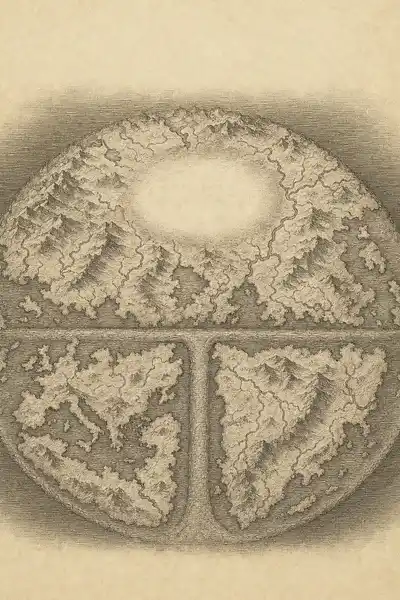
When Boorstin turns to geography, he tells a story of unlearning as much as learning. The educated people of medieval Europe were not ignorant of the wider world; the trouble was that they knew too much of the wrong kind. Their maps were crowded with received authority — with Eden in the east, with monstrous races at the edges, with a scheme inherited from scripture and from the ancients that arranged the earth according to meaning rather than measurement. The famous mappae mundi were beautiful and confident and almost useless for finding your way anywhere.
He is careful to dismantle one comfortable myth: the idea that sailors feared falling off a flat earth. Educated medieval people generally accepted that the earth was round. The real obstacles were different and more interesting. One was the towering authority of Ptolemy, the second-century geographer whose work, recovered and revered in the Renaissance, was so detailed and so respected that it fixed errors in place for centuries — including a serious underestimate of the earth's size that made a westward voyage to Asia look far shorter than it was.
03Chapter 3 — When the body stopped being a mystery
The same pattern that governed maps governed the human body, and Boorstin follows it into anatomy and medicine with evident relish. For well over a thousand years, European medicine rested on the writings of Galen, a Greek physician of the second century whose authority was so complete that students learned his descriptions rather than examining actual bodies. When the cadaver on the table disagreed with the text, it was the cadaver, remarkably, that was assumed to be at fault. Knowledge had become a matter of reading rather than looking.
The break, when it came, was as much an act of nerve as of intellect. In 1543 — the same year Copernicus moved the earth from the center of the universe — Andreas Vesalius published his great anatomy, based on his own dissections, and quietly showed that Galen had been describing animals, not men. Boorstin savors the audacity of simply trusting the evidence of one's own hands and eyes against a thousand years of settled doctrine. It was not that Vesalius was cleverer than his predecessors; he was willing to look, and to believe what he found.
04Chapter 4 — The illusion of illusory knowledge
Step back from the clocks and coastlines and cadavers, and Boorstin's real subject comes into focus. His most quoted line names it directly: the great obstacle to discovering the shape of the earth, the continents, and the ocean was not ignorance but the illusion of knowledge. It is a claim that reorganizes the whole book. The villain is never the blank mind waiting to be filled; it is the full mind, satisfied and certain, holding a map of the world so complete and so respected that no one thinks to check it against the world itself.
This reframes what a discoverer actually does. In Boorstin's account, the decisive move is almost always subtractive — clearing away an inherited authority to make room for the evidence in front of you. Ptolemy in geography, Galen in medicine, the ancient calendar in timekeeping: each was not a gap in knowledge but a magnificent structure of it, and each had to be dismantled before anything new could be seen. The pioneers he honors are the ones who could hold their own certainties loosely enough to notice when reality disagreed.
05Conclusion
Boorstin ends where he began, with the sense that discovery is a continuing story rather than a finished one. The clock, the map, the anatomy, the microscope — each was a way of prying open a world that people had convinced themselves they already understood. His discoverers are linked not by genius but by a shared willingness to look again, to draw the blank space, to trust the cadaver over the book, to distrust the very certainties that made them feel most secure. The knowledge they won was always provisional, and they mostly knew it.
Related books