
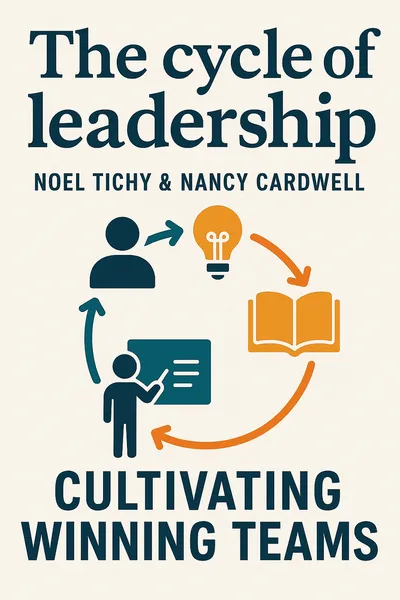
The cycle of leadership
Cultivating winning teams
Description
In the competitive landscape of the 21st century, the paramount commercial challenge is to continually innovate in delighting customers. This requires organizations to enhance their collective intelligence daily. The most effective strategy for this is fostering a robust internal culture of teaching and learning, where every individual is simultaneously an educator of their expertise and a learner of fresh perspectives.
The essence of thriving in the knowledge-driven economy lies in establishing a strong teaching organization characterized by reciprocal teaching cycles. In this model, leaders impart wisdom while also absorbing insights from those who directly engage with customers. This process is encapsulated in what's known as "the virtuous teaching cycle," a practice integral to the core of many successful businesses, and essential for any future competitors.
Table of contents
01 Making the case for educational enterprises
In the contemporary landscape of the knowledge economy, top-tier organizations are leveraging interactive, bidirectional educational methods—often referred to as virtuous teaching cycles—to enhance the intelligence and proficiency of their workforce. This, in turn, empowers them to create products and services that exceed customer expectations. As a result, these organizations are able to swiftly adapt and respond to the dynamic needs of their customers.
While the fundamental business challenge of creating value remains unchanged, the approach to achieving this in the amalgamated old and new economies has evolved significantly. In the past, value was often generated through the acquisition of new hardware or by venturing into untapped geographical markets. However, in today's industrial landscape, such strategies are no longer the primary source of competitive advantage. Instead, intellectual capital has become the principal engine driving growth, overshadowing the importance of physical assets.
Given this shift, the new commercial imperative for both established and emerging companies is to master the art of scaling up and accelerating their operations. For legacy companies, the hurdle lies in navigating through entrenched cultures, bureaucracies, and processes to become more agile in meeting customer demands. On the other hand, startups face the challenge of achieving the necessary scale and velocity to outpace their competitors.
The most effective strategy to address this imperative is to cultivate a teaching organization, grounded in the interactive and multifaceted learning that virtuous teaching cycles provide. This approach triggers a domino effect of subsequent benefits:
- Historically, there was a perceived trade-off between an organization's size and its agility. Large corporations had ample resources to explore new ideas but were often hampered by bureaucratic inertia. Conversely, startups were seen as nimble and customer-centric but lacked the resources to compete on a larger scale. Teaching organizations resolve this dichotomy by fostering a workforce of intelligent individuals who can independently discern and execute the necessary actions without waiting for top-down directives. They apply business processes with intelligence and efficiency to produce the goods and services that customers desire.

02 Crafting educational corporate cultures
While there isn't a universal blueprint or a straightforward recipe that guarantees the creation of a teaching organization, several common traits can be observed across most successful examples. These include a foundational focus on cycles of virtuous teaching, unwavering support and active participation from the organization's leadership, the development of dynamic and comprehensive teachable viewpoints, and the seamless weaving of teaching into the fabric of daily operations.
Essentially, the journey to establishing a thriving teaching organization is deceptively simple in theory, demanding a deep-rooted dedication to fostering knowledge through teaching.
Central to the functionality and success of teaching organizations are the virtuous teaching cycles. At their core, these cycles embody the essence of what makes teaching organizations excel. They operate on the principle that everyone has something to teach and something to learn, transforming every business activity into a potential lesson.
This approach was partly inspired by the concept of learning organizations, which gained traction in management discussions for promoting learning. However, it only addressed half of the equation. Learning is significantly enhanced when it is paired with the opportunity to teach the learned principles to others. This reciprocal process of learning and teaching not only facilitates the creation of new knowledge but also ensures the optimal utilization of existing information.
03 Challenges facing educational enterprises
High-performing teaching organizations are distinguished by their attention to five pivotal concerns that shape their growth trajectory. These include the grooming of future business leaders, the integration of new employees into the corporate culture, the expansion of teaching to involve all staff members, the incorporation of digital technology into educational practices, and the exploitation of global operational opportunities. Organizations that adeptly navigate these critical areas are poised to experience accelerated expansion in the forthcoming years.
Teaching organizations proactively cultivate the next wave of business leaders, rather than waiting for leadership gaps to emerge. This ongoing process is more comprehensive than a mere apprenticeship; it is a structured initiative designed to equip potential leaders with the necessary competencies for future challenges. Historically, many firms have mismanaged succession planning, often postponing the search for successors until the current leaders are on the verge of departure. In contrast, the raison d'être of a teaching organization is to internally develop its leadership cadre.
Business leaders are essentially individuals who can independently think and act with acumen. The most effective method to nurture a leader is through education imparted by another leader. When these emerging leaders are encouraged to impart their knowledge to others, it reinforces their grasp of the underlying principles. Consequently, a teaching organization can be likened to an academy dedicated to leadership development.
Related books