

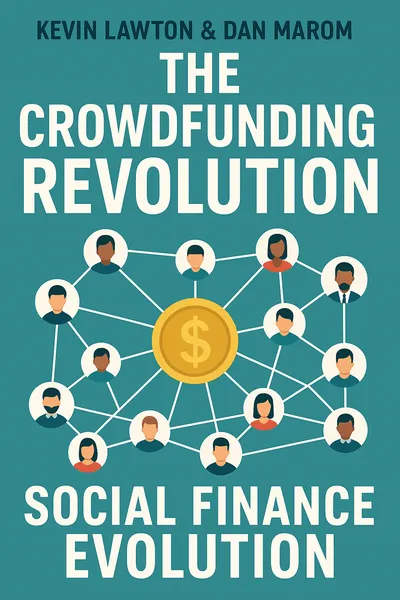
The crowdfunding revolution
Social finance evolution
Description
Crowdfunding represents a novel and collaborative approach to securing funds for various endeavors. It enables the solicitation of donations for global causes, the generation of project funding where contributors become partners, the pre-sale of creative works like books or CDs to cover production costs, and the financing of startups or established companies in exchange for equity.
This method combines social networking with venture capitalism, revolutionizing how projects receive funding by democratizing business financing. Crowdfunding allows anyone with internet access to contribute to the collective investment pool, changing the traditional dynamics of capital allocation.
Table of contents
01Journey to present
Crowdfunding, which is reshaping funding landscapes, thrives on today's interconnectedness, technological advancements, social media's reach, and regulatory changes. This innovative funding method empowers startups and projects, marking a significant shift in societal structures and funding mechanisms, echoing peter drucker's observations on historical transformations.
Crowd's ascension
In the modern era, the concept of the g-7, representing the seven major economies of the world in 1985, has evolved significantly. By 2010, this group expanded into the g-20, encompassing the 20 major economies globally. Parallel to this economic evolution, the digital landscape has undergone a remarkable transformation. From a mere few hundred users, the internet has burgeoned to connect around 2 billion individuals out of a global population of 7 billion. This exponential growth has effectively turned the internet into a vast, informal network, humorously dubbed the g-2 billion.
With projections suggesting a potential shift towards a g-7 billion in the near future, the implications for business and social structures are profound. The term "crowdsourcing," first introduced in a 2006 article by jeff howe in wired magazine, encapsulates one such disruptive potential. This concept isn't entirely new; it echoes the collaborative spirit of free software and open-source movements, which have thrived on the internet and continue to expand. The ancient greek philosopher democritus's observation that "birds of a feather flock together" aptly describes the internet's role in facilitating connections among like-minded individuals, fostering collaboration and innovation.
The rise of the internet and social technologies has significantly diminished physical barriers to human creativity, enabling the formation of affinity groups that tackle complex challenges, from writing encyclopedias like wikipedia to engaging in various collaborative projects. Today, internet users often play dual roles as both consumers and producers of content, contributing to a culture of "pro-sumers" and "pro-ams," amateurs who produce work at professional standards. This digital landscape has also given rise to "crowd-ployees," individuals who derive their income from crowdsourced activities, and "crowd-porations," agile web-based companies that leverage the crowd for essential business tasks.
As the digital crowd continues to grow, its influence on the future of internet and society is undeniable, underscoring the shift towards a culture of sharing as a pivotal aspect of the digital age.
Traditional funding downturn
Venture capital has traditionally been seen as a key player in the success of startups, particularly in the tech industry. However, a report by morgan stanley in 2003 highlighted that the industry's ability to pick winners was less than stellar. The study found that only a small fraction of startups reached an ipo stage, and even fewer managed to create shareholder value. This marginal success can be attributed to several emerging socio-economic trends that venture capital seems to be at odds with.
The pace of change across industries is accelerating, shortening the lifespan of expertise. Venture capitalists, once adept at valuing startups, now often face industries they are unfamiliar with, leading to more valuation errors. Additionally, many groundbreaking ideas today are cross-disciplinary, making the collective knowledge of a diverse crowd more valuable than the insular networks of venture capital.

02Future pathways
Crowdfunding is revolutionizing capital allocation by leveraging the collective will of the market, eliminating biases inherent in traditional systems. This shift towards intellectual and financial decentralization paves the way for new leaders, embodying the proactive approach to shaping the future as described by john richardson jr.
Virtual infrastructure influence
The transformative nature of crowdfunding is reshaping project financing far beyond the simplistic notion of a zero-sum game. Kevin lawton and dan marom highlight that this evolution is fueled by multiple socio-economic trends, addressing inefficiencies in capital allocation that have persisted throughout history. Unlike traditional methods, crowdfunding doesn't merely replace old systems with new; it leverages and amplifies unprecedented opportunities for growth and engagement.
Historically, venture capital firms meticulously curated potential deals through extensive pipelines, a process now being revolutionized by digital infrastructures enabled by crowdfunding. These future platforms are envisioned to scale significantly, surpassing the capabilities of traditional venture capital frameworks. Essential to their success will be features like effective matchmaking between backers and diverse projects, integration of social networking to enhance discoverability and communication, robust video infrastructures for pitching and updates, tiered participation with specialized tools for different user roles, real-time financial transparency, controlled information disclosure, and preemptive handling of intellectual property issues.
The future of crowdfunding platforms promises a dynamic ecosystem, supported by apis and apps, capable of standing toe-to-toe with the biggest names online. This vision requires platforms to not only cater to various stages of enterprise growth but also to standardize, facilitating smoother transitions between crowdfunding phases. The potential of these platforms is immense, signaling a shift towards more inclusive, efficient, and transparent financing models.
Harnessing collective intelligence
Crowdfunding uniquely harnesses the collective intelligence of diverse groups, offering a competitive edge by leveraging the broader wisdom over a small management team's decision-making. To tap into this collective iq, various strategies can be employed.
Decision markets allow for voting on specific decisions, inviting both internal employees and the external public to participate. Prediction markets, exemplified by platforms like intrade, pose questions about future outcomes, supported by open-source software such as that found on zocalo. Competitions with enticing rewards can also stimulate participation and innovation, as demonstrated by goldcorp's challenge which led to significant gold discoveries by releasing geological data to the public.
Furthermore, robust crowdfunding platforms enable the funding and valuation of projects, allowing trend spotting and early participation in emerging issues. This open participation model ensures that fresh perspectives are considered, often leading to the creation of value. As noted by bill joy and friedrich von schiller, the vast majority of intelligent individuals work outside any given organization, and today's actions are already shaping tomorrow. Being an early participant in successful projects is crucial for players in the crowdfunding ecosystem. The ability to spot trends in real-time, or even predict them, offers a significant advantage. Crowdfunding platforms serve as rich ecosystems for trend analytics, providing insights not just on the projects being funded but also on broader shifts in the market.