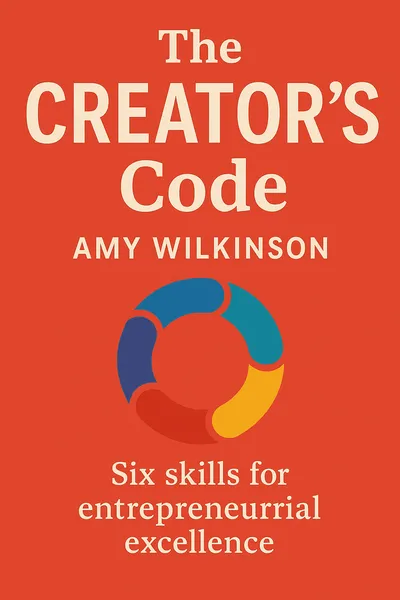
The creators code
Six skills for entrepreneurial excellence
Description
The research uncovered six essential skills shared by founders of companies that grew to over $100 million in revenue. These skills can be learned and applied by anyone willing to put in the effort.
First is spotting gaps in the market and envisioning solutions. Second is maintaining focus on long-term goals while iterating quickly. Third is failing intelligently and pivoting when needed. Fourth is collaborating across teams and functions. Fifth is being creative in product development and marketing. Sixth is generosity in sharing connections, advice and small favors. Individually these skills are powerful, but together they create momentum and synergy.
By mastering all six skills, entrepreneurs attract loyal teams, customers and investors to turn ideas into thriving enterprises. These collaborative abilities can be nurtured over time through practice and persistence. With the right mindset, anyone can develop the toolkit to build an impactful business.
Table of contents
01Spot the openings
Creators excel at spotting opportunities that elude others. They stay alert to needs that have yet to be met and then generate ideas by transferring concepts across different fields, crafting innovative solutions, or blending distinct ideas. Successful creators typically adopt one of three perspectives to view the world:
Sunbirds take existing solutions and adapt them to new contexts. They analyze why a solution is effective in its original setting and then determine the changes needed to apply it elsewhere. By repurposing concepts from unrelated fields, Sunbirds achieve breakthroughs. For instance, Gutenberg's printing press was inspired by the technology of wine presses, and Pierre Omidyar created eBay by taking the concept of garage sales online. Sunbirds pay attention to details that most would ignore, using analogies and working backwards to understand the original functionality and how to transfer it.
Architects, on the other hand, devise entirely new solutions by pinpointing problems and addressing their root causes. They question why existing solutions are the way they are and how they can be enhanced. Elon Musk, for example, was shocked by the high costs of rockets and realized that the main expense was not materials but the single-use production model. He established SpaceX with the goal of producing standardized rockets to slash costs significantly. Similarly, Sara Blakely reinvented pantyhose by adding elastic bands, leading to the creation of the billion-dollar brand Spanx. Architects challenge assumptions and traditional views, constantly thinking and asking the right questions to uncover new opportunities.

02Seek the light
Creators and race car drivers share a common trait: an unwavering focus on the path ahead. They both scan the horizon for new ideas and adjust swiftly to market changes. Seasoned drivers often talk about "driving for daylight," which means keeping their eyes on the horizon and letting their hands automatically steer the speeding vehicle. Similarly, creators overlook immediate hurdles, relentlessly pursuing their long-term goals.
Like drivers, creators maintain a vision of their future work, aiming to astonish and please their audience. They anticipate the complexities of bringing their ideas to life and stay alert to trends, all while striving to outdo their rivals in the race to the future. They plan meticulously, innovating to advance their field. Elizabeth holmes, for example, revolutionized blood testing with theranos by creating analyzers that use dna profiling to provide quick test results, and partnered with walgreens to offer lab services to those without easy access to healthcare.
03Employ the ooda loop
The concept of the "OODA loop," which stands for observe, orient, decide, and act, was initially developed by military aviators to gain an advantage in aerial combat by making rapid decisions to stay ahead of the enemy. This approach proved to be a significant factor in the success of American pilots during the Korean War, allowing them to react and adapt quicker than their adversaries who relied on outdated information.
This principle of swift iteration and adaptation has also been successfully applied in the business realm, notably by PayPal, co-founded by Max Levchin, Peter Thiel, and Elon Musk. After its acquisition by eBay for $1.5 billion in 2002, PayPal alumni went on to establish other highly successful tech companies, including YouTube, Yelp, LinkedIn, and Tesla Motors, by effectively utilizing the OODA loop to outpace their competitors.
Initially starting as encryption software for PDAs named FieldLink, PayPal underwent several pivots and business model transformations before discovering its successful formula. After the initial concept and a subsequent "virtual wallet" idea failed to attract interest, the focus shifted to facilitating payments between PalmPilot devices. Despite the technology's functionality, consumer interest remained low, leading to the launch of a web-based money transfer service targeting eBay power users under the new name Confinity. This service showed promise, leading to a complete shift towards online transactions and a merger with Elon Musk's X.com, eventually forming PayPal.
04Learn while failing
Creators often share a mindset that emphasizes the importance of small and early failures over catastrophic ones later on. They engage in making tiny bets to test their ideas, which builds resilience and teaches them how to transform setbacks into future successes.
According to Amy Wilkinson, failure is a common trait among creators, occurring early, often, or repeatedly. However, it is through these failures that provocative learning emerges, albeit uncomfortably. To fail "wisely" and move towards success, there are several practices creators follow.
Firstly, creators make small, inexpensive bets to explore various avenues, quickly identifying what works by failing fast and early. They anticipate failures rather than expecting perfect outcomes from the start. This approach involves testing ideas through low-risk experiments, conducting quick, affordable, and creative tests to determine the viability of a product or idea. Taking small risks early on helps avoid costly disasters later.
05Connect the minds
Innovators excel at uniting varied viewpoints to address challenges creatively. They craft spaces that are conducive to the exchange of ideas among individuals from different fields.
For instance, top creative agencies establish centers where diverse minds can converge and engage in dialogue, fostering an environment where ideas can intermingle and grow. The architecture of these spaces is intentionally designed to promote teamwork, such as by incorporating seating that discourages prolonged sitting to keep the energy dynamic.
Another method innovators employ to spark creativity is the formation of "flash teams," which are ad hoc groups assembled to tackle immediate challenges. The urgency and common goal of these teams can be a powerful motivator. This concept is evident in scenarios like search-and-rescue operations and the film industry, and it's gaining traction in other sectors as a way to harness diverse expertise and blend the insights of seasoned professionals with fresh perspectives.
Competitions with incentives are yet another tool in the innovator's arsenal. History shows us that prizes can lead to significant breakthroughs, such as the pioneering nonstop flight across the Atlantic, and the invention of essential items like fire extinguishers and canned food. Today, online contests expand this concept, drawing participants from around the globe. For example, platforms like InnoCentive have addressed longstanding engineering challenges by accessing a worldwide pool of talent. Similarly, Threadless has created a successful business model centered around an online competition for t-shirt designs.
06Give small gifts
Creators embody a spirit of generosity, enhancing their productivity by helping others, sharing knowledge, collaborating on projects, and creating exciting opportunities for their peers. This approach initiates a positive feedback loop with significant benefits. Unlike a narrow view of success, creators value nurturing relationships with users, colleagues, and peers as much as developing outstanding products. They often give small gifts to strengthen bonds and support others.
In our interconnected world, this work style not only aligns with ethical practices but also serves as a competitive advantage. Venture capitalist Matt Cohler observes that in today's transparent, interconnected, and efficient world, being good aligns with one's self-interest. Generosity facilitates new collaborations and attracts more people to work with you, fostering a network of meaningful relationships that can collectively tackle challenges.
Creators understand that small acts of kindness can generate immense value, sparking chain reactions of cooperation that benefit entire communities. LinkedIn co-founder Reid Hoffman highlights the importance of surrounding oneself with people who can provide information, complete tasks, make deals, and create opportunities, emphasizing that much of business is non-zero-sum, with small acts of assistance yielding significant returns.
Related books