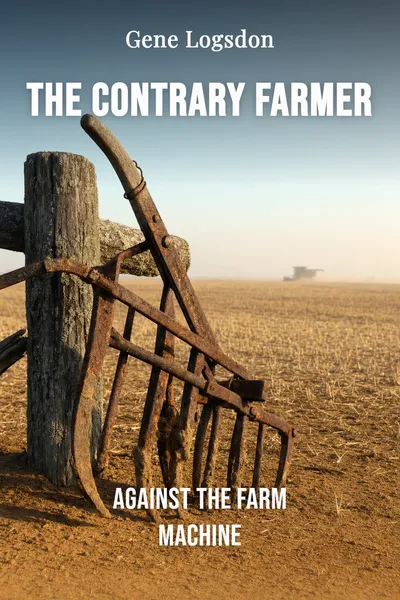
The Contrary Farmer
Against the farm machine
Description
Gene Logsdon farmed a few acres in Wyandot County, Ohio, and spent decades writing about it with the ornery affection of a man who had watched his neighbors get bigger, get indebted, and get out. When he published The Contrary Farmer in 1994, American agriculture had a clear direction: consolidate, mechanize, borrow, expand. Get big or get out, as an agriculture secretary had famously put it years before. Logsdon looked at that road and walked the other way — not out of nostalgia, but because he had done the arithmetic and it didn't add up.
His book is a guide for what he called the cottage farmer: someone who works a small piece of land not to feed a commodity market but to feed a household, a community, and a certain idea of a good life. It reads like advice from a neighbor who has made every mistake already — which livestock breeds forgive a beginner, how to let a pasture do the fertilizing, why the tractor is often the most expensive way to solve a problem you created by buying the tractor. Practical, granular, unsentimental.
But underneath the how-to runs an argument, and the argument is the reason the book has outlasted most farming manuals. Logsdon isn't just describing a technique. He's contesting the whole logic that says a farm is a factory for producing calories at the lowest possible cost, and that efficiency means fewer hands on more land. He thought that logic was quietly ruinous — for the soil, for rural places, and for the farmers themselves.
The question we’re asking : Why would a working farmer argue, in the middle of agriculture's biggest expansion, that smaller and slower is the smarter bet?What we’ll see : How Logsdon's contrary farm actually works, and what his stubbornness was really defending.
Table of contents
01 Chapter 1 — The farmer who chose to stay small
The word contrary in Logsdon's title is doing real work. He meant it the way a mule is contrary — not difficult for its own sake, but unwilling to be driven in a direction that makes no sense. The direction he refused was the one every farm-bureau meeting and equipment dealer was pushing in the postwar decades: scale up, specialize, and treat debt as the price of staying in the game. A farmer who plants a thousand acres of corn is not, in Logsdon's telling, richer than the one who works twenty. He is more exposed, more leveraged, and more dependent on prices, chemicals and machinery he doesn't control.
Logsdon's alternative was deliberately modest. A cottage farm — his term, borrowed from the idea of cottage industry — is small enough that one household can genuinely know it, plant by plant and animal by animal. That intimacy is the whole point. On a small holding you can notice which corner of the field drains poorly, which ewe is a good mother, where the weeds are telling you something about the soil. The industrial farm trades that knowledge for square footage, and Logsdon thought it was a bad trade.

02 Chapter 2 — Where the animals do the work
The technical heart of the book is Logsdon's insistence that a well-designed farm mimics an ecosystem rather than a production line. The industrial model separates everything: crops here, livestock there, fertilizer bought in, waste hauled out. Logsdon wanted the pieces to feed each other. Animals graze the pasture and drop manure that fertilizes it; the grass that fattens them costs almost nothing; the whole loop runs largely on sunlight and rain rather than on purchased inputs.
Pasture is his obsession, and he treats grass management as the most underrated skill in farming. A good pasture, rotated so animals move on before they overgraze, can carry livestock cheaply while building soil rather than depleting it. He's practical about the choices this demands — which breeds thrive on grass instead of grain, how to fence and subdivide, when to let a field rest. The recurring theme is that the land, managed with attention, does work the industrial farmer pays cash for.
03 Chapter 3 — The math that industrial farming hides
Logsdon's most pointed argument is economic, and it cuts against the intuition that bigger farms are simply more efficient. The efficiency, he argues, is largely an accounting illusion. The big operation looks profitable because it externalizes and finances so much of what it uses — the eroded soil doesn't appear on the balance sheet, the fuel and chemicals are bought on credit, the machinery is a rolling debt that must be justified by ever more acres. Strip out the borrowing and the hidden depletion and the picture darkens considerably.
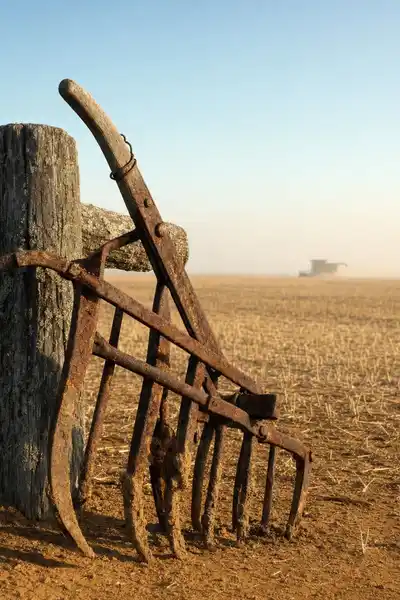
He is especially sharp on machinery. A tractor and its implements represent an enormous fixed cost, and once a farmer owns them, the pressure to farm more land to pay them off never lets up. The machine that was supposed to save labor ends up dictating the scale of the whole enterprise. The cottage farmer, working within his means, escapes this trap — he uses smaller, cheaper, often older equipment, keeps his fixed costs low, and is therefore not forced to expand simply to service his tools.
04 Chapter 4 — What the land teaches when nobody is watching
Step back from the pasture rotations and the machinery math, and The Contrary Farmer turns out to be an argument about what a life is for. Logsdon never quite says it as a thesis, but the whole book leans on the conviction that farming small is not a lesser version of farming big — it's a different pursuit altogether, closer to a craft or a vocation than to a business. The cottage farmer measures success in soil that gets richer over decades, in work that is physically hard but self-directed, in a household that provides much of what it needs. Those are goods that don't convert cleanly into dollars, which is precisely why the industrial accounting can't see them.
This is where his contrariness stops being about agriculture and becomes a quiet critique of how we define value at all. An economy organized entirely around lowest-cost production will always push toward consolidation, toward fewer people doing more with more borrowed capital, toward treating the natural world as a stock to be drawn down. Logsdon's farm is a working counterexample: a system designed to be permanent rather than maximal, to leave the ground better than it found it, to reward attention over throughput. It asks whether efficiency, unqualified, is even the right thing to be maximizing.
05 Conclusion
Logsdon spent his whole life on the contrary side of that argument, farming his corner of Ohio and writing about it until his death in 2016, long enough to watch the industrial model deliver exactly the vulnerabilities he had warned about — depleted soils, hollowed-out rural counties, farmers running faster to stay in place. His book never pretended small farming was easy or that it would win on the market's own terms. It made the harder claim: that the market's terms were the problem, and that a farm built to endure rather than to expand was the more rational bet all along.
Related books