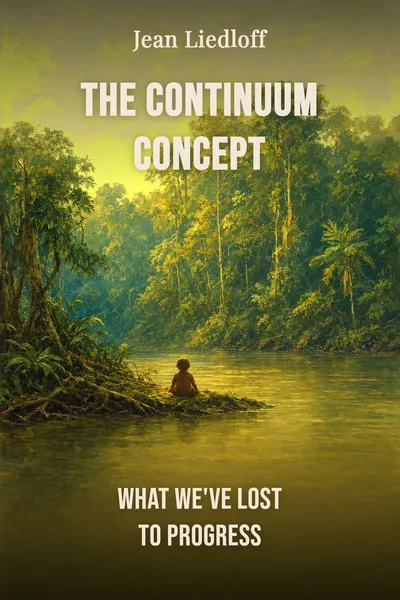
The Continuum Concept
What we've lost to progress
Description
In the late 1950s, a young American named Jean Liedloff joined an expedition into the Venezuelan rainforest, ostensibly hunting for diamonds. What she found instead was a group of people called the Yequana, and a way of living so unlike her own that it reorganized the rest of her life. She would return to the region several times over roughly two and a half years, watching how these people raised their children, worked, argued, and moved through a day. The thing that struck her hardest was not the absence of tools or money. It was the mood. Nobody seemed anxious. The children did not whine, did not fight, did not have to be disciplined. The adults were, by any measure she knew, remarkably content.
Liedloff was not a trained anthropologist, and she never pretended to be. She was someone who had grown up inside the ordinary Western machinery of nannies, boarding schools, and low-grade unhappiness, and who now stood in a clearing watching toddlers play unsupervised at the edge of a river without a single one falling in. The gap between what she was seeing and what she had been taught to expect from human beings became, over years, an argument. She published it in 1975 as a book with an odd title: The Continuum Concept.
The claim underneath it is large and uncomfortable. Liedloff argued that human infants arrive with a set of expectations shaped over hundreds of thousands of years, and that the modern world quietly violates almost all of them from the first hours of life. What the Yequana had, in her reading, was not a charming folk practice. It was the baseline. What we have is the deviation — and much of what we call unhappiness is the long echo of a beginning that went wrong.
The question we’re asking : What did Liedloff believe we quietly gave up when our societies got more sophisticated?What we’ll see : A jungle observation that turned into a theory of human happiness, and the everyday habits it puts on trial.
Table of contents
01 Chapter 1 — A woman in the Venezuelan jungle
Liedloff arrived in South America almost by accident. A chance meeting in Florence with two Italian explorers led to an invitation to join their diamond-prospecting trips into the interior of Venezuela, and she went, twice at first, then in longer stays that stretched the total time she spent among the Yequana and the neighboring Sanema to something over two years across the late 1950s and early 1960s. She was in her twenties, restless, and entirely unprepared for what would happen to her thinking.
The prospecting was mostly a failure. The observation was not. Living close to a people who had had almost no contact with industrial society, she began to notice patterns that no book had prepared her for. Small children carried heavy loads without being asked and without complaint. Boys handled machetes and fire near infants, and the infants were not harmed. There was play, but there was no organized effort to entertain children, and no visible boredom. When she watched a group of boys paddling a canoe upriver against a hard current for hours, what she saw on their faces was not endurance but delight.

02 Chapter 2 — The expectation a baby is born with
Liedloff's answer began with the infant. A human baby, she argued, does not arrive as a blank slate waiting to be programmed. It arrives with expectations — deep, specific, evolved anticipations of the conditions it will meet, shaped by the millions of years its ancestors lived under roughly the same circumstances. She called this inherited set of anticipations the continuum: the line of experience each creature is designed to expect, and against which it measures whether it is safe or in danger.
The most important of these expectations, in her account, concerns the very beginning of life. A newborn expects continuous physical contact with a warm, moving body — being carried, held, and kept close to the rhythm of an adult going about ordinary life. This is not a preference. It is, in Liedloff's framing, the ancient signal that says the world is as it should be. Among the Yequana, a baby was carried against a body more or less constantly for the first months, not gazed at or performed for, simply included in the flow of activity while its mother did whatever the day required.
03 Chapter 3 — Where the in-arms phase breaks
The Western infant, on this account, meets an entirely different world, and it meets it immediately. It is separated at birth, laid alone in a crib, wheeled in a carriage that faces away from the parent, put down to sleep in a silent room, and left to cry on the theory that responding will spoil it. Each of these arrangements, which we regard as normal and even wise, sends the ancient signal that something is catastrophically wrong. The baby is not being neglected by any decent measure. But its continuum does not know that. It only knows the expected contact is missing.
Liedloff argued that this early deprivation does not simply pass. The unmet need for in-arms belonging is not erased; it is carried forward, unsatisfied, into the rest of a life. The adult who was not held enough goes on searching, without knowing what it is searching for, in relationships, in achievement, in substances, in the endless low hum of wanting more. She saw in this the root of a distinctly modern restlessness — the sense that contentment is always somewhere else, always one more acquisition away.
04 Chapter 4 — The unhappiness we mistook for normal
Step back from the cradle and Liedloff's real target comes into view. Her book is not finally about babies; it is about a civilization that stopped trusting instinct. Somewhere along the way, she argued, we came to believe that our evolved impulses were primitive, that a mother's urge to hold her crying child was sentimental weakness, that intelligence meant overriding the body's ancient knowledge with expert instruction. Every generation handed the next a little more theory and a little less certainty, and the confident competence she saw among the Yequana drained out of us.
This is what she meant by what progress cost. The technical gains were real, and she never denied them. But she saw them purchased with a hidden currency: the loss of an ability our ancestors had simply possessed, the ability to raise children who expected to be happy and largely were. We got hospitals and appliances and libraries of advice, and in the same movement we lost the wordless confidence that used to make the whole business of living feel supported rather than effortful.
05 Conclusion
Liedloff went back to New York and spent the rest of her life turning what she had seen in the rainforest into an argument the modern world could hear. She died in 2011, and The Continuum Concept has never quite left circulation, passed between parents who sense that something in the standard arrangements does not fit and cannot say why. The image at its center stays with a reader: a baby riding calmly against a working body, absorbing the news that the world is a place it belongs.
Related books