The Complete Essays
One man, endlessly examining himself
Description
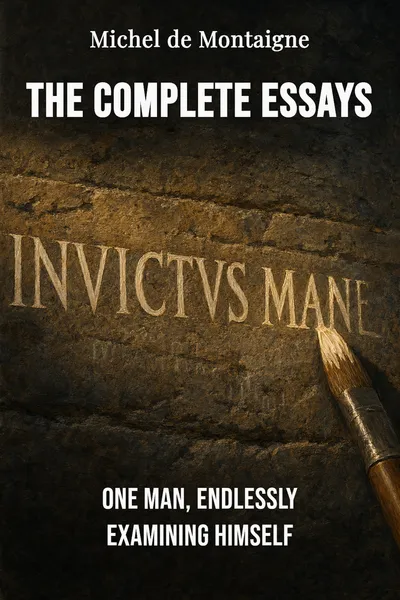
In 1571, on his thirty-eighth birthday, a magistrate from the Bordeaux region named Michel de Montaigne had a Latin inscription painted on the wall of a small room in his tower. It announced, more or less, that he was retiring from public office to spend what remained of his life in freedom, tranquillity, and study. He had inherited an estate, buried a beloved friend, done his years in the Parlement, and now he meant to sit among his books and think. What came out of that retreat was a book unlike anything before it: a sprawling collection of pieces he called, in French, essais — attempts, tries, tests.
He kept at them for the rest of his life, adding, revising, contradicting himself in the margins, letting later thoughts sit next to earlier ones without smoothing the seam. The subjects wander with cheerful abandon — war-horses and cannibals, thumbs and kidney stones, sleep, smells, the education of children, the way we die. But underneath the variety runs one steady occupation. Montaigne is watching Montaigne: his moods, his memory, his cowardice and courage, the odd machinery of a mind observing itself in the act of thinking.
The Penguin Classics edition, translated and edited by M.A. Screech, gathers all of it into a single volume that runs well past a thousand pages. It is a strange thing to read four centuries later — intimate in a way old books rarely are, as if a curious, self-deprecating man had pulled up a chair and started talking. We come away feeling we know him. We also come away wondering why writing about oneself, done this particular way, should feel like it is about everyone.
The question we’re asking : Why did a country gentleman spend two decades writing about himself, and how did that private habit become a whole way of thinking on the page?What we’ll see : How a retreat into a tower turned into a lifelong self-portrait — and a literary form that still shapes how we write when we don't yet know what we think.
Table of contents
01 Chapter 1 — A tower, a library, and a decision to stop
Montaigne was born in 1533 into a family of recently ennobled merchants near Bordeaux. His father raised him with an experiment or two — waking him each morning to music, having him speak only Latin before French. He trained as a lawyer and served in the Bordeaux Parlement, where in the 1550s he met Étienne de La Boétie, a fellow magistrate whose friendship became the emotional centre of his life. When La Boétie died in 1563, Montaigne lost the one person to whom he had felt he could say everything. The essays never quite stop circling that loss.
In 1570 he sold his legal office, and the following year he withdrew to the family estate to read and reflect. This was not a dramatic renunciation of the world — he still travelled, served two terms as mayor of Bordeaux, and got pulled repeatedly into the wars of religion tearing France apart. But the tower, with its books and its painted beams inscribed with maxims from Latin authors, was where he did his real work. He describes wanting to give his mind rest, and finding instead that an idle mind bolts like a runaway horse, throwing up monsters and chimeras. So he began writing them down, if only to look at them.

02 Chapter 2 — Assays, not arguments
The word Montaigne chose tells us how to read him. An essai, in the French of his day, was a trial, a sampling, an attempt — the assay a goldsmith makes to test a metal. He was not delivering finished treatises. He was trying things out, seeing what a thought weighed once he put it on the page. "I do not portray being," he wrote in one of the later pieces, "I portray passing." The book is a record of a mind in motion, and he made no apology for the fact that it kept changing direction.
This is why the essays feel so unlike the philosophy that preceded them. A scholastic writer built a structure, defended a position, refuted objections. Montaigne meanders. A chapter titled "Of coaches" spends most of its length on the conquest of the New World; a chapter on friendship spirals into grief for La Boétie. He follows the association, not the outline. He quotes Seneca, Plutarch, Lucretius by the fistful, then turns their authority against itself, because his purpose is never to prove but to weigh — pour and pour again until the balance settles somewhere honest.
03 Chapter 3 — The self as the only subject he trusted
Montaigne warns his reader early, with a shrug, that he himself is the matter of his book — and that it is hardly worth anyone's while to spend leisure on so frivolous a subject. The false modesty is a feint. He genuinely believed that the surest knowledge available to him was of his own experience, felt from the inside, unfiltered by other men's systems. Everything else was hearsay. His body, his tastes, his fears, the way his bowels and his moods misbehaved — these he could actually observe.
So he observes them with a candour that startled his contemporaries and still startles now. He tells us he has a bad memory, that he is idle and slow, that he pisses stones and dreads the pain, that he prefers Gascon wine and hates being interrupted. He writes at length and without squeamishness about sex, impotence, the indignities of the ageing body. In "On some verses of Virgil" he confesses more about his own desires than most writers would dare four hundred years later. He is not performing intimacy. He is reporting.
04 Chapter 4 — A form built to hold a mind that keeps moving
What Montaigne left behind was not just a book but a shape for thinking. Before him, prose that took ideas seriously mostly announced conclusions and marshalled proofs. The essay he stumbled into does the opposite: it thinks out loud, in real time, and lets the reader watch the process rather than receive the verdict. The form is honest about the fact that a mind arriving at a thought is a different thing from a mind defending one — and Montaigne cared far more about the arriving.
That turns out to be the deep reason his self-examination reads as universal. The essay does not require its author to be an authority. It requires only that he be honest about the movement of his attention — where it wanders, what it snags on, how it revises itself. When Montaigne circles a subject, doubles back, admits he has lost the thread, he is not being sloppy. He is modelling how thinking actually feels from the inside, before it has been tidied into an argument. Anyone who has ever changed their mind mid-sentence recognises the rhythm.
05 Conclusion
Montaigne died in 1592, still adding to the essays, still crossing out and expanding, the book unfinished because it was designed never to finish. He had spent roughly two decades in and around that tower turning a private habit into a thousand pages, and he never claimed to have arrived anywhere. The last version of the text simply stops where the man stopped. The Screech edition preserves that open-endedness, layers and all, so that we read not a monument but a life caught in the act of examining itself.
Related books