The Clock of the Long Now
Thinking in ten-thousand years
Description
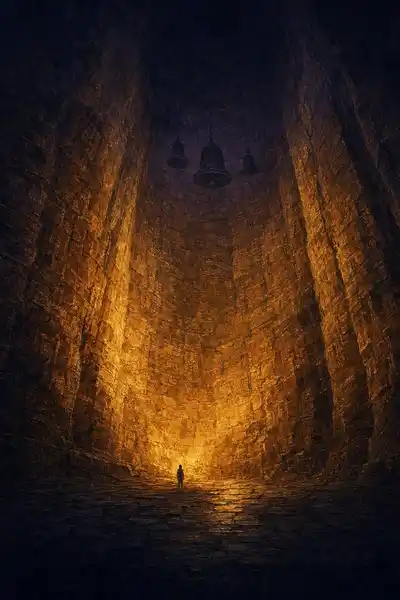
Somewhere inside a mountain in West Texas, a machine the size of a building is being assembled to keep time for ten thousand years. It ticks once a year. A cog advances once a century. A cuckoo of sorts — a chime that never repeats the same sequence in ten millennia — is meant to sound for whoever climbs up to hear it. The idea belongs to the computer scientist Danny Hillis, who proposed it in the mid-1990s, and it found its steward in Stewart Brand, the man who a generation earlier had put the whole Earth on a magazine cover and asked people to look at it. Brand co-founded the Long Now Foundation to build the thing, and then wrote a short book about why.
The book, published in 1999, is called The Clock of the Long Now, and the clock is mostly a pretext. What Brand is really after is a question that sounds almost embarrassing to say out loud: why is it so hard for us to think past next quarter, next election, next product cycle? He noticed that culture had begun to accelerate faster than any of its instruments could measure — that the "now" we live in had contracted to something like a rolling ten-year window, and that everything outside it, forward or back, had gone soft and unreal.
So the clock is a provocation dressed as engineering. It asks what would change if the long term had a physical address — a place you could visit, a mechanism you could wind, a thing that would outlast every institution currently arguing about it. Brand treats the design problems as genuinely fascinating, and they are, but he keeps sliding from the mechanical to the philosophical without warning, because for him they were never separate.
The question we’re asking : What does it take to make long-term thinking ordinary rather than heroic — and why does that matter more now than it used to?What we’ll see : How a strange machine became an argument about time, responsibility, and the shrinking present we've been living inside.
Table of contents
01 Chapter 1 — A clock built to tick for ten thousand years
Danny Hillis had spent his career building the fastest computers on Earth — massively parallel machines that did billions of operations a second — when he started to feel he was living inside a kind of temporal cage. He wrote that the future had stopped feeling long. As a child in the 1960s, people spoke casually of the year 2000; by the 1990s that date had arrived in the imagination and nobody was talking about 3000. So he proposed the opposite of everything he'd built: a clock so slow it made a human lifetime look like an afternoon.
The engineering constraints turn out to be the interesting part, and Brand lingers on them. A machine meant to run for ten thousand years cannot depend on anything we currently manufacture. It must be repairable by people who have lost the manuals, ideally with Bronze Age tools. It should keep time even if abandoned, and correct itself against the sun. It should be legible to someone who shares none of our language or assumptions. Every choice becomes a wager about what will still exist — metals that won't corrode, mechanisms simple enough to reverse-engineer by looking.

02 Chapter 2 — The problem with a present that keeps shrinking
The condition Brand diagnoses is that the "now" has been getting shorter. He borrows a phrase from the musician Brian Eno, a fellow founder of the foundation, who noticed while living in New York that the people around him seemed to inhabit a very small present — a now measured in days, with no felt connection to what came before or what would follow. Eno called the alternative the Long Now, and the name stuck.
The shrinking isn't imaginary. Markets report quarterly and punish anyone who plans past it. News refreshes by the minute. Software ships and is obsolete before it's understood. Brand's worry is that our tools for going fast have outrun our tools for going slow, and that a civilization with no functioning long-term memory or long-term intention starts making decisions it cannot possibly evaluate. We build things that will affect people ten thousand years out — nuclear waste, altered climates, engineered organisms — using a mind that can barely hold a decade.
03 Chapter 3 — How discipline in time becomes a kind of freedom
The counterintuitive heart of the book is that long-term thinking is not a constraint on freedom but a precondition for it. Brand's formulation is that discipline in thought allows freedom — that you need the reliability of a stable frame to have the confidence to change everything else. A jazz musician improvises freely because the tempo holds. A society can risk revolutions precisely when it trusts that certain things underneath will endure.
This flips the usual intuition. We tend to imagine that thinking about the deep future would be paralyzing, that it would freeze us into caution. Brand argues the reverse: it is the absence of a long horizon that makes us fearful and grasping, because when the now is all you have, every loss feels total. Extend the horizon and you buy room to experiment, to fail, to try again. The clock is meant to supply exactly this — a background continuity so dependable that the foreground can be as turbulent as it likes.
04 Chapter 4 — Civilization as something we owe the people who aren't here yet
Step back from the machine and the argument is finally about obligation. Brand's real proposal is that responsibility to the future should be an ordinary civic habit rather than a rare and saintly virtue. We already accept, without thinking, that we inherited roads and languages and laws from people we'll never meet. The Long Now simply asks us to complete the sentence: if we are the beneficiaries of strangers who came before, we are also the ancestors of strangers who will come after, and we owe them something more than the mess.
This is why the clock had to be an object and not an essay. Virtues that depend on individual heroism don't scale and don't last; they die with the person who held them. Institutions and monuments carry intentions across generations that no single mind can hold. Brand wants long-term care to be built into the furniture of a civilization — into how it keeps records, funds projects, dates its documents, tells its stories — so that thinking in millennia becomes automatic rather than exceptional, the default setting rather than the extraordinary effort.
05 Conclusion
The clock is still being built, which is fitting for a project that measures success in millennia. It will chime for people who don't yet exist, in a language we can't predict, kept running — or not — by hands we'll never shake. Brand's book, barely two hundred pages, is less a description of that machine than an invitation to stand where it stands and feel how far the ground extends in both directions. The engineering was always the way in; the reorientation of attention was the destination.
Related books