The Climate Casino
Pricing the risk of a warming world
Description
In 2018, William Nordhaus won the Nobel Prize in economics for work that most people would find, at first glance, almost boring: he put a number on the cost of a warming planet. Not a slogan, not a warning, an actual figure, running through equations that link how much carbon we burn to how much the climate shifts to how much money that will cost the global economy decades from now. He had been building these models since the 1970s, quietly, while the debate around him swung between apocalypse and denial. His book The Climate Casino, published in 2013, is his attempt to hand the whole apparatus to a general reader — to explain, in plain terms, what the economics of climate change actually says.
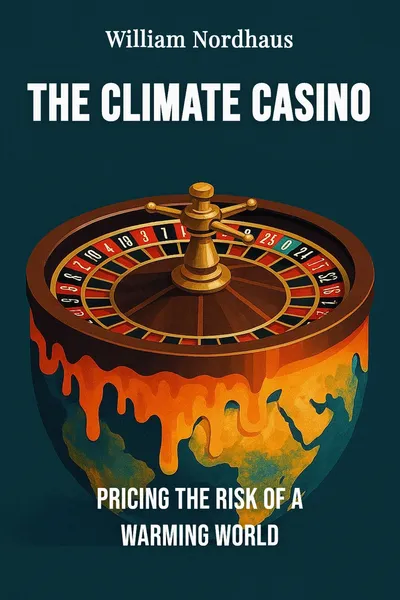
The title is the argument in miniature. Nordhaus does not describe a runaway disaster or a hoax. He describes a casino: a place where we are already placing bets, whether we admit it or not, and where the odds are shifting against us with every ton of carbon dioxide we send up. Some of the outcomes are mild. Some are catastrophic — melting ice sheets, collapsing ecosystems, tipping points we cannot reverse. We do not know which card the house will deal. What we do know is that we keep raising the stakes.
And here the economist parts ways with both the activist and the skeptic. Nordhaus is not interested in telling us the sky is falling, nor in telling us to relax. He wants to know what a rational player would do at a table like this — how much to spend now to avoid losses later, and how to spend it without wasting a fortune. His answer is unglamorous, and it has divided the room ever since.
The question we’re asking : If climate change is a gamble we cannot leave, how much should we pay to change the odds — and how?What we’ll see : How an economist turned a planetary risk into numbers, and why his cure comes down to a single, deeply unpopular idea.
Table of contents
01Chapter 1 — The house always has an edge
Nordhaus starts by refusing the two easy stories. One says climate change is a fabrication, a scare cooked up to justify big government. The other says it is certain doom, so overwhelming that ordinary economic thinking becomes irrelevant. He rejects both because neither matches what the science and the numbers actually show. The physical case, he argues, is settled enough to act on: carbon dioxide traps heat, we are adding it fast, and the planet is warming as a result. What remains genuinely open is how bad the consequences will be, and how much they will cost us.
That mix of certainty and uncertainty is why he reaches for the casino. In a casino, you know the rules and roughly the odds, but not the outcome of any single hand. With the climate, we know the direction of travel — more warming, more disruption — but the precise damage from, say, three degrees of warming versus two remains a probability distribution, not a fixed fact. Some scenarios are manageable. Others involve what he calls the dangerous corners of the casino: the low-probability, high-consequence events that could reorder coastlines and food supplies.

02Chapter 2 — Where the numbers come from
To answer his own question, Nordhaus needed a way to connect the physical world to the economic one. That is what his integrated assessment models do — the most famous being DICE, the Dynamic Integrated model of Climate and the Economy, which he began building around 1990. The idea is to run the whole chain inside one framework: economic activity produces emissions, emissions raise atmospheric concentrations, concentrations raise temperatures, and higher temperatures inflict damage back on the economy. Loop it forward across the coming century and you can ask what different policies would cost and save.
Out of this machinery comes the number that anchors everything: the social cost of carbon. It is an attempt to put a dollar figure on the harm done by emitting one additional ton of carbon dioxide — the future flooding, lost crops, heat stress, and disruption that ton will help cause. Nordhaus's estimates have landed in the range of a few tens of dollars per ton, though the figure swings with the assumptions. If you can price the damage, you can compare it against the cost of preventing it, and the whole debate acquires a common currency.
03Chapter 3 — The tax nobody wants and everybody needs
Once the damage has a price, Nordhaus's prescription follows almost mechanically, and it is where the book plants its flag. The core problem, he argues, is that carbon pollution is free. When someone burns fossil fuel, they pocket the benefit but push the cost — the warming, the damage — onto everyone else, present and future. Economists have a dry name for this: an externality. The market, left alone, produces far too much of it because the price at the pump never reflects the harm at the horizon.
The fix, in his view, is to make the price tell the truth. Put a charge on carbon equal to the damage it does, and suddenly every decision across the economy — what to build, what to drive, what to invent — carries the real cost of its emissions. He is fairly agnostic about the exact instrument: a carbon tax and a well-designed cap-and-trade system can both raise the price of emitting. What matters is that the signal reaches everyone, everywhere, at once, rather than relying on regulators to micromanage each factory and appliance.
04Chapter 4 — Betting under uncertainty
Step back from the tax and the models, and what Nordhaus is really offering is a way of thinking about action when the future refuses to hold still. This is where the casino metaphor earns its keep. A cautious gambler does not need to know exactly which hand will ruin him to justify buying insurance; he acts on the shape of the risk, not on a guaranteed forecast. Nordhaus applies the same logic to the planet. We do not need certainty about three degrees versus four to conclude that paying something now to lower the odds of the worst outcomes is a sound bet.
In fact, uncertainty strengthens his case rather than weakening it. The deniers' instinct is that if we cannot pin down the damage, we should wait. Nordhaus turns this around. It is precisely the tail risks — the small chances of catastrophic, irreversible harm — that make inaction reckless. When you cannot rule out disaster, a rational player pays a premium to stay away from the dangerous corners of the table. A carbon price is that premium: not a bet on any single scenario, but a hedge across all of them at once.
05Conclusion
By the end, the casino has done its work. Nordhaus has taken an issue that usually arrives as a shout — save the planet, or it's all a con — and returned it as a wager any careful person can recognize. We are at the table. The stakes rise with every ton. The odds of a bad hand are climbing, and the only real question is how much we are willing to pay to nudge them back. His answer, arrived at through decades of models and a Nobel Prize's worth of scrutiny, keeps coming back to one instrument: a price on carbon that lets the market feel the cost it has been ignoring.
Related books